


Anti-GFP antibody (ab6556)
Key features and details
- Rabbit polyclonal to GFP
- Suitable for: IHC-P, Electron Microscopy, ICC, IP, Flow Cyt, IHC-Fr, WB
- Reacts with: Species independent
- Isotype: IgG
Get better batch-to-batch reproducibility with a recombinant antibody


- Research with confidence – consistent and reproducible results with every batch
- Long-term and scalable supply – powered by recombinant technology for fast production
- Success from the first experiment – confirmed specificity through extensive validation
- Ethical standards compliant – production is animal-free
Overview
-
Product name
Anti-GFP antibody
See all GFP primary antibodies -
Description
Rabbit polyclonal to GFP -
Host species
Rabbit -
Specificity
GFP antibody (ab6556) is reactive against all variants of Aequorea victoria GFP such as S65T-GFP, RS-GFP, YFP, CFP, RFP and EGFP.
-
Tested applications
Suitable for: IHC-P, Electron Microscopy, ICC, IP, Flow Cyt, IHC-Fr, WBmore details -
Species reactivity
Reacts with: Species independent -
Immunogen
Recombinant full length protein corresponding to GFP.
Database link: P42212 -
General notes
Please note that a mistake was made in reference 4 (Mesaeli et.al., J. Cell. Biol. 1999 Mar 8;144(5):857-68). The antibody used for immunohistochemistry on paraformaldehyde fixed tissues was the crude serum version of this antibody (Abcam ab290) and not Clontech's monoclonal as stated. This product is supplied in 25% glycerol. During freezeing and thawing some phase separation might occur - Please ensure that the solution is mixed thoroughly but GENTLY before use.
This antibody (ab6556) is the purified version of our best-selling rabbit polyclonal to GFP (ab290). It has been developed specifically for use in applications requiring a high titre and specificity with minimum background such as immuno-electron microscopy.
This anti-GFP antibody recognizes the enhanced form of GFP as well.
Abcam recommended secondaries - Goat Anti-Rabbit HRP (ab205718) and Goat Anti-Rabbit Alexa Fluor® 488 (ab150077). Or search our wide range of secondary antibodies for use with your experiment.The Life Science industry has been in the grips of a reproducibility crisis for a number of years. Abcam is leading the way in addressing this with our range of recombinant monoclonal antibodies and knockout edited cell lines for gold-standard validation. Please check that this product meets your needs before purchasing.
If you have any questions, special requirements or concerns, please send us an inquiry and/or contact our Support team ahead of purchase. Recommended alternatives for this product can be found below, along with publications, customer reviews and Q&As
Properties
-
Form
Liquid -
Storage instructions
Shipped at 4°C. Store at +4°C short term (1-2 weeks). Upon delivery aliquot. Store at -20°C or -80°C. Avoid freeze / thaw cycle. -
Storage buffer
pH: 7.40
Constituents: 0.79% Tris HCl, 25% Glycerol -
 Concentration information loading...
 -
Purity
Immunogen affinity purified -
Purification notes
This antibody is an affinity purified rabbit anti-GFP antibody purified on an affinity chromatography column made with highly purified recombinant GFP. -
Clonality
Polyclonal -
Isotype
IgG -
Research areas
Associated products
-
Compatible Secondaries
-
Isotype control
-
Positive Controls
-
Recombinant Protein
-
Related Products
Applications
The Abpromise guarantee
Our Abpromise guarantee covers the use of ab6556 in the following tested applications.
The application notes include recommended starting dilutions; optimal dilutions/concentrations should be determined by the end user.
| Application | Abreviews | Notes |
|---|---|---|
| IHC-P | (11) |
Use at an assay dependent concentration.
|
| Electron Microscopy |
1/5000.
|
|
| ICC | (1) |
1/2000.
|
| IP | (3) |
Use at an assay dependent concentration.
|
| Flow Cyt | (1) |
Use at an assay dependent concentration.
|
| IHC-Fr | (4) |
Use at an assay dependent concentration.
|
| WB | (27) |
Use at an assay dependent concentration. Predicted molecular weight: 27 kDa.
|
| Notes |
|---|
|
IHC-P
Use at an assay dependent concentration. |
|
Electron Microscopy
1/5000. |
|
ICC
1/2000. |
|
IP
Use at an assay dependent concentration. |
|
Flow Cyt
Use at an assay dependent concentration. |
|
IHC-Fr
Use at an assay dependent concentration. |
|
WB
Use at an assay dependent concentration. Predicted molecular weight: 27 kDa. |
Target
-
Relevance
Function: Energy-transfer acceptor. Its role is to transduce the blue chemiluminescence of the protein aequorin into green fluorescent light by energy transfer. Fluoresces in vivo upon receiving energy from the Ca2+ -activated photoprotein aequorin.
Subunit structure: Monomer.
Tissue specificity: Photocytes.
Post-translational modification: Contains a chromophore consisting of modified amino acid residues. The chromophore is formed by autocatalytic backbone condensation between Ser-65 and Gly-67, and oxidation of Tyr-66 to didehydrotyrosine. Maturation of the chromophore requires nothing other than molecular oxygen.
Biotechnological use: Green fluorescent protein has been engineered to produce a vast number of variously colored mutants, fusion proteins, and biosensors. Fluorescent proteins and its mutated allelic forms, blue, cyan and yellow have become a useful and ubiquitous tool for making chimeric proteins, where they function as a fluorescent protein tag. Typically they tolerate N- and C-terminal fusion to a broad variety of proteins. They have been expressed in most known cell types and are used as a noninvasive fluorescent marker in living cells and organisms. They enable a wide range of applications where they have functioned as a cell lineage tracer, reporter of gene expression, or as a measure of protein-protein interactions. Can also be used as a molecular thermometer, allowing accurate temperature measurements in fluids. The measurement process relies on the detection of the blinking of GFP using fluorescence correlation spectroscopy.
Sequence similarities: Belongs to the GFP family.
Biophysicochemical properties: Absorption: Abs(max)=395 nm
Exhibits a smaller absorbance peak at 470 nm. The fluorescence emission spectrum peaks at 509 nm with a shoulder at 540 nm. -
Alternative names
- GFP antibody
- Green fluorescent protein antibody
Images
-
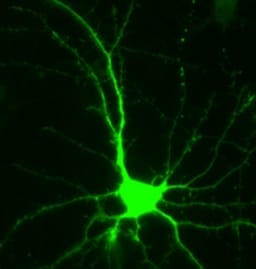
Immunocytochemistry - Anti-GFP antibody (ab6556)
This image shows a single primary hippocampal neuron from a primary culture overexpressing GFP stained with ab6556 at a dilution of 1/2000. This picture was kindly supplied as part of the review submitted by one of our customers.
-
 Immunocytochemistry - Anti-GFP antibody (ab6556)
This image shows IF using GFP-expressing glial cells (green) transplanted into lesioned rat spinal cord. This was detected using ab6556 anti-GFP antibody and a FITC conjugated secondary antibody. Axons are labelled red by an antibody to neurofilament-200 and a rhodamine secondary. ab6556 reveals the morphology of the transplanted cells to such an extent that their close interactions with axons are obvious. The top picture shows an optical section from a confocal microscope scan showing how a GFP cell wraps around a branched axon travelling longitudinally. The bottom picture consists of an optical section from another confocal scan showing a GFP cell enveloping an axon in the transverse plane. Review by Andrew Toft submitted 19 May 2004.
-
 Electron Microscopy - Anti-GFP antibody (ab6556)
Specific labeling of a Trk-GFP fusion protein being synthesized on ER in sympathetic neurons infected with an adenovirus carrying the construct. The gold is associated with the ER membranes. This was done using a 1/5000 dilution of affinity purified antibody (ab6556). The tissue section was fixed and embedded using durcupan resin.
Protocols
To our knowledge, customised protocols are not required for this product. Please try the standard protocols listed below and let us know how you get on.
Datasheets and documents
-
SDS download
-
Datasheet download

References (1204)
ab6556 has been referenced in 1204 publications.
- Park G et al. Neurodegeneration risk factor, EIF2AK3 (PERK), influences tau protein aggregation. J Biol Chem 299:102821 (2023). PubMed: 36563857
- Gao X et al. Palmitoylation regulates cellular distribution of and transmembrane Ca flux through TrpM7. Cell Calcium 106:102639 (2022). PubMed: 36027648
- Yamamoto-Fukuda T et al. Keratinocyte Growth Factor Stimulates Growth of p75+ Neural Crest Lineage Cells During Middle Ear Cholesteatoma Formation in Mice. Am J Pathol N/A:N/A (2022). PubMed: 36210210
- Weston LJ et al. Aggregated Alpha-Synuclein Inclusions within the Nucleus Predict Impending Neuronal Cell Death in a Mouse Model of Parkinsonism. Int J Mol Sci 23:N/A (2022). PubMed: 36499619
- Guo Q et al. Temporal regulation of notch activation improves arteriovenous fistula maturation. J Transl Med 20:543 (2022). PubMed: 36419038