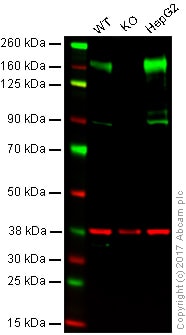
Anti-P Glycoprotein antibody [JSB-1] (ab3366)
Overview
- Product nameAnti-P Glycoprotein antibody [JSB-1]See all P Glycoprotein primary antibodies ...
- DescriptionMouse monoclonal [JSB-1] to P Glycoprotein
- SpecificityThis antibody is specific for the MDR1 isoform of P Glycoprotein. It does not cross-react with MDR3. It has been shown to cross-react with Pyruvate Carboxylase, an abundant mitochondrial enzyme (130 kDa), on both immunoblots and immunohistochemical tissue sections. Weak homogeneous, cytoplasmic, or granular patterns of reactivity may represent staining of the PC cross-reactive epitope rather than positive staining for P glycoprotein.
- Tested applicationsELISA, ICC, IHC-P, IP, Flow Cyt more details
- Species reactivityReacts with: Mouse, Rat, Human
- Immunogen
Multidrug-resistant Chinese hamster ovary cell line (CHrC5).
- EpitopeCytoplasmic domain present on the MDR1 isoform of P Glycoprotein. This epitope is strongly conserved in mammals.
- Positive controlDrug-sensitive parental cell lines and their multidrug-resistant derivatives. Human liver (positive staining detected along luminal surfaces of bilecanaliculi) or human colon (positive staining localized to luminal surface of secretaoryepithelium).
- General notesThis antibody is reported to work in WB according to the literature(PubMed 22389470 and 17961285). Due to customer feedback of difficulty in WB, we are no longer able to guarantee ab3366 in WB.
Properties
- FormLiquid
- Storage instructionsStore at +4°C.
- Storage bufferPreservative: 0.1% Sodium Azide
Constituents: 1% BSA, 0.01M PBS -
Concentration information loading... - PurityProtein A purified
- Clonality Monoclonal
- Clone numberJSB-1
- IsotypeIgG1
- Research Areas
Applications
Our Abpromise guarantee covers the use of ab3366 in the following tested applications.
The application notes include recommended starting dilutions; optimal dilutions/concentrations should be determined by the end user.
| Application | Notes |
|---|---|
| ELISA | ELISA: Use at an assay dependent dilution. |
| ICC | ICC: Use at an assay dependent dilution. |
| IHC-P | IHC-P: 1/40. Perform heat mediated antigen retrieval before commencing with IHC staining protocol. (EDTA, pH 8-9 for example). 20-60 minutes at room temperature. |
| IP | IP: Use at an assay dependent dilution. |
| Flow Cyt | Flow Cyt: Use at an assay dependent dilution. PubMed: 18630504 |
Target
- FunctionEnergy-dependent efflux pump responsible for decreased drug accumulation in multidrug-resistant cells.
- Tissue specificityExpressed in liver, kidney, small intestine and brain.
- Involvement in diseaseGenetic variations in ABCB1 are associated with susceptibility to inflammatory bowel disease type 13 (IBD13) [MIM:612244]. Inflammatory bowel disease is characterized by a chronic relapsing intestinal inflammation. It is subdivided into Crohn disease and ulcerative colitis phenotypes. Crohn disease may involve any part of the gastrointestinal tract, but most frequently the terminal ileum and colon. Bowel inflammation is transmural and discontinuous; it may contain granulomas or be associated with intestinal or perianal fistulas. In contrast, in ulcerative colitis, the inflammation is continuous and limited to rectal and colonic mucosal layers; fistulas and granulomas are not observed. Both diseases include extraintestinal inflammation of the skin, eyes, or joints. Crohn disease and ulcerative colitis are commonly classified as autoimmune diseases.
- Sequence similaritiesBelongs to the ABC transporter superfamily. ABCB family. Multidrug resistance exporter (TC 3.A.1.201) subfamily.
Contains 2 ABC transmembrane type-1 domains.
Contains 2 ABC transporter domains. - Cellular localizationMembrane.
-
Database links
- Entrez Gene: 5243 Human
- Entrez Gene: 18669 Mouse
- Entrez Gene: 24646 Rat
- Omim: 171050 Human
- SwissProt: P08183 Human
- SwissProt: P06795 Mouse
- SwissProt: P43245 Rat
- Unigene: 489033 Human
- Unigene: 146649 Mouse
- Unigene: 389059 Mouse
- Unigene: 144554 Rat
- Unigene: 154810 Rat
see all
Target information above from: UniProt accession
P08183
The UniProt Consortium
The Universal Protein Resource (UniProt) in 2010
Nucleic Acids Res. 38:D142-D148 (2010)
.
-
Alternative names
- ABC20 antibodyABCB1 antibodyATP binding cassette sub family B MDR/TAP member 1 antibody
- ATP binding cassette, sub family B (MDR/TAP), member 1 antibodyATP-binding cassette sub-family B member 1 antibodyCD243 antibodyCD243 antigen antibodyCLCS antibodyColchicin sensitivity antibodyDoxorubicin resistance antibodyGP170 antibodyMDR 1 antibodyMDR1 antibodyMDR1_HUMAN antibodyMultidrug resistance 1 antibodyMultidrug resistance protein 1 antibodyP glycoprotein 1 antibodyP gp antibodyP-glycoprotein 1 antibodyPGY1 antibody
see all
Anti-P Glycoprotein antibody [JSB-1] images
-
Immunohistochemistry (Formalin/PFA-fixed paraffin-embedded sections) - P Glycoprotein antibody [JSB-1] (ab3366)ab3366 (4µg/ml) staining p Glycoprotein in human liver, using an automated system (DAKO Autostainer Plus). Using this protocol there is a cell membrane staining of a subpopulation of hepatocytes.
Sections were rehydrated and antigen retrieved with the Dako 3 in 1 AR buffer EDTA pH 9.0 in a DAKO PT link. Slides were peroxidase blocked in 3% H2O2 in methanol for 10 mins. They were then blocked with Dako Protein block for 10 minutes (containing casein 0.25% in PBS) then incubated with primary antibody for 20 min and detected with Dako envision flex amplification kit for 30 minutes. Colorimetric detection was completed with Diaminobenzidine for 5 minutes. Slides were counterstained with Haematoxylin and coverslipped under DePeX. Please note that, for manual staining, optimization of primary antibody concentration and incubation time is recommended. Signal amplification may be required.
References for Anti-P Glycoprotein antibody [JSB-1] (ab3366)
This product has been referenced in:
- Minami T et al. HER2 as therapeutic target for overcoming ATP-binding cassette transporter-mediated chemoresistance in small cell lung cancer. Mol Cancer Ther 11:830-41 (2012). WB ; Human . Read more (PubMed: 22389470) »
- Kuo YC & Chen HH Effect of electromagnetic field on endocytosis of cationic solid lipid nanoparticles by human brain-microvascular endothelial cells. J Drug Target 18:447-56 (2010). ICC/IF ; Human . Read more (PubMed: 20528098) »