


Anti-BACE1 antibody (ab2077)

Key features and details
- Rabbit polyclonal to BACE1
- Suitable for: WB, ICC, IHC-P
- Reacts with: Mouse, Human
- Isotype: IgG
Get better batch-to-batch reproducibility with a recombinant antibody


- Research with confidence – consistent and reproducible results with every batch
- Long-term and scalable supply – powered by recombinant technology for fast production
- Success from the first experiment – confirmed specificity through extensive validation
- Ethical standards compliant – production is animal-free
Overview
-
Product name
Anti-BACE1 antibody
See all BACE1 primary antibodies -
Description
Rabbit polyclonal to BACE1 -
Host species
Rabbit -
Tested applications
Suitable for: WB, ICC, IHC-Pmore details -
Species reactivity
Reacts with: Mouse, Human -
Immunogen
-
Positive control
- WB: Human A431, A549, Caco-2, Daudi, HeLa, K562, Jurkat, SK-N-SH, THP-1 and brain tissue lysates. Mouse: 3T3/NIH cell lysate. IHC-P: Mouse brain tissue. ICC: Mouse 3T3 cells.
-
General notes
The Life Science industry has been in the grips of a reproducibility crisis for a number of years. Abcam is leading the way in addressing this with our range of recombinant monoclonal antibodies and knockout edited cell lines for gold-standard validation. Please check that this product meets your needs before purchasing.
If you have any questions, special requirements or concerns, please send us an inquiry and/or contact our Support team ahead of purchase. Recommended alternatives for this product can be found below, along with publications, customer reviews and Q&As
Properties
-
Form
Liquid -
Storage instructions
Shipped at 4°C. Store at +4°C short term (1-2 weeks). Upon delivery aliquot. Store at -20°C. Avoid freeze / thaw cycle. Stable for 12 months at -20°C. -
Storage buffer
pH: 7.2
Preservative: 0.02% Sodium azide -
 Concentration information loading...
 -
Purity
Affinity purified -
Primary antibody notes
Beta-site APP Cleaving Enzyme. -
Clonality
Polyclonal -
Isotype
IgG -
Research areas
Associated products
-
Alternative Versions
-
Assay kits
-
Compatible Secondaries
-
Isotype control
-
Recombinant Protein
Applications
The Abpromise guarantee
Our Abpromise guarantee covers the use of ab2077 in the following tested applications.
The application notes include recommended starting dilutions; optimal dilutions/concentrations should be determined by the end user.
| Application | Abreviews | Notes |
|---|---|---|
| WB | (2) |
Use a concentration of 1 µg/ml. Detects a band of approximately 70 kDa. We recommend overnight incubation at 4C and using 5% skim milk to block.
|
| ICC |
Use a concentration of 10 µg/ml.
|
|
| IHC-P |
Use a concentration of 2.5 µg/ml.
|
| Notes |
|---|
|
WB
Use a concentration of 1 µg/ml. Detects a band of approximately 70 kDa. We recommend overnight incubation at 4C and using 5% skim milk to block. |
|
ICC
Use a concentration of 10 µg/ml. |
|
IHC-P
Use a concentration of 2.5 µg/ml. |
Target
-
Function
Responsible for the proteolytic processing of the amyloid precursor protein (APP). Cleaves at the N-terminus of the A-beta peptide sequence, between residues 671 and 672 of APP, leads to the generation and extracellular release of beta-cleaved soluble APP, and a corresponding cell-associated C-terminal fragment which is later released by gamma-secretase. -
Tissue specificity
Expressed at high levels in the brain and pancreas. In the brain, expression is highest in the substantia nigra, locus coruleus and medulla oblongata. -
Sequence similarities
Belongs to the peptidase A1 family. -
Domain
The transmembrane domain is necessary for its activity. It determines its late Golgi localization and access to its substrate, APP. -
Post-translational
modificationsGlycosylated. -
Cellular localization
Membrane. Golgi apparatus > trans-Golgi network. Endoplasmic reticulum. Endosome. Cell surface. Predominantly localized to the later Golgi/trans-Golgi network (TGN) and minimally detectable in the early Golgi compartments. A small portion is also found in the endoplasmic reticulum, endosomes and on the cell surface. - Information by UniProt
-
Database links
- Entrez Gene: 23621 Human
- Entrez Gene: 23821 Mouse
- Omim: 604252 Human
- SwissProt: P56817 Human
- SwissProt: P56818 Mouse
- Unigene: 504003 Human
- Unigene: 24044 Mouse
-
Alternative names
- APP beta secretase antibody
- Asp 2 antibody
- ASP2 antibody
see all
Images
-
Western blot - Anti-BACE1 antibody (ab2077)All lanes :
Lane 1 : A431 (Human epidermoid carcinoma cell line) whole cell lysate withAnti-BACE1 antibody (ab2077)
Lane 2 : A549 (Human lung carcinoma cell line) whole cell lysate withAnti-BACE1 antibody (ab2077)
Lane 3 : Caco-2 (Human colorectal adenocarcinoma cell line) whole cell lysate withAnti-BACE1 antibody (ab2077)
Lane 4 : Daudi (Human Burkitt's lymphoma cell line) whole cell lysate withAnti-BACE1 antibody (ab2077)
Lane 5 : HeLa (Human epithelial cell line from cervix adenocarcinoma) whole cell lysate withAnti-BACE1 antibody (ab2077)
Lane 6 : K562 (Human chronic myelogenous leukemia cell line from bone marrow ) whole cell lysate withAnti-BACE1 antibody (ab2077)
Lane 7 : Jurkat (Human T cell leukemia cell line from peripheral blood) whole cell lysate withAnti-BACE1 antibody (ab2077)
Lane 8 : SK-N-SH (Human neuroblastoma cell line) whole cell lysate withAnti-BACE1 antibody (ab2077)
Lane 9 : THP-1 (Human monocytic leukemia cell line) whole cell lysate withAnti-BACE1 antibody (ab2077)
Lysates/proteins at 15 µg per lane.
Blocking peptides at 1 µg/ml per lane.
Secondary
All lanes : Rabbit IgG antibody (HRP) at 1/10000 dilution
Developed using the ECL technique.
Additional bands at: 65 kDa (possible glycosylated form)10% gel.
Running conditions: 130v for 2 hours.
Transfer conditions: wet, 250mA, 2 hrs (Nitrocellulose membrane).
Blocking condition: 5% non-fat dry milk in TBS, 4C, overnight.
Primary antibody incubation: Room temperature for 1 hour.
Secondary antibody incubation: Room temperature for 1 hour.
Washing conditions: 15 mL TSBT, 3 x 10 minutes.
Exposure: ECL solution
-
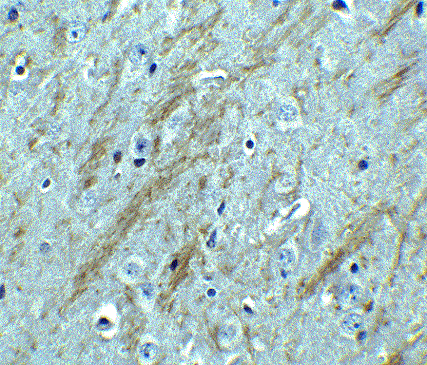 Immunohistochemistry (Formalin/PFA-fixed paraffin-embedded sections) - Anti-BACE1 antibody (ab2077)
Immunohistochemical analysis of paraffin-embedded mouse brain tissue using ab2077 at 2.5 µg/ml. Tissue was fixed with formaldehyde and blocked with 10% serum for 1 h at RT; antigen retrieval was by heat mediation with a citrate buffer (pH6). Samples were incubated with primary antibody overnight at 4°C. A goat anti-rabbit IgG H&L (HRP) at 1/250 was used as secondary. Counter stained with Hematoxylin.
-
 Immunocytochemistry - Anti-BACE1 antibody (ab2077)
Immunocytochemical analysis of 4% paraformaldehyde-fixed NIH/3T3 (Mouse embryo fibroblast cell line) cells labeling BACE1 with ab2077 at 20 ug/mL, followed by goat anti-rabbit IgG secondary antibody at 1/500 dilution (green) and DAPI staining (blue). Image showing both membrane and cytosol staining on NIH/3T3 cells.
-
 Immunocytochemistry - Anti-BACE1 antibody (ab2077)Immunocytochemical analysis of NIH/3T3 (Mouse embryo fibroblast cell line) cells labeling BACE1 with ab2077 at 10 μg/mL. Cells were fixed with formaldehyde and blocked with 10% serum for 1 h at RT; antigen retrieval was by heat mediation with a citrate buffer (pH6). Samples were incubated with primary antibody overnight at 4oC. A goat anti-rabbit IgG H&L (HRP) at 1/250 was used as secondary. Counter stained with Hematoxylin.
 -
 Western blot - Anti-BACE1 antibody (ab2077)All lanes : Anti-BACE1 antibody (ab2077) at 1 µg/ml
Lane 1 : Human brain tissue lysate with absence of blocking peptide
Lane 2 : Human brain tissue
lysate with BACE1 peptide (ab7883)
Lane 3 : Mouse 3T3/NIH cell lysate
Lysates/proteins at 15 µg per lane.
Secondary
All lanes : Goat anti-rabbit IgG HRP conjugate at 1/10000 dilution
Observed band size: 70 kDa why is the actual band size different from the predicted?Incubate the antibody for 1 hour at room temperature in 5% NFDM/TBST.
-
 Immunocytochemistry - Anti-BACE1 antibody (ab2077)Image courtesy of an anonymous Abreview.
Immunocytochemical analysis of D54MG (human glioblastoma cell line) cells labeling BACE1 with ab2077.Cells were fixed in paraformaldehyde, permeabilized with 0.1% Triton X-100, blocked with 0.5% BSA for 20 minutes at room temperature, then incubated with ab2077 at a 1/50 dilution for 16 hours at 4°C. The secondary used was a TRITC conjugated goat anti-rabbit polyclonal, used at a 1/400 dilution. Nuclei are counterstained with DAPI.
Protocols
Datasheets and documents
-
SDS download
-
Datasheet download

References (86)
ab2077 has been referenced in 86 publications.
- Iyaswamy A et al. Theranostic F-SLOH mitigates Alzheimer's disease pathology involving TFEB and ameliorates cognitive functions in Alzheimer's disease models. Redox Biol 51:102280 (2022). PubMed: 35286997
- Yuan DJ et al. Reducing Nav1.6 expression attenuates the pathogenesis of Alzheimer's disease by suppressing BACE1 transcription. Aging Cell 21:e13593 (2022). PubMed: 35353937
- Gu L et al. Inhibitory Effects of Macelignan on Tau Phosphorylation and Aβ Aggregation in the Cell Model of Alzheimer's Disease. Front Nutr 9:892558 (2022). PubMed: 35662922
- Wang LW et al. The interrelationships between neuronal viability, synaptic integrity, microglial responses, and amyloid-beta formation in an in vitro neurotrauma model. Sci Rep 12:22028 (2022). PubMed: 36539544
- Phitthayaphong P et al. Blockage of Fc Gamma Receptors Alleviates Neuronal and Microglial Toxicity Induced by Palmitic Acid. J Alzheimers Dis 82:1315-1332 (2021). PubMed: 34151811