Acetylcholinesterase Assay Kit (Fluorometric - Green)
Be the first to review this product! Submit a review
|
(2 Publications )
- includes Acetylcholinesterase / AChE enzyme positive control / standard
- FuncS
Supplier Data
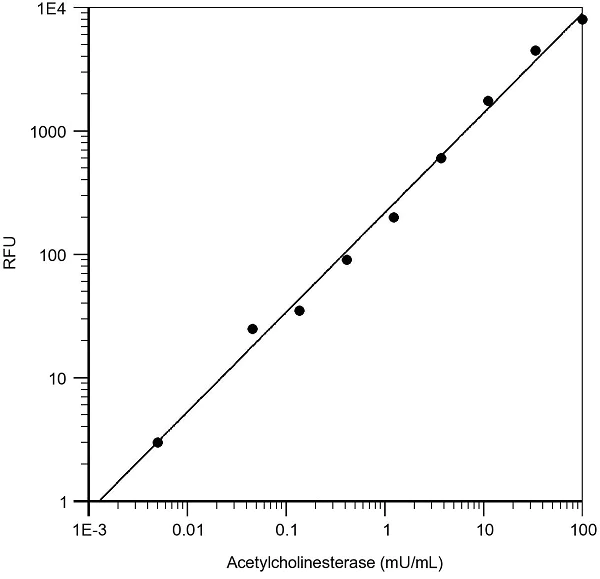
Functional Studies - Acetylcholinesterase Assay Kit (Fluorometric - Green) (AB138872)
Sample Standard Curve for Acetylcholinesterase. Acetylcholinesterase dose response was measured in a solid black 96-well plate with ab138872 using a fluorescence microplate reader. As low as 0.01 mU/well of acetylcholinesterase can be detected with 20 minutes incubation (n=3).
Complementary Products


Reactivity data
Product details
Acetylcholinesterase Assay KIt (Fluorometric - Green) (ab138872) uses a Thiol Green Indicator to quantify the thiocholine produced from the hydrolysis of acetylthiocholine by AChE in blood, in cell extracts, and in other solutions.
Thiol Green Indicator is not fluorescent until reacted with a thiol group. It has spectral properties similar to those of fluorescein, making this assay compatible with almost every fluorescence instrument. The fluorescence intensity of Thiol Green Indicator is used to measure AChE activity. Compared to the existing thiol probes (e.g., mBBr and bBBr), Thiol Green Indicator is much more sensitive.
This product is an optimized "mix-and-read" assay that provides an ultrasensitive fluorometric one-step protocol to detect as little as 0.01mU AChE in a 100 μl assay volume (0.1 mU/ml). The assay can be performed in a convenient 96-well or 384-well microtiter-plate format. Its signal can be easily read by a fluorescence microplate reader at Ex/Em = 490/520 nm.
Please note this product does not differentiate between acetylcholesterase (AchE) or butyrylcholinesterase (BChE) activity as both enzymes can hydrolyze acetylcholine.
Related AChE assay kits
For a colorimetric assay readout, use Acetylcholinesterase Assay Kit (Colorimetric) (ab138871).
If your plate reader has a filter to measure red fluorescence (Ex/Em = 540/590 nm), use Acetylcholinesterase Assay Kit (Fluorometric - Red) (ab138873).
Other notes
Acetylcholinesterase (AChE) is one of the most crucial enzymes for nerve response and function. AChE degrades the neurotransmitter acetylcholine (ACh) into choline and acetic acid. It is mainly found at neuromuscular junctions and cholinergic synapses in the central nervous system, where its activity serves to terminate the synaptic transmission. AChE inhibitors are among the key drugs approved for Alzheimer's disease (AD) and myasthenia gravis.
What's included?
Properties and storage information
Shipped at conditions
Appropriate short-term storage conditions
Appropriate long-term storage conditions
Storage information
Supplementary information
This supplementary information is collated from multiple sources and compiled automatically.
Biological function summary
Acetylcholinesterase is essential for maintaining neurotransmission dynamics by ensuring timely acetylcholine breakdown. It does not function as part of a larger enzyme complex but its activity is necessary for efficient synaptic signaling in the nervous system. This enzymatic action prevents continuous stimulation of muscles and nerves by rapidly degrading acetylcholine thereby ensuring proper muscle contraction and cognitive processes.
Pathways
Acetylcholinesterase participates significantly in the cholinergic system. It influences cholinergic signaling pathways by inactivating acetylcholine after its release into the synaptic cleft. This function aligns acetylcholinesterase closely with receptors like nicotinic and muscarinic acetylcholine receptors. It indirectly affects signal transduction pathways that involve these receptors with potential downstream effects on ion channels and intracellular messengers.
Product protocols
- Visit the General protocols
- Visit the Troubleshooting
- Download websiteProtocolBooklet|en
Target data
Alternative Names
Publications (2)
Recent publications for all applications. Explore the full listand refine your search
Frontiers in aging neuroscience 13:665400 PubMed34122043
2021
Applications
Unspecified application
Species
Unspecified reactive species
Molecular therapy. Methods & clinical development 18:803-810 PubMed32953931
2020
Applications
Unspecified application
Species
Unspecified reactive species
Product promise
Please note: All products are 'FOR RESEARCH USE ONLY. NOT FOR USE IN DIAGNOSTIC OR THERAPEUTIC PROCEDURES'.
For licensing inquiries, please contact partnerships@abcam.com