JavaScript is disabled in your browser. Please enable JavaScript to view this website.
AB190554

Acid Sphingomyelinase Assay Kit (Fluorometric)

Be the first to review this product! Submit a review

|

(9 Publications )
Acid Sphingomyelinase Assay Kit (Fluorometric) (ab190554) provides one of the most sensitive methods for detecting acidic sphingomyelinase (SMase) activity in cell extracts, or for screening the effect of inhibitors on acid SMase activity.
1 Images
Functional Studies - Acid Sphingomyelinase Assay Kit (Fluorometric) (AB190554)
  • FuncS

Unknown

Functional Studies - Acid Sphingomyelinase Assay Kit (Fluorometric) (AB190554)

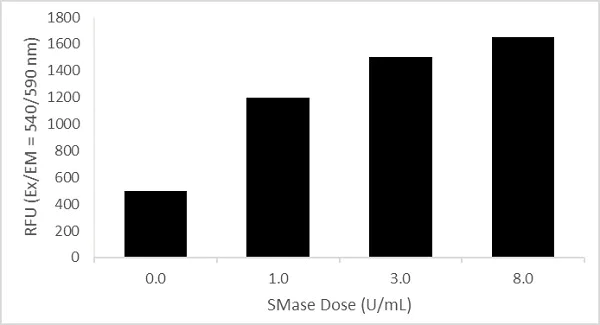
Sphingomyelinase Dose Response.

Sphingomyelinase (purified from human placenta) dose response was measured on a 96-well half-are black plate following assay procedure, using a Gemini fluorescence microplate reader (Molecular Devices). 20 μL of SMase solution was incubated with 20 μL of Sphingomyelin Working Solution at 37°C for 3 hours, and then 20 μL of sphingomyelinase assay mixture was added into each well. Signals shown in the figure correspond to the readings at Ex/Em = 540/590 nm (cut off at 570 nm) after 2 hours incubation at room temperature.

Key facts

Detection method

Fluorescent

Sample types

Cell culture extracts, Tissue Extracts

Results type

Semi-Quantitative

Sensitivity

= 1 U/mL

Assay Platform

Microplate reader

Reactivity data

{ "title": "Reactivity Data", "filters": { "stats": ["", "Reactivity", "Dilution Info", "Notes"] }, "values": { "Enzyme activity assay": { "reactivity":"TESTED_AND_REACTS", "dilution-info":"", "notes":"<p></p>" } } }

Product details

Acid Sphingomyelinase Assay Kit (Fluorometric) (ab190554) provides one of the most sensitive methods for detecting acidic sphingomyelinase (SMase) activity in cell extracts, or for screening the effect of inhibitors on acid SMase activity. The kit uses the AbRed Indicator as a fluorogenic probe to indirectly quantify the phosphocholine produced from the hydrolysis of sphingomyelin (SM) by sphingomyelinase (SMase). The fluorescence intensity of AbRed is proportional to the formation of phosphocholine, therefore proportional to the SMase activity.

This product can be used for measuring the SMase activity in cell extracts or solutions such as blood. The kit is an optimized "mix and read" assay which is compatible with HTS liquid handling instruments.

This assay is semi-quantitative as it does not contain a SMase standard for calibration. When a known concentration of sphingomyelinase is used, the assay can detect as low as 1 U/mL acidic sphingomyelinase in solution.

Other notes
This product was previously called Acidic Sphingomyelinase Assay Kit (Fluorimetric).

Sphingomyelinase (SMase; sphingomyelin phosphodiesterase, EC 3.1.4.12) is responsible for cleaving sphingomyelin (SM) to phosphocholine and ceramide. Activation of SMase plays an important role in cellular responses such as regulation of cell growth, cell differentiation, cell cycle arrest and programmed cell death. Five types of sphingomyelinase have been identified, based on their cation dependence and optimal pH of action: lysosomal acid SMase, secreted zinc-dependent acid SMase, magnesium-dependent neutral SMase, magnesium-independent neutral SMase and alkaline SMase. Among those five types, lysosomal acidic SMase and magnesium-dependent neutral SMase are considered to be the major factors for the production of ceramide in cellular stress responses.

What's included?

{ "values": { "200Test": { "sellingSize": "200 Test", "publicAssetCode":"ab190554-200Test", "assetComponentDetails": [ { "size":"1 x 200 µL", "name":"DMSO", "number":"AB190554-CMP03", "productcode":"" }, { "size":"1 x 1 Vial", "name":"AbRed Indicator", "number":"AB190554-CMP01", "productcode":"" }, { "size":"1 x 10 mL", "name":"SMase Reaction Buffer", "number":"AB190554-CMP05", "productcode":"" }, { "size":"1 x 10 mL", "name":"Assay Buffer", "number":"AB190554-CMP02", "productcode":"" }, { "size":"1 x 100 µL", "name":"Sphingomyelin", "number":"AB190554-CMP06", "productcode":"" }, { "size":"2 x 1 Vial", "name":"Enzyme Mix", "number":"AB190554-CMP04", "productcode":"" } ] } } }

Properties and storage information

Shipped at conditions
Blue Ice
Appropriate short-term storage conditions
-20°C
Appropriate long-term storage conditions
-20°C
Storage information
-20°C

Supplementary information

This supplementary information is collated from multiple sources and compiled automatically.

Acid sphingomyelinase (ASMase) also known as sphingomyelin phosphodiesterase 1 or NP is an enzyme involved in sphingolipid metabolism. ASMase has a mass of approximately 75 kDa and appears in lysosomes where it converts sphingomyelin to ceramide and phosphorylcholine. This enzyme is important in maintaining cellular lipid balance and signaling. Expression of ASMase occurs in various tissues such as the liver spleen and brain.
Biological function summary

ASMase plays a role in membrane microdomain composition through its involvement in ceramide production. It participates in generating ceramide-enriched platforms that facilitate the clustering of signaling molecules. Ceramide acts as a second messenger in multiple cellular processes including apoptosis proliferation and inflammation. ASMase operates in the lysosomal lipid degradation pathway and connects with other lysosomal enzymes to modulate lipid turnovers such as glucosylceramidase affecting downstream cellular functions.

Pathways

Sphingolipid metabolism involves ASMase. This enzyme participates in the ceramide signaling pathway influencing apoptosis and stress responses. Related proteins in this pathway include casein kinase II which phosphorylates ASMase and cathepsin D involved in the lysosomal degradation process. ASMase activity alters ceramide levels impacting pro-apoptotic and pro-survival signals mediated by related proteins in the cell signaling network.

ASMase deficiency connects to Niemann-Pick disease types A and B characterized by lipid accumulation in lysosomes. Mutations in the ASMase gene lead to impaired enzyme function resulting in excessive sphingomyelin storage and cell damage. The disorder links ASMase to proteins such as hexa-beta-N-acetylglucosaminidase which is affected in other lysosomal storage disorders. Research shows that ASMase activity also influences cardiovascular diseases by regulating ceramide and cholesterol levels in atherosclerotic lesions connecting it to inflammatory pathways involving adhesion molecules and cytokines.

Product protocols

Target data

Converts sphingomyelin to ceramide (PubMed : 12563314, PubMed : 1840600, PubMed : 18815062, PubMed : 25339683, PubMed : 25920558, PubMed : 27659707, PubMed : 33163980). Exists as two enzymatic forms that arise from alternative trafficking of a single protein precursor, one that is targeted to the endolysosomal compartment, whereas the other is released extracellularly (PubMed : 20807762, PubMed : 21098024, PubMed : 9660788). However, in response to various forms of stress, lysosomal exocytosis may represent a major source of the secretory form (PubMed : 12563314, PubMed : 20530211, PubMed : 20807762, PubMed : 22573858, PubMed : 9393854).. In the lysosomes, converts sphingomyelin to ceramide (PubMed : 20807762, PubMed : 21098024). Plays an important role in the export of cholesterol from the intraendolysosomal membranes (PubMed : 25339683). Also has phospholipase C activities toward 1,2-diacylglycerolphosphocholine and 1,2-diacylglycerolphosphoglycerol (PubMed : 25339683). Modulates stress-induced apoptosis through the production of ceramide (PubMed : 8706124).. When secreted, modulates cell signaling with its ability to reorganize the plasma membrane by converting sphingomyelin to ceramide (PubMed : 12563314, PubMed : 17303575, PubMed : 20807762). Secreted form is increased in response to stress and inflammatory mediators such as IL1B, IFNG or TNF as well as upon infection with bacteria and viruses (PubMed : 12563314, PubMed : 20807762, PubMed : 9393854). Produces the release of ceramide in the outer leaflet of the plasma membrane playing a central role in host defense (PubMed : 12563314, PubMed : 20807762, PubMed : 9393854). Ceramide reorganizes these rafts into larger signaling platforms that are required to internalize P.aeruginosa, induce apoptosis and regulate the cytokine response in infected cells (PubMed : 12563314). In wounded cells, the lysosomal form is released extracellularly in the presence of Ca(2+) and promotes endocytosis and plasma membrane repair (PubMed : 20530211).. Sphingomyelin phosphodiesterase, processed form. This form is generated following cleavage by CASP7 in the extracellular milieu in response to bacterial infection (PubMed : 21157428). It shows increased ability to convert sphingomyelin to ceramide and promotes plasma membrane repair (By similarity). Plasma membrane repair by ceramide counteracts the action of gasdermin-D (GSDMD) perforin (PRF1) pores that are formed in response to bacterial infection (By similarity).. (Microbial infection) Secretion is activated by bacteria such as P.aeruginosa, N.gonorrhoeae and others, this activation results in the release of ceramide in the outer leaflet of the plasma membrane which facilitates the infection.. (Microbial infection) Secretion is activated by human coronaviruses SARS-CoV and SARS-CoV-2 as well as Zaire ebolavirus, this activation results in the release of ceramide in the outer leaflet of the plasma membrane which facilitates the infection.. Isoform 2. Lacks residues that bind the cofactor Zn(2+) and has no enzyme activity.. Isoform 3. Lacks residues that bind the cofactor Zn(2+) and has no enzyme activity.
See full target information SMPD1

Alternative Names

ASM, SMPD1, Sphingomyelin phosphodiesterase, Acid sphingomyelinase, aSMase

Publications (9)

Recent publications for all applications. Explore the full listand refine your search

Disease models & mechanisms 16: PubMed37401371

2023

Oxidative stress induces lysosomal membrane permeabilization and ceramide accumulation in retinal pigment epithelial cells.

Applications

Unspecified application

Species

Unspecified reactive species

Kevin R Zhang,Connor S R Jankowski,Rayna Marshall,Rohini Nair,Néstor Más Gómez,Ahab Alnemri,Yingrui Liu,Elizabeth Erler,Julia Ferrante,Ying Song,Brent A Bell,Bailey H Baumann,Jacob Sterling,Brandon Anderson,Sierra Foshe,Jennifer Roof,Hossein Fazelinia,Lynn A Spruce,Jen-Zen Chuang,Ching-Hwa Sung,Anuradha Dhingra,Kathleen Boesze-Battaglia,Venkata R M Chavali,Joshua D Rabinowitz,Claire H Mitchell,Joshua L Dunaief

Journal of lipid research 63:100298 PubMed36252682

2022

Endothelial Acid Sphingomyelinase Promotes NLRP3 Inflammasome and Neointima Formation During Hypercholesterolemia.

Applications

Unspecified application

Species

Unspecified reactive species

Xinxu Yuan,Owais M Bhat,Yao Zou,Xiang Li,Yang Zhang,Pin-Lan Li

Cardiovascular drugs and therapy 38:43-56 PubMed36103099

2022

The Acid Sphingomyelinase Inhibitor Amitriptyline Ameliorates TNF-α-Induced Endothelial Dysfunction.

Applications

Unspecified application

Species

Unspecified reactive species

Yang Ji,Jing Chen,Lihua Pang,Changnong Chen,Jinhao Ye,Hao Liu,Huanzhen Chen,Songhui Zhang,Shaojun Liu,Benrong Liu,Chuanfang Cheng,Shiming Liu,Yun Zhong

The Journal of clinical investigation 132: PubMed35104805

2022

Targeting the ASMase/S1P pathway protects from sortilin-evoked vascular damage in hypertension.

Applications

Unspecified application

Species

Unspecified reactive species

Paola Di Pietro,Albino Carrizzo,Eduardo Sommella,Marco Oliveti,Licia Iacoviello,Augusto Di Castelnuovo,Fausto Acernese,Antonio Damato,Massimiliano De Lucia,Fabrizio Merciai,Paola Iesu,Eleonora Venturini,Raffaele Izzo,Valentina Trimarco,Michele Ciccarelli,Giuseppe Giugliano,Roberto Carnevale,Vittoria Cammisotto,Serena Migliarino,Nicola Virtuoso,Andrea Strianese,Viviana Izzo,Pietro Campiglia,Elena Ciaglia,Bodo Levkau,Annibale A Puca,Carmine Vecchione

Cellular and molecular life sciences : CMLS 79:48 PubMed34951654

2021

Activation of neutral sphingomyelinase 2 through hyperglycemia contributes to endothelial apoptosis via vesicle-bound intercellular transfer of ceramides.

Applications

Unspecified application

Species

Unspecified reactive species

Andreas Zietzer,Alina Lisann Jahnel,Marko Bulic,Katharina Gutbrod,Philip Düsing,Mohammed Rabiul Hosen,Peter Dörmann,Nikos Werner,Georg Nickenig,Felix Jansen

Cells 9: PubMed32033487

2020

Impairment of Membrane Lipid Homeostasis by Bichalcone Analog TSWU-BR4 Attenuates Function of GRP78 in Regulation of the Oxidative Balance and Invasion of Cancer Cells.

Applications

Unspecified application

Species

Unspecified reactive species

Tsung-Lin Lee,Shyang-Guang Wang,Wen-Ling Chan,Ching-Hsiao Lee,Tian-Shung Wu,Meng-Liang Lin,Shih-Shun Chen

International journal of molecular sciences 20: PubMed31574943

2019

Changes in Membrane Ceramide Pools in Rat Soleus Muscle in Response to Short-Term Disuse.

Applications

Unspecified application

Species

Unspecified reactive species

Alexey M Petrov,Maria N Shalagina,Vladimir A Protopopov,Valeriy G Sergeev,Sergey V Ovechkin,Natalia G Ovchinina,Alexey V Sekunov,Andrey L Zefirov,Guzalia F Zakirjanova,Irina G Bryndina

Nature communications 10:1387 PubMed30918259

2019

Sulfisoxazole inhibits the secretion of small extracellular vesicles by targeting the endothelin receptor A.

Applications

Unspecified application

Species

Unspecified reactive species

Eun-Ju Im,Chan-Hyeong Lee,Pyong-Gon Moon,Gunassekaran Gowri Rangaswamy,Byungheon Lee,Jae Man Lee,Jae-Chul Lee,Jun-Goo Jee,Jong-Sup Bae,Taeg-Kyu Kwon,Keon-Wook Kang,Myeong-Seon Jeong,Joo-Eun Lee,Hyun-Suk Jung,Hyun-Joo Ro,Sangmi Jun,Wonku Kang,Seung-Yong Seo,Young-Eun Cho,Byoung-Joon Song,Moon-Chang Baek

Journal of dermatological science 92:97-105 PubMed30017509

2018

Phenotypic and lipidomic characterization of primary human epidermal keratinocytes exposed to simulated solar UV radiation.

Applications

Unspecified application

Species

Unspecified reactive species

Núria Dalmau,Nathalie Andrieu-Abadie,Romà Tauler,Carmen Bedia
View all publications
websiteProtocolBooklet
en

Product promise

We are committed to supporting your work with high-quality reagents, and we're here for you every step of the way. In the unlikely event that one of our products does not perform as expected, you're protected by our Product Promise.
For full details, please see our Terms & Conditions

Please note: All products are 'FOR RESEARCH USE ONLY. NOT FOR USE IN DIAGNOSTIC OR THERAPEUTIC PROCEDURES'.

For licensing inquiries, please contact partnerships@abcam.com