Alkaline Phosphatase Staining Kit (Purple)
Be the first to review this product! Submit a review
|
(6 Publications )
- ICC
Supplier Data
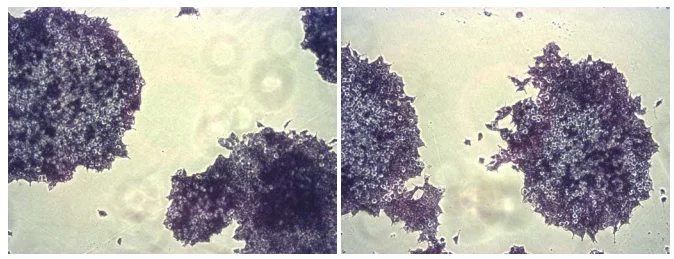
Immunocytochemistry - Alkaline Phosphatase Staining Kit (Purple) (AB242287)
AP staining of ES Cells.
Murine embryonic stem cells (ES-D3) are maintained in an undifferentiated stage on gelatin-coated dishes in the presence of LIF. AP staining of undifferentiated ES cells was performed as described in the Assay Protocol.
Complementary Products


Primary Antibodies
AB183734
RabMAb|Recombinant|Lab Essentials|20ul selling size
- 5
- 24
Reactivity data
Product details
Alkaline Phosphatase Staining Kit (Purple) (ab242286) uses a convenient method to identify and monitor stem cells by staining for alkaline phosphatase activity.
Pluripotent stem cells typically have higher levels of alkaline phosphatase activity than differentiated cell types (although osteoblasts retain this activity). Alkaline phosphatase staining / activity is often used as a biomarker of stem cells.
In this alkaline phosphatase staining kit, alkaline phosphatase acts on a substrate to form a purple colored chemical, producing a purple color in stem cells that is imaged with light microscopy.
The kit can be used with any tissue section or cell type that have alkaline phosphatase activity. It is not compatible with paraffin-embedded sections.
The alkaline phosphatase staining protocol is simple:
- prepare samples (the kit protocol is written for use with ES cells; the kit can be used with any cell or tissues with alkaline phosphatase activity)
- add fixing solution to cells or tissues, incubate for 2 mins, and wash with PBST
- add staining solution and incubate for 15-30 mins
- wash with PBS and image
Alkaline Phosphatase Staining Kit (Red) ab242286 is an alternative to this kit, using an equivalent method, with a different colored dye. Generally, the red kit gives cleaner staining.
What's included?
Properties and storage information
Shipped at conditions
Appropriate short-term storage conditions
Appropriate long-term storage conditions
Storage information
Supplementary information
This supplementary information is collated from multiple sources and compiled automatically.
Biological function summary
Alkaline phosphatase plays important roles in dephosphorylation processes. Particularly in bone it is associated with osteoblast activity where it is important for bone mineralization. The enzyme is not known to be part of a large protein complex but its activity aids in the conversion of inorganic pyrophosphate into phosphate which promotes the deposition of calcium phosphate in bone. ALP staining and ALP staining osteoblast can be used in laboratory settings for studying the mineralization and function of osteoblasts.
Pathways
Alkaline phosphatase is key in the regulation of the phosphate group levels within the organism particularly in the bone mineralization process. It participates in the vitamin D metabolic pathway which influences calcium and phosphorus homeostasis. Its function has a dynamic relationship with proteins like NPP1 which regulates levels of inorganic pyrophosphate acting counter to alkaline phosphatase's phosphate-producing activity.
Product protocols
- Visit the General protocols
- Visit the Troubleshooting
- Download websiteProtocolBooklet|en
- Download websiteProtocolBooklet|en
Target data
Additional targets
Alternative Names
Publications (6)
Recent publications for all applications. Explore the full listand refine your search
Frontiers in bioengineering and biotechnology 11:1254506 PubMed38033818
2023
Applications
Unspecified application
Species
Unspecified reactive species
Stem cell research & therapy 14:154 PubMed37280707
2023
Applications
Unspecified application
Species
Unspecified reactive species
Human cell 36:1041-1053 PubMed36952210
2023
Applications
Unspecified application
Species
Unspecified reactive species
Materials today. Bio 16:100404 PubMed36065353
2022
Applications
Unspecified application
Species
Unspecified reactive species
Frontiers in genetics 12:831420 PubMed35308164
2022
Applications
Unspecified application
Species
Unspecified reactive species
Biomaterials 276:121019 PubMed34325337
2021
Applications
Unspecified application
Species
Unspecified reactive species
Product promise
Please note: All products are 'FOR RESEARCH USE ONLY. NOT FOR USE IN DIAGNOSTIC OR THERAPEUTIC PROCEDURES'.
For licensing inquiries, please contact partnerships@abcam.com