Annexin V- DY-634 PI Apoptosis Staining / Detection Kit
Be the first to review this product! Submit a review
|
(10 Publications )
- Flow Cyt
Supplier Data
Flow Cytometry - Annexin V- DY-634 PI Apoptosis Staining / Detection Kit (AB214484)
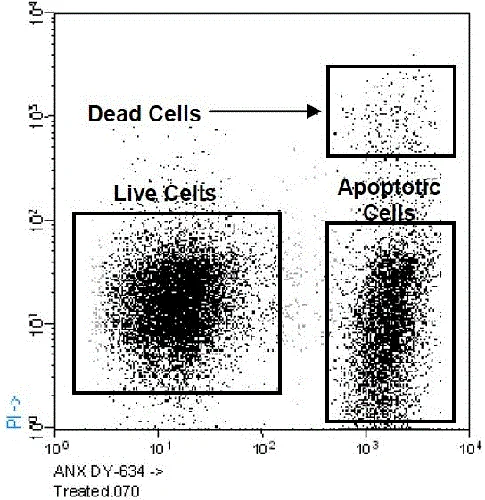
Jurkat cells treated with 6 μM camptothecin for four hours were stained with Annexin V-DY-634/PI Apoptosis Detection Kit (ab214484), following assay protocol. Gating showing the different populations of live, dead and apoptotic cells are shown in the figure.
- Flow Cyt
Supplier Data
Flow Cytometry - Annexin V- DY-634 PI Apoptosis Staining / Detection Kit (AB214484)
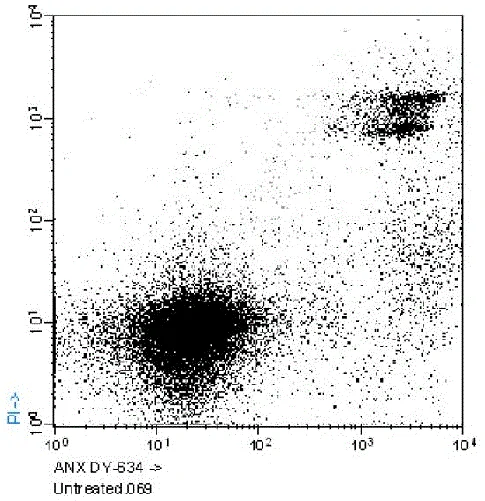
Untreated Jurkat cells were stained with Annexin V-DY-634/PI Apoptosis Detection Kit (ab214484), following assay protocol.
Complementary Products


Primary Antibodies
AB184787
Anti-Caspase-3 antibody [EPR18297]
20ul selling size|RabMAb|Recombinant|KO Validated
- 3
- 3
Product details
Annexin V- DY-634 PI Apoptosis Staining / Detection Kit (ab214484) contains Annexin V labeled with DY-634, which allows the identification and quantitation of apoptotic cells on a single-cell basis by flow cytometry. Simultaneous staining of cells with Annexin V – DY634 (red fluorescence) and the non-vital dye propidium iodide (PI) (orange fluorescence) allows the discrimination of intact cells (AnnexinV-DY-634 negative, PI Staining Solution negative), early apoptotic (Annexin V-DY-634 positive, PI Staining Solution negative) and late apoptotic or necrotic cells (Annexin V-DY-634 positive, PI Staining Solution positive).
DY-634 can be used as direct replacement for APC.
For more apoptosis assays, review the full set of Annexin V assays, or the apoptosis assay and apoptosis marker guide.
Apoptosis is a regulated process of cell death that occurs during embryonic development as well as maintenance of tissue homeostasis. Inappropriately regulated apoptosis is implicated in different disease states, such as neurodegeneration disease and cancer. The apoptosis program is characterized by morphologic features, including loss of plasma membrane asymmetry and attachment, condensation off the cytoplasm and nucleus, and compaction and fragmentation of the nuclear chromatin. Exposure of phosphatidylserine (PS) on the external surface of the cell membrane has been reported to occur in the early phases of apoptotic cell death, during which the cell membrane remains intact. In leukocyte apoptosis, PS on the outer surface of the cell marks the cell for recognition and phagocytosis by macrophages. The human vascular anticoagulant, annexin V, is a 35-36 kDa Ca2+ dependent phospholipid binding protein that has a high affinity for PS, and shows minimal binding to phosphatidylcholine and sphingomyelin. Changes in PS asymmetry, which can be analyzed by measuring annexin V binding to the cell membrane, are generally observed before morphological changes associated with apoptosis occurred and before membrane integrity is lost.
What's included?
Properties and storage information
Shipped at conditions
Appropriate short-term storage conditions
Appropriate long-term storage conditions
Storage information
Product protocols
- Visit the General protocols
- Visit the Troubleshooting
- Download websiteProtocolBooklet|en
Target data
Alternative Names
Publications (10)
Recent publications for all applications. Explore the full listand refine your search
Journal of translational medicine 23:144 PubMed39894850
2025
Applications
Unspecified application
Species
Unspecified reactive species
Frontiers in cardiovascular medicine 11:1386733 PubMed38803660
2024
Applications
Unspecified application
Species
Unspecified reactive species
PeerJ 12:e17356 PubMed38766485
2024
Applications
Unspecified application
Species
Unspecified reactive species
Digestive and liver disease : official journal of the Italian Society of Gastroenterology and the Italian Association for the Study of the Liver 56:1327-1334 PubMed38553338
2024
Applications
Unspecified application
Species
Unspecified reactive species
Liver international : official journal of the International Association for the Study of the Liver 44:1610-1623 PubMed38517208
2024
Applications
Unspecified application
Species
Unspecified reactive species
Biomedical reports 19:83 PubMed37881601
2023
Applications
Unspecified application
Species
Unspecified reactive species
BMC complementary medicine and therapies 23:177 PubMed37264344
2023
Applications
Unspecified application
Species
Unspecified reactive species
Cancer discovery 12:2820-2837 PubMed36122307
2022
Applications
Unspecified application
Species
Unspecified reactive species
Journal of nanobiotechnology 20:14 PubMed34983539
2022
Applications
Unspecified application
Species
Unspecified reactive species
Biomolecules & therapeutics 28:202-210 PubMed31522488
2019
Applications
Unspecified application
Species
Unspecified reactive species
Product promise
Please note: All products are 'FOR RESEARCH USE ONLY. NOT FOR USE IN DIAGNOSTIC OR THERAPEUTIC PROCEDURES'.
For licensing inquiries, please contact partnerships@abcam.com