JavaScript is disabled in your browser. Please enable JavaScript to view this website.
AB245883

Jones Stain Kit (Basement Membrane)

Be the first to review this product! Submit a review

|

(1 Publication)
Jones Stain Kit (Basement Membrane) ab245883 is intended for use in histological demonstration of the basement membrane and reticular fibers.
1 Images
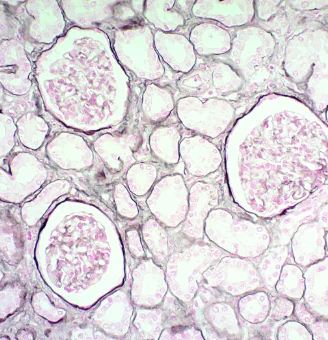
Immunohistochemistry (Formalin/PFA-fixed paraffin-embedded sections) - Jones Stain Kit (Basement Membrane) (AB245883)
  • IHC-P

Supplier Data

Immunohistochemistry (Formalin/PFA-fixed paraffin-embedded sections) - Jones Stain Kit (Basement Membrane) (AB245883)

ab245883 Jones Stain Kit (Basement Membrane) staining formalin-fixed-paraffin embedded tissue sections.

Key facts

Sample types

Tissue sections

Product details

Jones Stain Kit (Basement Membrane) ab245883 is intended for use in histological demonstration of the basement membrane and reticular fibers. This procedure is ideal for staining renal glomerular basement membranes. The main function of the basement membrane and reticular fibers is to provide anchorage and support. They are normally found throughout the body, particularly in the kidney, spleen, and lung.

Basement Membrane: Black

Reticulum Fibers: Black

Nuclei: Red

Cytoplasm: Light Pink

Control Tissue: Kidney cut at 2 microns. Lung. Spleen.

Other products for staining tissue sections

Find more kits and reagents in the special stains guide, or products for antigen retrieval, blocking, signal amplification, visualization, counterstaining, and mounting in the IHC kits and reagents guide.

What's included?

{ "values": { "1Kit": { "sellingSize": "1 Kit", "publicAssetCode":"ab245883-1Kit", "assetComponentDetails": [ { "size":"1 x 125 mL", "name":"Sodium Thiosulfate Solution (5%)", "number":"AB245883-CMP05", "productcode":"" }, { "size":"2 x 250 mL", "name":"Methenamine Solution", "number":"AB245883-CMP07", "productcode":"" }, { "size":"1 x 250 mL", "name":"Periodic acid solution", "number":"AB245883-CMP03", "productcode":"" }, { "size":"1 x 125 mL", "name":"Borax Solution", "number":"AB245883-CMP06", "productcode":"" }, { "size":"1 x 125 mL", "name":"Gold Chloride Solution (0.2%)", "number":"AB245883-CMP01", "productcode":"" }, { "size":"1 x 30 mL", "name":"Silver Nitrate Solution", "number":"AB245883-CMP04", "productcode":"" }, { "size":"1 x 125 mL", "name":"Nuclear Fast Red Solution", "number":"AB245883-CMP02", "productcode":"" } ] } } }

Properties and storage information

Shipped at conditions
Blue Ice
Appropriate short-term storage conditions
+4°C
Appropriate long-term storage conditions
Multi
Storage information
Please refer to protocols

Supplementary information

This supplementary information is collated from multiple sources and compiled automatically.

Basement membrane and reticular fibres often referred to as basal membrane play an important role in providing structural support in tissues. The basement membrane is a specialized matrix present at the interface between the epithelium and underlying connective tissue. Composed of a mass of proteins like collagen laminins and nidogens it serves as a semipermeable filter and a substrate for cell adhesion. Basement membranes are expressed in various organs including skin kidney glomeruli and blood vessels. They are often visualized using specific staining techniques such as Jones methenamine silver stain also known as Jones silver stain or PAMs stain which highlight their unique structural characteristics.
Biological function summary

These structures serve critical functions in tissue organization and compartmentalization. Basement membranes actively participate in cellular signaling and tissue morphogenesis. They are part of a complex network that regulates cell behavior and development. Reticular fibers composed of type III collagen augment the networking capability of the basement membrane by forming fine and supportive mesh around structures such as blood vessels and nerves. These fibers help maintain the property of flexibility and provide an additional scaffold for cellular interaction.

Pathways

Basement membrane components interact with integrins and matrix metalloproteinases influencing pathways like the matrix degradation pathway and the integrin signaling pathway. These interactions are significant in mediating processes such as cell migration proliferation and differentiation. Laminins within the basement membrane bind to integrins on the cell surface triggering cascades that regulate cellular response to the surrounding matrix. This interaction is also vital for maintaining homeostasis and adapting to physiological changes.

Alterations in basement membrane structure or composition can lead to conditions such as Alport syndrome and cancer metastasis. Alport syndrome is a hereditary disorder affecting the kidneys' basement membrane associated with mutations in collagen IV proteins. In cancer the degradation of basement membranes facilitates the invasion and spread of tumor cells. Proteins like matrix metalloproteinases which are involved in the breakdown of extracellular matrix play a role in these pathological states by targeting the structural integrity of the basement membrane for invasion contributing to disease progression.

Product protocols

Target data

Publications (1)

Recent publications for all applications. Explore the full listand refine your search

Cancer cell 42:662-681.e10 PubMed38518775

2024

Mapping functional to morphological variation reveals the basis of regional extracellular matrix subversion and nerve invasion in pancreatic cancer.

Applications

Unspecified application

Species

Unspecified reactive species

Pierluigi Di Chiaro,Lucia Nacci,Fabiana Arco,Stefania Brandini,Sara Polletti,Andrea Palamidessi,Benedetta Donati,Chiara Soriani,Francesco Gualdrini,Gianmaria Frigè,Luca Mazzarella,Alessia Ciarrocchi,Alessandro Zerbi,Paola Spaggiari,Giorgio Scita,Simona Rodighiero,Iros Barozzi,Giuseppe R Diaferia,Gioacchino Natoli
View all publications
websiteProtocolBooklet
en

Product promise

We are committed to supporting your work with high-quality reagents, and we're here for you every step of the way. In the unlikely event that one of our products does not perform as expected, you're protected by our Product Promise.
For full details, please see our Terms & Conditions

Please note: All products are 'FOR RESEARCH USE ONLY. NOT FOR USE IN DIAGNOSTIC OR THERAPEUTIC PROCEDURES'.

For licensing inquiries, please contact partnerships@abcam.com