JavaScript is disabled in your browser. Please enable JavaScript to view this website.
AB219925

Myeloperoxidase (MPO) Activity Assay Kit (Fluorometric - Red)

Be the first to review this product! Submit a review

|

(1 Publication)
Myeloperoxidase (MPO) Activity Assay Kit (Fluorometric) (ab219925) provides a simple method to measure Myeloperoxidase (MPO) activity in cell lysates.
1 Images
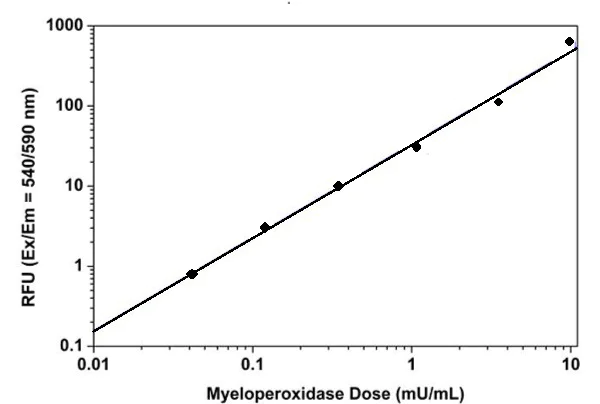
Functional Studies - Myeloperoxidase (MPO) Activity Assay Kit (Fluorometric - Red) (AB219925)
  • FuncS

Supplier Data

Functional Studies - Myeloperoxidase (MPO) Activity Assay Kit (Fluorometric - Red) (AB219925)

Typical Myeloperoxidase (MPO) dose response curve. Absorbance was measured on a 96-well black solid plate using a Gemini fluoresence microplate reader (Molecular Devices). As low as 0.1 mU/mL Myeloperoxidase (MPO) activity can be detected after 60 minutes incubation.

Key facts

Detection method

Fluorescent

Sample types

Cell Lysate

Assay type

Enzyme activity

Sensitivity

< 0.1 mU/mL

Assay Platform

Microplate reader

Reactivity data

{ "title": "Reactivity Data", "filters": { "stats": ["", "Reactivity", "Dilution Info", "Notes"] }, "values": { "Enzyme activity assay": { "reactivity":"TESTED_AND_REACTS", "dilution-info":"", "notes":"<p></p>" } } }

Product details

Myeloperoxidase (MPO) Activity Assay Kit (Fluorometric) (ab219925) provides a simple method to measure Myeloperoxidase (MPO) activity in cell lysates. The assay uses our AbRed Indicator to monitor myeloperoxidase (MPO) activity, leading to an increase in fluorescence that can be easily detected at an optimal Ex/Em = 540/590 nm (range: 530-570/590-600 nm). The signal can also be read by absorbance at OD: 576 ± 5 nm, although the sensitivity of the assay is reduced 10-fold.

This assay can detect activity from as low as 0.1 mU/mL Myeloperoxidase (MPO) in solution. The assay can be performed in a convenient 96-well or 384-well plate format and is easily adapted to automation without a separation or wash step.

Myeloperoxidase (MPO), most abundantly present in neutrophils and monocytes, is a green hemoprotein having peroxidase activity. It catalyzes the reaction of hydrogen peroxide and halide ions to form cytotoxic acids and other intermediates; and plays an important role in the oxygen-dependent killing of tumor cells and microorganisms. MPO deficiency is a hereditary deficiency of the enzyme, which predisposes to immune deficiency. However, elevated MPO levels significantly increases the risk for cardiovascular mortality. The fact that circulating levels of MPO have been shown to predict risks for major adverse cardiac events and that levels of MPO derived chlorinated compounds are specific biomarkers for disease progression, has attracted considerable interest in the development of therapeutic MPO inhibitors.

What's included?

{ "values": { "200Test": { "sellingSize": "200 Test", "publicAssetCode":"ab219925-200Test", "assetComponentDetails": [ { "size":"1 x 1 Vial", "name":"Red Dye (light-sensitive)", "number":"AB219925-CMP05", "productcode":"" }, { "size":"1 x 200 µL", "name":"DMSO", "number":"AB219925-CMP04", "productcode":"" }, { "size":"1 x 100 µL", "name":"H2O2 (3%)", "number":"AB219925-CMP01", "productcode":"" }, { "size":"1 x 20 mL", "name":"Assay Buffer", "number":"AB219925-CMP03", "productcode":"" }, { "size":"1 x 1 Vial", "name":"Myeloperoxidase Standard (10 mU)", "number":"AB219925-CMP02", "productcode":"" } ] } } }

Properties and storage information

Shipped at conditions
Blue Ice
Appropriate short-term storage conditions
-20°C
Appropriate long-term storage conditions
-20°C
Storage information
-20°C

Supplementary information

This supplementary information is collated from multiple sources and compiled automatically.

Myeloperoxidase also called MPO is an enzyme that plays a critical role in the body's immune response. This protein has a mass of approximately 150 kDa and exists as a dimer composed of heavy and light polypeptide chains. Myeloperoxidase is prominently expressed in neutrophils and monocytes which are types of white blood cells important for combating infections. The enzyme catalyzes the production of hypochlorous acid and other reactive substances by utilizing hydrogen peroxide and chloride ions. These reactive substances help in neutralizing pathogens during the immune response.
Biological function summary

The generation of reactive oxygen species by myeloperoxidase is essential for microbicidal activity. Myeloperoxidase functions as part of the antimicrobial system in the phagosome which is the intracellular compartment where pathogens are degraded. This enzyme works in conjunction with other components of the immune system such as NADPH oxidase. By generating hypochlorous acid MPO contributes to the oxidative burst a rapid release of reactive oxygen species during the response to pathogens.

Pathways

Myeloperoxidase integrates into the immune defense and inflammatory pathways. In particular it is associated with the neutrophil degranulation pathway where it releases its enzymatic contents to fight off microbes. MPO also interacts with proteins involved in oxidative stress processes such as superoxide dismutase which moderates levels of reactive oxygen species in cells. These interactions ensure balance in the immune response preventing excessive tissue damage during inflammation.

Dysregulated MPO activity can contribute to the development of diseases. For instance myeloperoxidase is linked with atherosclerosis a cardiovascular condition where inflammation and oxidative stress lead to plaque formation in the arteries. It also associates with vasculitis an autoimmune disorder causing inflammation of blood vessels. Both disorders can relate to the inflammatory pathways that involve MPO and proteins like C-reactive protein which serves as a marker of inflammation. Understanding MPO's role in these conditions is important for effective therapeutic interventions.

Product protocols

Target data

Part of the host defense system of polymorphonuclear leukocytes. It is responsible for microbicidal activity against a wide range of organisms. In the stimulated PMN, MPO catalyzes the production of hypohalous acids, primarily hypochlorous acid in physiologic situations, and other toxic intermediates that greatly enhance PMN microbicidal activity (PubMed : 9922160). Mediates the proteolytic cleavage of alpha-1-microglobulin to form t-alpha-1-microglobulin, which potently inhibits oxidation of low-density lipoprotein particles and limits vascular damage (PubMed : 25698971).
See full target information MPO

Alternative Names

Myeloperoxidase, MPO

Publications (1)

Recent publications for all applications. Explore the full list and refine your search

Nature 615:168-174 PubMed36813961

2023

Microbiota-derived 3-IAA influences chemotherapy efficacy in pancreatic cancer.

Applications

Unspecified application

Species

Unspecified reactive species

Joseph Tintelnot,Yang Xu,Till R Lesker,Martin Schönlein,Leonie Konczalla,Anastasios D Giannou,Penelope Pelczar,Dominik Kylies,Victor G Puelles,Agata A Bielecka,Manuela Peschka,Filippo Cortesi,Kristoffer Riecken,Maximilian Jung,Lena Amend,Tobias S Bröring,Marija Trajkovic-Arsic,Jens T Siveke,Thomas Renné,Danmei Zhang,Stefan Boeck,Till Strowig,Faik G Uzunoglu,Cenap Güngör,Alexander Stein,Jakob R Izbicki,Carsten Bokemeyer,Marianne Sinn,Alec C Kimmelman,Samuel Huber,Nicola Gagliani
View all publications
websiteProtocolBooklet
en

Product promise

We are committed to supporting your work with high-quality reagents, and we're here for you every step of the way. In the unlikely event that one of our products does not perform as expected, you're protected by our Product Promise.
For full details, please see our Terms & Conditions

Please note: All products are 'FOR RESEARCH USE ONLY. NOT FOR USE IN DIAGNOSTIC OR THERAPEUTIC PROCEDURES'.

For licensing inquiries, please contact partnerships@abcam.com