N-epsilon-(Carboxyethyl) Lysine (CEL) Assay Kit
Be the first to review this product! Submit a review
|
(0 Publication)
- cELISA
Supplier Data
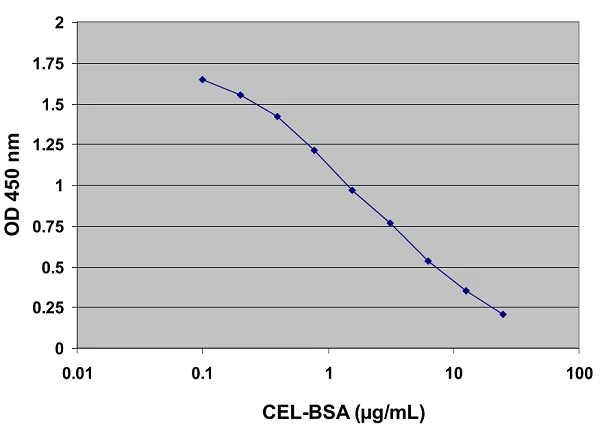
Competitive ELISA - N-epsilon-(Carboxyethyl) Lysine (CEL) Assay Kit (AB238540)
Example CEL-BSA ELISA Standard Curve.
Typical CEL ELISA results.
This data is for reference only and should not be used to interpret actual results.
Complementary Products

Primary Antibodies
AB184451
Anti-Dopamine Transporter antibody [EPR19695]
BOND RX™ Validated|20ul selling size|RabMAb|Recombinant

- 0
- 0


Product details
N-epsilon-(Carboxyethyl) Lysine (CEL) Assay Kit (ab238540) is designed for the rapid detection and quantitation of CEL protein adducts.
First, a CEL conjugate is coated on the ELISA plate. The unknown CEL protein samples or CEL-BSA standards are then added to the CEL conjugate preabsorbed plate. After a brief incubation the anti-CEL monoclonal antibody is added, followed by an HRP conjugated secondary antibody. The content of CEL protein adducts in unknown samples is determined by comparison with the pre-determined CEL-BSA standard curve. Despite the structure similarity between CEL and CML, the anti-CEL specific antibody in this kit will not cross react with CML protein adducts.
What's included?
Properties and storage information
Shipped at conditions
Appropriate short-term storage conditions
Appropriate long-term storage conditions
Storage information
Supplementary information
This supplementary information is collated from multiple sources and compiled automatically.
Biological function summary
The modification of proteins by CEL impacts cellular processes. CEL alters the function and lifespan of proteins disrupting homeostasis and contributing to altered cell signaling pathways. It is associated with the alteration of extracellular matrix proteins and redox-sensitive cytoplasmic proteins. CEL is not typically part of a specific complex but its presence can influence the assembly and function of protein complexes within cells. Its influence on protein modification underlies the aging process and other cellular dysfunctions.
Pathways
CEL plays a role in oxidative stress and inflammatory pathways. It associates with the receptor for AGE (RAGE) initiating signaling cascades that contribute to inflammation and oxidative stress. The AGE-RAGE axis represents a fundamental pathway where CEL engages in modifying cellular responses and protein expressions. Other related proteins include glyoxalase enzymes that detoxify reactive carbonyl species thereby potentially counteracting CEL formation and mitigating downstream effects.
Product protocols
- Visit the General protocols
- Visit the Troubleshooting
- Download websiteProtocolBooklet|en
Product promise
Please note: All products are 'FOR RESEARCH USE ONLY. NOT FOR USE IN DIAGNOSTIC OR THERAPEUTIC PROCEDURES'.
For licensing inquiries, please contact partnerships@abcam.com