Peroxynitrite Assay Kit (Fluorometric)
Be the first to review this product! Submit a review
|
(5 Publications )
- FuncS
Supplier Data
Functional Studies - Peroxynitrite Assay Kit (Fluorometric) (AB233469)
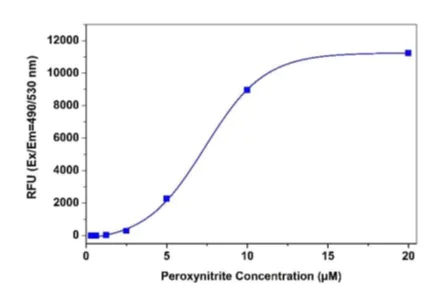
Example standard curve of Peroxynitrite showing concentration against absorbance.
Peroxynitrite was measured with the Peroxynitrite Quantification Kit (Fluorometric) (ab233469) on a solid black 96-well plate using a Gemini microplate reader. As low as 1.25 μM was detected. (Δ Note : The fluorescence background increases with time, thus it is important to subtract the fluorescence intensity value of the blank wells for each data point.)
- FuncS
Unknown
Functional Studies - Peroxynitrite Assay Kit (Fluorometric) (AB233469)
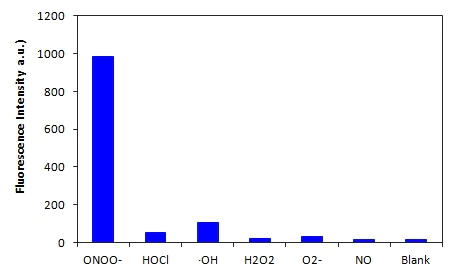
Fluorescence response of Peroxynitrite Sensor Green to different reactive oxygen species.
The fluorescence intensities were measured with Ex/Em = 490/530 nm.
Complementary Products


Product details
Peroxynitrite Assay Kit (Fluorometric) (ab233469) provides a sensitive tool to measure peroxynitrite in solution.
Peroxynitrite Sensor Green reacts with ONOO¯ to generate a bright green fluorescent product. It specifically reacts with ONOO¯ with high selectivity over other reactive oxygen species (ROS) and reactive nitrogen species (RNS). This kit can be used with a fluorescence microplate reader and spectrometer.
Peroxynitrite (ONOO¯) is a strong oxidizing species and a highly active nitrating agent. It is formed from the reaction between superoxide radicals and nitric oxide generated in cells. It can damage a wide array of biomolecules including proteins, enzymes, lipids and nucleic acids, eventually contributing to cell death. Due to its extremely short half-life and low steady-state concentration, it has been challenging to detect and quantify peroxynitrite in solution.
What's included?
Properties and storage information
Shipped at conditions
Appropriate short-term storage conditions
Appropriate long-term storage conditions
Storage information
Supplementary information
This supplementary information is collated from multiple sources and compiled automatically.
Biological function summary
Peroxynitrite exerts its influence through oxidizing and nitrating various biological macromolecules. It primarily targets proteins lipids and DNA affecting their function and integrity. Although not part of a complex itself it disrupts cellular complexes like mitochondrial electron transport chain components. This prevention of proper ATP production highlights peroxynitrite's role in energy metabolism disruptions.
Pathways
Peroxynitrite plays a role in inflammatory and apoptotic pathways. It interacts with signaling molecules like NF-kB and caspases mediating cellular stress responses. Peroxynitrite modifies tyrosine residues on proteins leading to altered signaling functions. It closely relates to proteins such as SOD (superoxide dismutase) and iNOS (inducible nitric oxide synthase) due to its formation and effects on cellular processes.
Product protocols
- Visit the General protocols
- Visit the Troubleshooting
- Download websiteProtocolBooklet|en
Target data
Publications (5)
Recent publications for all applications. Explore the full listand refine your search
International journal of molecular sciences 25: PubMed39457062
2024
Applications
Unspecified application
Species
Unspecified reactive species
Antioxidants (Basel, Switzerland) 13: PubMed38790647
2024
Applications
Unspecified application
Species
Unspecified reactive species
Journal of colloid and interface science 640:144-161 PubMed36842420
2023
Applications
Unspecified application
Species
Unspecified reactive species
Pharmaceutics 14: PubMed35335878
2022
Applications
Unspecified application
Species
Unspecified reactive species
Bone research 10:12 PubMed35145063
2022
Applications
Unspecified application
Species
Unspecified reactive species
Product promise
Please note: All products are 'FOR RESEARCH USE ONLY. NOT FOR USE IN DIAGNOSTIC OR THERAPEUTIC PROCEDURES'.
For licensing inquiries, please contact partnerships@abcam.com