2-Chloro-N6-cyclopentyladenosine (CCPA), A1 agonist
Be the first to review this product! Submit a review
|
(2 Publications )
MW 369.8 Da, Purity >98%. Highly potent and selective A1 receptor agonist (Ki values are 0.8, 2300 and 42 nM for human A1, A2A and A3 receptors, respectively). Shows >2000-fold selectivity over A2A. Centrally active following systemic administration and anticonvulsive *in vivo*.
View Alternative Names
A1AR, A1R, A2AAR, A2aR, A3AR, A3R, AA1R_HUMAN, AA2AR_HUMAN, AA3R_HUMAN, AD 026, ADENO, ADORA 1, ADORA 2, ADORA 3, ADORA2A, ARA3, Adenosine A2 receptor, Adenosine A2a receptor, Adenosine A3 receptor, Adenosine receptor A1, Adenosine receptor A2a, Adenosine receptor A3, Adenosine receptor subtype A2a, GPCR 2, RDC 7, RDC 8, RP11 552M11.7, Ri, TGPCR1, bA552M11.5, hA2aR
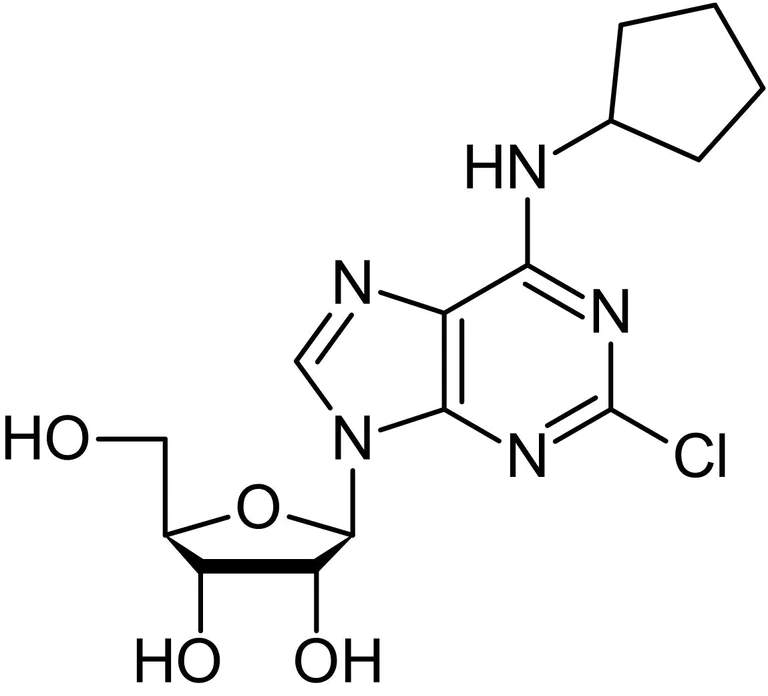
- Chemical Structure
Lab
Chemical Structure - 2-Chloro-N6-cyclopentyladenosine (CCPA), A1 agonist (AB120434)
2D chemical structure image of ab120434, 2-Chloro-N6-cyclopentyladenosine (CCPA), A1 agonist
Complementary Products
Primary Antibodies
AB51253
Anti-Alpha-synuclein (phospho S129) antibody [EP1536Y]
20ul selling size|BOND RX™ Validated|RabMAb|Recombinant

- 5
- 9
Properties and storage information
Shipped at conditions
Appropriate short-term storage conditions
Appropriate long-term storage conditions
Storage information
Handling instructions
Need more advice on solubility, usage and handling? Please visit our our product support page for more details.
|
Wherever possible, you should prepare and use solutions on the same day. However, if you need to make up stock solutions in advance, we recommend that you store the solution as aliquots in tightly sealed vials at -20°C. Generally, these will be useable for up to one month. Before use, and prior to opening the vial we recommend that you allow your product to equilibrate to room temperature for at least 1 hour.
Supplementary information
This supplementary information is collated from multiple sources and compiled automatically.
Biological function summary
These receptors mediate cellular responses to adenosine leading to changes in cellular activity. They are not part of a single complex but may interact with other proteins as part of signaling pathways. A1 receptors typically lead to an inhibitory effect by reducing cyclic AMP levels. A2a receptors however usually result in a stimulatory effect by increasing cyclic AMP levels. A3AR can have either effect depending on cellular context. These activities influence physiological processes like heart rate neurotransmitter release and immune response modulation.
Pathways
These receptors play significant roles in cardiovascular and neurological pathways. The A1 receptor participates importantly in the cardiac adenosine pathway influencing heart contractility and rhythm by working with proteins like Gi protein. The A2a receptor has a notable role in the dopaminergic signaling pathway within the central nervous system interacting with proteins such as dopamine receptors. A3AR is involved in inflammatory pathways sometimes linking with proteins like NF-kB to modulate immune cell activity.
Publications (2)
Recent publications for all applications. Explore the full list and refine your search
The Tohoku journal of experimental medicine 249:275-283 PubMed31875581
2019
Applications
Unspecified application
Species
Unspecified reactive species
Biochemical and biophysical research communication 497:850-856 PubMed29454963
2018
Applications
Unspecified application
Species
Unspecified reactive species
Product promise
Please note: All products are 'FOR RESEARCH USE ONLY. NOT FOR USE IN DIAGNOSTIC OR THERAPEUTIC PROCEDURES'.
For licensing inquiries, please contact partnerships@abcam.com