JavaScript is disabled in your browser. Please enable JavaScript to view this website.
AB120350

AACOCF3 (Arachidonyl trifluoromethyl ketone), Phospholipase-A2 inhibitor

Be the first to review this product! Submit a review

|

(1 Publication)
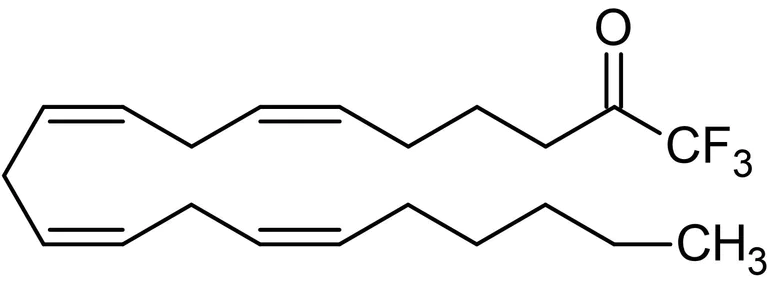
MW 356.5 Da, Purity >98%. Cell-permeable analog of arachidonic acid (ab120916). Widely used as an inhibitor of the 85-kDa cytosolic group IV phospholipase A2 (cPLA2) and calcium-independent group VI phospholipase A2 (iPLA2) (IC50 values are 1.5 and 6.0 μM, respectively). In non-neural cells, also inhibits cyclooxygenase and acyltransferase activities.
1 Images
Chemical Structure - AACOCF3 (Arachidonyl trifluoromethyl ketone), Phospholipase-A2 inhibitor (AB120350)
  • Chemical Structure

Lab

Chemical Structure - AACOCF3 (Arachidonyl trifluoromethyl ketone), Phospholipase-A2 inhibitor (AB120350)

2D chemical structure image of ab120350, AACOCF3 (Arachidonyl trifluoromethyl ketone), Phospholipase-A2 inhibitor

Key facts

CAS number

149301-79-1

Purity

>98%

Form

Liquid

form

Formulation

Constituents: 99% Methyl acetate, 1% AACOCF3

Molecular weight

356.5 Da

Molecular formula

C<sub>2</sub><sub>1</sub>H<sub>3</sub><sub>1</sub>F<sub>3</sub>O

PubChem

5280436

Nature

Synthetic

Biochemical name

Aacocf3

Biological description

Cell-permeable analog of arachidonic acid (ab120916). Widely used as an inhibitor of the 85-kDa cytosolic group IV phospholipase A2 (cPLA2) and calcium-independent group VI phospholipase A2 (iPLA2) (IC50 values are 1.5 and 6.0 μM, respectively) . In non-neural cells, also inhibits cyclooxygenase and acyltransferase activities.

Canonical smiles

CCCCCC=CCC=CCC=CCC=CCCCC(=O)C(F)(F)F

Isomeric smiles

CCCCC/C=C\C/C=C\C/C=C\C/C=C\CCCC(=O)C(F)(F)F

InChi

InChI=1S/C21H31F3O/c1-2-3-4-5-6-7-8-9-10-11-12-13-14-15-16-17-18-19-20(25)21(22,23)24/h6-7,9-10,12-13,15-16H,2-5,8,11,14,17-19H2,1H3/b7-6-,10-9-,13-12-,16-15-

InChiKey

PLWROONZUDKYKG-DOFZRALJSA-N

IUPAC Name

(6Z,9Z,12Z,15Z)-1,1,1-trifluorohenicosa-6,9,12,15-tetraen-2-one

Concentration

50 mg/mL

Properties and storage information

Shipped at conditions
Ambient - Can Ship with Ice
Appropriate short-term storage conditions
-20°C
Appropriate long-term storage conditions
-20°C
Storage information
Before use, and prior to opening the vial we recommend that you allow your product to equilibrate to room temperature for at least 1 hour|Store under desiccating conditions|The product can be stored for up to 12 months
Handling instructions

Need more advice on solubility, usage and handling? Please visit our our product support page for more details.

|

Refer to SDS for further information.

Supplementary information

This supplementary information is collated from multiple sources and compiled automatically.

FAAH1 JMJD7-PLA2G4B involves the enzyme fatty acid amide hydrolase 1 (FAAH1) and a fusion protein of the JMJD7-PLA2G4B gene. FAAH1 with a mass of approximately 63 kDa breaks down fatty acid amides such as anandamide. Known as a phospholipase A2 inhibitor FAAH1 is distributed in the brain and liver affecting neurotransmitter regulation and degradation. The enzyme targets specific pathways through substrates like arachidonyl trifluoromethyl ketone (AACOCF3) a known inhibitor of FAAH1 activity indicating its regulatory roles in intracellular signaling.
Biological function summary

FAAH1 serves as a vital component within the endocannabinoid system affecting lipid signaling pathways and neurotransmitter control. It is not usually found in a multi-protein complex functioning largely as a solitary enzyme in its regulatory processes. By controlling endocannabinoid levels FAAH1 modulates synaptic plasticity pain sensation and inflammation having broad impacts on various physiological processes and adaptations.

Pathways

FAAH1 plays a critical role in the endocannabinoid and phospholipid metabolic pathways. The enzyme modulates levels of N-acylethanolamines impacting signal transduction and neuromodulation. It relates to proteins like NAPE-PLD in these pathways which also participate in regulating amide classes and transmission of signals. FAAH1 is essential for maintaining balance within these pathways by regulating bioactive lipid concentrations.

FAAH1 relates to neuropathic pain and inflammatory diseases. The enzyme's regulatory activity on endogenous cannabinoids reveals its potential role in pain management disorders and neural dysfunctions. It connects with proteins such as COX-2 which also plays significant roles in inflammation and pain response. Manipulating FAAH1 activity with inhibitors links to therapeutic strategies for conditions like anxiety and inflammation-related disorders making it a target of interest for new drug development.

Product protocols

Publications (1)

Recent publications for all applications. Explore the full listand refine your search

Nature communications 12:4303 PubMed34262037

2021

Intracellular lipid droplet accumulation occurs early following viral infection and is required for an efficient interferon response.

Applications

Unspecified application

Species

Unspecified reactive species

E A Monson,K M Crosse,M Duan,W Chen,R D O'Shea,L M Wakim,J M Carr,D R Whelan,K J Helbig
View all publications

Product promise

We are committed to supporting your work with high-quality reagents, and we're here for you every step of the way. In the unlikely event that one of our products does not perform as expected, you're protected by our Product Promise.
For full details, please see our Terms & Conditions

Please note: All products are 'FOR RESEARCH USE ONLY. NOT FOR USE IN DIAGNOSTIC OR THERAPEUTIC PROCEDURES'.

For licensing inquiries, please contact partnerships@abcam.com