JavaScript is disabled in your browser. Please enable JavaScript to view this website.
AB142163

C 646, p300/CBP Inhibitor, p300/CBP HAT inhibitor

Be the first to review this product! Submit a review

|

(8 Publications )
MW 445.4 Da, Purity >98%. Cell-permeable, competitive, selective, potent p300/CBP histone acetyltransferase inhibitor (Ki = 400 nM). Blocks dynamic acetylation. Anticancer agent. Active in vitro and in vivo.
1 Images
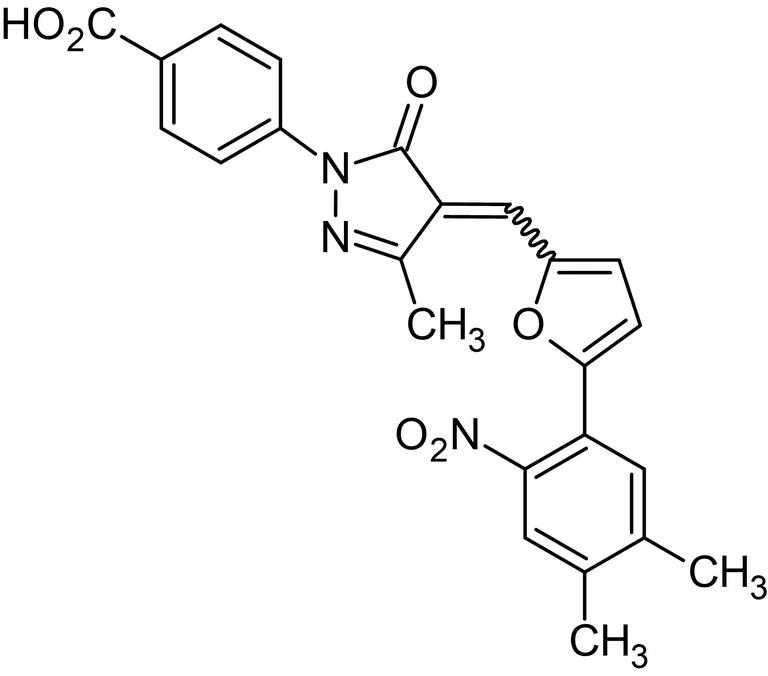
Chemical Structure - C 646, p300/CBP Inhibitor, p300/CBP HAT inhibitor (AB142163)
  • Chemical Structure

Lab

Chemical Structure - C 646, p300/CBP Inhibitor, p300/CBP HAT inhibitor (AB142163)

2D chemical structure image of ab142163, C 646, p300/CBP Inhibitor, p300/CBP HAT inhibitor

Key facts

CAS number

328968-36-1

Purity

>98%

Form

Solid

form

Formulation

Constituents: 100% 4-[(4Z)-4-[[5-(4,5-dimethyl-2-nitrophenyl)furan-2-yl]methylidene]-3-methyl-5-oxopyrazol-1-yl]benzoic acid

Molecular weight

445.4 Da

Molecular formula

C<sub>2</sub><sub>4</sub>H<sub>1</sub><sub>9</sub>N<sub>3</sub>O<sub>6</sub>

PubChem

2871948

Nature

Synthetic

Solubility

Soluble in DMSO to 25 mM

Biochemical name

4-(4-((5-(4,5-Dimethyl-2-nitrophenyl)furan-2-yl)methylene)-3-methyl-5-oxo-4,5-dihydro-1H-pyrazol-1-yl)benzoic acid

Biological description

Cell-permeable, competitive, selective, potent p300/CBP histone acetyltransferase inhibitor (Ki = 400 nM). Blocks dynamic acetylation. Anticancer agent. Active in vitro and in vivo.

Canonical smiles

CC1=CC(=C(C=C1C)[N+](=O)[O-])C2=CC=C(O2)C=C3C(=NN(C3=O)C4=CC=C(C=C4)C(=O)O)C

InChi

InChI=1S/C24H19N3O6/c1-13-10-20(21(27(31)32)11-14(13)2)22-9-8-18(33-22)12-19-15(3)25-26(23(19)28)17-6-4-16(5-7-17)24(29)30/h4-12H,1-3H3,(H,29,30)

InChiKey

HEKJYZZSCQBJGB-UHFFFAOYSA-N

IUPAC Name

4-[4-[[5-(4,5-dimethyl-2-nitrophenyl)furan-2-yl]methylidene]-3-methyl-5-oxopyrazol-1-yl]benzoic acid

Properties and storage information

Shipped at conditions
Ambient - Can Ship with Ice
Appropriate short-term storage conditions
-20°C
Appropriate long-term storage conditions
-20°C
Storage information
Store under desiccating conditions|The product can be stored for up to 12 months
Handling instructions

Need more advice on solubility, usage and handling? Please visit our our product support page for more details.

|

Wherever possible, you should prepare and use solutions on the same day. However, if you need to make up stock solutions in advance, we recommend that you store the solution as aliquots in tightly sealed vials at -20°C. Generally, these will be useable for up to one month. Before use, and prior to opening the vial we recommend that you allow your product to equilibrate to room temperature for at least 1 hour.

|

Toxic, refer to SDS for further information.

Supplementary information

This supplementary information is collated from multiple sources and compiled automatically.

KAT3B also known as p300 is a histone acetyltransferase with a molecular weight of approximately 300 kDa. Known for its ability to acetylate histone and non-histone proteins p300 modulates gene expression by altering chromatin structure. The protein is ubiquitously expressed across various tissues impacting numerous cellular processes by its mechanical functions of modifying chromatin.
Biological function summary

KAT3B/p300 influences multiple cellular activities like cell growth differentiation and apoptosis. It functions as a transcriptional coactivator and integrates various signaling pathways into the cell's gene expression program. p300 often forms complexes with other transcription factors enhancing or repressing their activity based on the cellular context. By modifying transcription factors it plays an essential role in controlling cell fate decisions.

Pathways

P300 participates in the regulation of significant cellular processes including the Wnt signaling pathway and the p53 pathway. In the Wnt signaling pathway p300 acts alongside beta-catenin to regulate gene expression while in the p53 pathway it acetylates the p53 protein influencing the cell’s response to DNA damage. These pathways highlight p300's interaction with important proteins such as CBP (CREB-binding protein) which shares a similar functional repertoire and works synergistically in gene regulation.

P300 is implicated in cancers and congenital disorders. In cancer aberrant regulation or mutation of p300 can lead to uncontrolled cell proliferation and tumor growth; p300 inhibitors like C646 are researched for their therapeutic potential. Additionally Rubinstein-Taybi syndrome a congenital disorder results from mutations in the p300 gene showcasing p300’s importance in developmental processes. The interplay of p300 with proteins such as CBP is also relevant in these conditions where disrupted interactions may lead to disease manifestation.

Product protocols

Publications (8)

Recent publications for all applications. Explore the full listand refine your search

Aging cell 21:e13677 PubMed35907249

2022

p300 arrests intervertebral disc degeneration by regulating the FOXO3/Sirt1/Wnt/β-catenin axis.

Applications

Unspecified application

Species

Unspecified reactive species

Yingjie Hao,Zhinan Ren,Lei Yu,Guangduo Zhu,Panke Zhang,Jian Zhu,Shuyan Cao

Molecular pharmacology 98:88-95 PubMed32487734

2020

Modulation of Human Arylamine -Acetyltransferase 1 Activity by Lysine Acetylation: Role of p300/CREB-Binding Protein and Sirtuins 1 and 2.

Applications

Unspecified application

Species

Unspecified reactive species

Neville J Butcher,Rachel Burow,Rodney F Minchin

Nature communications 10:5014 PubMed31676784

2019

The transcription factor ERG regulates a low shear stress-induced anti-thrombotic pathway in the microvasculature.

Applications

Unspecified application

Species

Unspecified reactive species

C Peghaire,N P Dufton,M Lang,I I Salles-Crawley,J Ahnström,V Kalna,C Raimondi,C Pericleous,L Inuabasi,R Kiseleva,V R Muzykantov,J C Mason,G M Birdsey,A M Randi

Molecular therapy. Nucleic acids 18:285-297 PubMed31604167

2019

Silencing of lncRNA MALAT1 Prevents Inflammatory Injury after Lung Transplant Ischemia-Reperfusion by Downregulation of IL-8 via p300.

Applications

Unspecified application

Species

Unspecified reactive species

Li Wei,Jiwei Li,Zhijun Han,Zhong Chen,Quan Zhang

American journal of physiology. Renal physiology : PubMed30623724

2019

TGF-β1 modifies histone acetylation and acetyl-coenzyme A metabolism in renal myofibroblasts.

Applications

Unspecified application

Species

Unspecified reactive species

Edward R Smith,Belinda Wigg,Stephen Holt,Timothy David Hewitson

eLife 7: PubMed29424686

2018

Gene-specific mechanisms direct glucocorticoid-receptor-driven repression of inflammatory response genes in macrophages.

Applications

Unspecified application

Species

Unspecified reactive species

Maria A Sacta,Bowranigan Tharmalingam,Maddalena Coppo,David A Rollins,Dinesh K Deochand,Bradley Benjamin,Li Yu,Bin Zhang,Xiaoyu Hu,Rong Li,Yurii Chinenov,Inez Rogatsky

Science advances 3:e1700475 PubMed28819643

2017

Membrane localization of acetylated CNK1 mediates a positive feedback on RAF/ERK signaling.

Applications

Unspecified application

Species

Unspecified reactive species

Adrian Fischer,Wignand W D Mühlhäuser,Bettina Warscheid,Gerald Radziwill

Frontiers in microbiology 8:1211 PubMed28713342

2017

NF-κBp50 and HDAC1 Interaction Is Implicated in the Host Tolerance to Infection Mediated by the Bacterial Quorum Sensing Signal 2-Aminoacetophenone.

Applications

Unspecified application

Species

Unspecified reactive species

Arunava Bandyopadhaya,Amy Tsurumi,Laurence G Rahme
View all publications

Product promise

We are committed to supporting your work with high-quality reagents, and we're here for you every step of the way. In the unlikely event that one of our products does not perform as expected, you're protected by our Product Promise.
For full details, please see our Terms & Conditions

Please note: All products are 'FOR RESEARCH USE ONLY. NOT FOR USE IN DIAGNOSTIC OR THERAPEUTIC PROCEDURES'.

For licensing inquiries, please contact partnerships@abcam.com