JavaScript is disabled in your browser. Please enable JavaScript to view this website.
AB141331

Clofibrate, PPARalpha agonist

Be the first to review this product! Submit a review

|

(0 Publication)

Clofibrate (CAS No: 637-07-0)(ab141331). PPARα agonist (EC50 values are 50 and 55 µM at mouse and human receptors respectively). Antihyperlipoproteinemic agent. MW 242.7. Purity >99%.

- Larger volume format available upon request.
1 Images
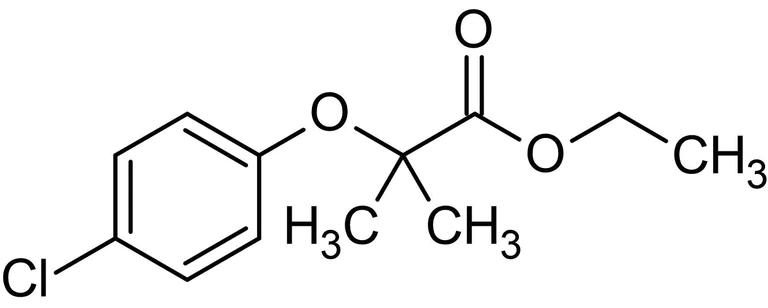
Chemical Structure - Clofibrate, PPARalpha agonist (AB141331)
  • Chemical Structure

Lab

Chemical Structure - Clofibrate, PPARalpha agonist (AB141331)

2D chemical structure image of ab141331, Clofibrate, PPARalpha agonist

Key facts

CAS number

637-07-0

Purity

>99%

Form

Liquid

form

Formulation

Constituents: 100% Clofibrate

Molecular weight

242.7 Da

Molecular formula

C<sub>1</sub><sub>2</sub>H<sub>1</sub><sub>5</sub>ClO<sub>3</sub>

PubChem

2796

Nature

Synthetic

Biochemical name

Clofibrate

Biological description

PPARα agonist (EC50 values are 50 and 55 μM at mouse and human receptors respectively). Antihyperlipoproteinemic agent.

Canonical smiles

CCOC(=O)C(C)(C)OC1=CC=C(C=C1)Cl

InChi

InChI=1S/C12H15ClO3/c1-4-15-11(14)12(2,3)16-10-7-5-9(13)6-8-10/h5-8H,4H2,1-3H3

InChiKey

KNHUKKLJHYUCFP-UHFFFAOYSA-N

IUPAC Name

ethyl 2-(4-chlorophenoxy)-2-methylpropanoate

Product details

ab141331 is a colorless liquid at room temperature with a density of approximately 1.1 g/mL.

Properties and storage information

Shipped at conditions
Ambient - Can Ship with Ice
Appropriate short-term storage conditions
+4°C
Appropriate long-term storage conditions
+4°C
Handling instructions

Need more advice on solubility, usage and handling? Please visit our our product support page for more details.

|

Wherever possible, you should prepare and use solutions on the same day. However, if you need to make up stock solutions in advance, we recommend that you store the solution as aliquots in tightly sealed vials at -20°C. Generally, these will be useable for up to one month. Before use, and prior to opening the vial we recommend that you allow your product to equilibrate to room temperature for at least 1 hour.

|

Refer to SDS for further information.

Supplementary information

This supplementary information is collated from multiple sources and compiled automatically.

The Estrogen Receptor Cytochrome P450 3A4 (CYP3A4) and liver FABP (Fatty Acid Binding Protein) are important proteins with distinct mechanical roles in the body. The Estrogen Receptor acts as a nuclear hormone receptor regulating gene expression upon estrogen binding. CYP3A4 a member of the cytochrome P450 family is a large enzyme with a mass of approximately 57 kDa and is mainly expressed in the liver. It functions to metabolize various xenobiotics and endogenous compounds. The liver FABP a smaller protein helps bind and transport fatty acids within liver cells.
Biological function summary

The Estrogen Receptor influences reproductive tissues and breast development by regulating genes involved in cell growth. It forms complexes with coactivator proteins to modulate transcription. CYP3A4 participates in the metabolism of drugs and steroids affecting their clearance and bioavailability. Liver FABP assists in the intracellular trafficking of lipids and the modulation of lipid levels within hepatocytes which are liver cells.

Pathways

The Estrogen Receptor plays significant roles in the estrogen signaling pathway which involves proteins like coactivators and corepressors influencing cell proliferation and differentiation. CYP3A4 facilitates the drug metabolism pathway interacting with proteins such as cytochrome P450 reductase. These proteins collaborate to metabolize drugs and regulate endogenous steroid levels. Liver FABP is involved in lipid metabolism pathways working with enzymes that process and transport lipids within the liver.

Estrogen Receptor dysfunction relates to hormone-sensitive cancers such as breast cancer. This receptor's interaction with proteins like HER2 impacts tumor progression and response to therapy. CYP3A4 is associated with drug metabolism disorders leading to altered pharmacokinetics and may affect proteins involved in drug clearance increasing susceptibility to drug toxicity. Liver FABP plays a role in fatty liver disease with its interaction affecting lipid metabolism pathways and gene expression in metabolic disorders.

Product protocols

Product promise

We are committed to supporting your work with high-quality reagents, and we're here for you every step of the way. In the unlikely event that one of our products does not perform as expected, you're protected by our Product Promise.
For full details, please see our Terms & Conditions

Please note: All products are 'FOR RESEARCH USE ONLY. NOT FOR USE IN DIAGNOSTIC OR THERAPEUTIC PROCEDURES'.

For licensing inquiries, please contact partnerships@abcam.com