JavaScript is disabled in your browser. Please enable JavaScript to view this website.
AB141320

LY 225910, CCK2 receptor antagonist

Be the first to review this product! Submit a review

|

(1 Publication)
MW 502.4 Da, Purity >99%. Potent, selective CCK2 receptor antagonist (IC50 = 9.3 nM). Shows anxiolytic effects in vivo. .
1 Images
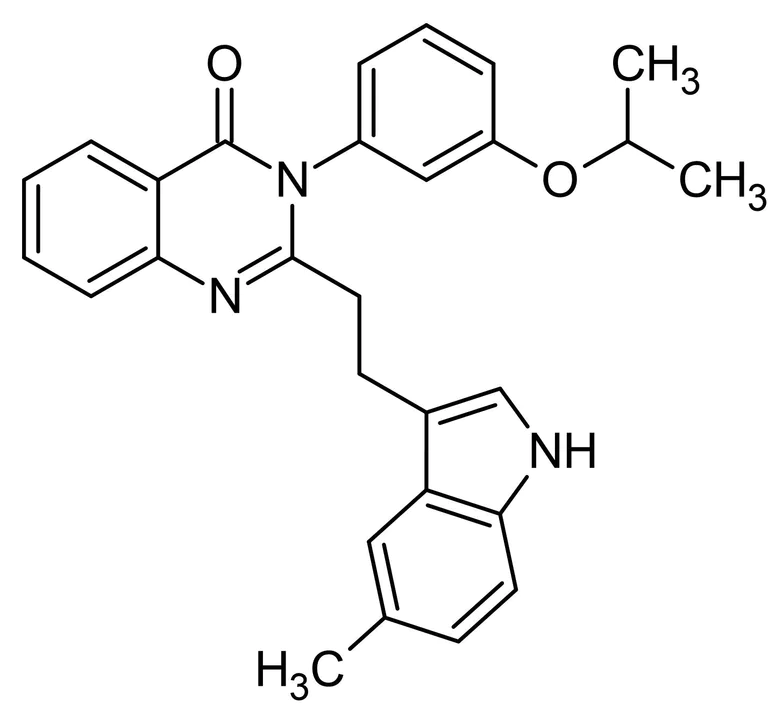
Chemical Structure - LY 225910, CCK2 receptor antagonist (AB141320)
  • Chemical Structure

Lab

Chemical Structure - LY 225910, CCK2 receptor antagonist (AB141320)

2D chemical structure image of ab141320, LY 225910, CCK2 receptor antagonist

Key facts

CAS number

133040-77-4

Purity

>99%

Form

Solid

form

Formulation

Constituents: 100% 2-[2-(5-Bromo-1H-indol-3-yl)ethyl]-3-[3-(1-methylethoxy )phenyl]-4-(3H)-quinazolinone

Molecular weight

502.4 Da

Molecular formula

C<sub>2</sub><sub>7</sub>H<sub>2</sub><sub>4</sub>BrN<sub>3</sub>O<sub>2</sub>

PubChem

4355450

Nature

Synthetic

Solubility

Soluble in DMSO to 100 mM

Biochemical name

2-[2-(5-Bromo-1H-indol-3-YL)ethyl]-3-[3-(1-methylethoxy)phenyl]-4-(3H)-quinazolinone

Biological description

Potent, selective CCK2 receptor antagonist (IC50 = 9.3 nM). Shows anxiolytic effects in vivo.

Canonical smiles

CC(C)OC1=CC=CC(=C1)N2C(=NC3=CC=CC=C3C2=O)CCC4=CNC5=C4C=C(C=C5)Br

InChi

InChI=1S/C27H24BrN3O2/c1-17(2)33-21-7-5-6-20(15-21)31-26(30-25-9-4-3-8-22(25)27(31)32)13-10-18-16-29-24-12-11-19(28)14-23(18)24/h3-9,11-12,14-17,29H,10,13H2,1-2H3

InChiKey

KUECXUACQOYKNB-UHFFFAOYSA-N

IUPAC Name

2-[2-(5-bromo-1H-indol-3-yl)ethyl]-3-(3-propan-2-yloxyphenyl)quinazolin-4-one

Properties and storage information

Shipped at conditions
Ambient - Can Ship with Ice
Appropriate short-term storage conditions
-20°C
Appropriate long-term storage conditions
-20°C
Storage information
Store under desiccating conditions|The product can be stored for up to 12 months
Handling instructions

Need more advice on solubility, usage and handling? Please visit our our product support page for more details.

|

Wherever possible, you should prepare and use solutions on the same day. However, if you need to make up stock solutions in advance, we recommend that you store the solution as aliquots in tightly sealed vials at -20°C. Generally, these will be useable for up to one month. Before use, and prior to opening the vial we recommend that you allow your product to equilibrate to room temperature for at least 1 hour.

|

Toxic, refer to SDS for further information.

Supplementary information

This supplementary information is collated from multiple sources and compiled automatically.

Cytochrome P450 3A4 commonly known as CYP3A4 functions as an enzyme in the cytochrome P450 family playing a vital role in metabolizing drugs and xenobiotics. It acts by oxidizing small organic molecules such as drugs so they can be more easily excreted from the body. The molecular mass of CYP3A4 is approximately 57 kDa. This enzyme is expressed mainly in the liver and small intestine where it contributes to the first-pass metabolism of a wide range of compounds.
Biological function summary

Cytochrome P450 3A4 participates in the metabolism of endogenous and exogenous substances such as steroids and xenobiotics being the most active isoform in humans. It works within a larger enzyme complex that includes NADPH-cytochrome P450 reductase to facilitate electron transfer during oxidation reactions. This integration makes CYP3A4 essential for fine-tuning the concentration of various bioactive molecules helping to maintain homeostasis.

Pathways

CYP3A4 is involved in the drug metabolism pathway and the steroid hormone biosynthesis pathway. In the drug metabolism pathway it plays a major role where it assists in detoxifying numerous pharmaceuticals modifying the chemical structure to facilitate their removal. Related proteins in this context include CYP1A2 and CYP2D6 which also engage in drug metabolism but have different substrate specificities. The enzyme's role in steroid hormone biosynthesis further highlights its importance in maintaining hormonal balance.

Mutations or polymorphisms in CYP3A4 can impact drug efficacy and safety relating to disorders such as drug-induced liver injury and certain cancers. Variability in CYP3A4 activity can lead to ineffective drug metabolism contributing to toxicity or therapeutic failure. The enzyme is also connected to CCK2 receptors where their interaction might affect drug metabolism and response particularly for drugs targeting gastrointestinal or neurological systems.

Product protocols

Publications (1)

Recent publications for all applications. Explore the full listand refine your search

Scientific reports 7:12413 PubMed28963554

2017

CCK reduces the food intake mainly through CCK1R in Siberian sturgeon (Acipenser baerii Brandt).

Applications

Unspecified application

Species

Unspecified reactive species

Xin Zhang,Ni Tang,Jinwen Qi,Shuyao Wang,Jin Hao,Yuanbing Wu,Hu Chen,Zhengzhi Tian,Bin Wang,Defang Chen,Zhiqiong Li
View all publications

Product promise

We are committed to supporting your work with high-quality reagents, and we're here for you every step of the way. In the unlikely event that one of our products does not perform as expected, you're protected by our Product Promise.
For full details, please see our Terms & Conditions

Please note: All products are 'FOR RESEARCH USE ONLY. NOT FOR USE IN DIAGNOSTIC OR THERAPEUTIC PROCEDURES'.

For licensing inquiries, please contact partnerships@abcam.com