JavaScript is disabled in your browser. Please enable JavaScript to view this website.
AB120397

MRS 1754, A2B antagonist

Be the first to review this product! Submit a review

|

(3 Publications )

MW 486.5 Da, Purity >98%. Selective A2B antagonist (Ki values are 1.97 (hA2B), 403 (hA1), 503 (hA2A), and 570 nM (hA3)). Achieve your results faster with highly validated, pure and trusted compounds.
1 Images
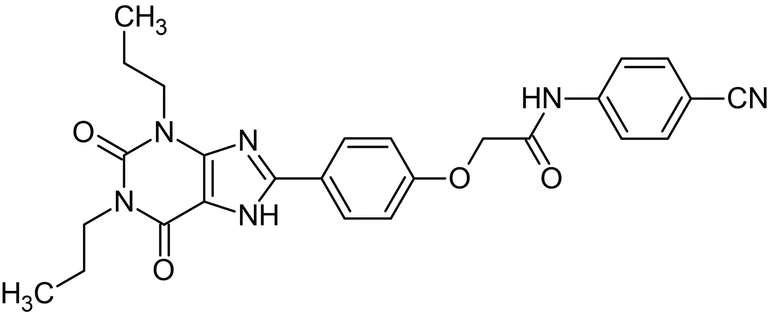
Chemical Structure - MRS 1754, A2B antagonist (AB120397)
  • Chemical Structure

Lab

Chemical Structure - MRS 1754, A2B antagonist (AB120397)

2D chemical structure image of ab120397, MRS 1754, A2B antagonist

Key facts

CAS number

264622-58-4

Purity

>98%

Form

Solid

form

Formulation

Constituents: 100% N-(4-Cyanophenyl)-2-[4-(2,3,6,7-tetrahydro-2,6-dioxo-1,3-dipropyl-1H-purin-8-yl)phenoxy]-acetamide

Molecular weight

486.5 Da

Molecular formula

C<sub>2</sub><sub>6</sub>H<sub>2</sub><sub>6</sub>N<sub>6</sub>O<sub>4</sub>

PubChem

6603931

Nature

Synthetic

Solubility

Soluble in DMSO to 50 mM

Biochemical name

N-(4-cyanophenyl)-2-[4-(2,6-dioxo-1,3-dipropyl-7H-purin-8-yl)phenoxy]acetamide

Biological description

Selective A2B antagonist (Ki values are 1.97 (hA2B), 403 (hA1), 503 (hA2A), and 570 nM (hA3)).

Canonical smiles

CCCN1C2=C(C(=O)N(C1=O)CCC)NC(=N2)C3=CC=C(C=C3)OCC(=O)NC4=CC=C(C=C4)C#N

InChi

InChI=1S/C26H26N6O4/c1-3-13-31-24-22(25(34)32(14-4-2)26(31)35)29-23(30-24)18-7-11-20(12-8-18)36-16-21(33)28-19-9-5-17(15-27)6-10-19/h5-12H,3-4,13-14,16H2,1-2H3,(H,28,33)(H,29,30)

InChiKey

AJBBEYXFRYFVNM-UHFFFAOYSA-N

IUPAC Name

N-(4-cyanophenyl)-2-[4-(2,6-dioxo-1,3-dipropyl-7H-purin-8-yl)phenoxy]acetamide

Properties and storage information

Shipped at conditions
Ambient - Can Ship with Ice
Appropriate short-term storage conditions
Ambient
Appropriate long-term storage conditions
Ambient
Storage information
Store under desiccating conditions|The product can be stored for up to 12 months
Handling instructions

Need more advice on solubility, usage and handling? Please visit our our product support page for more details.

|

Wherever possible, you should prepare and use solutions on the same day. However, if you need to make up stock solutions in advance, we recommend that you store the solution as aliquots in tightly sealed vials at -20°C. Generally, these will be useable for up to one month. Before use, and prior to opening the vial we recommend that you allow your product to equilibrate to room temperature for at least 1 hour.

|

Refer to SDS for further information.

Supplementary information

This supplementary information is collated from multiple sources and compiled automatically.

The adenosine receptor family includes four subtypes: Adenosine A1 Receptor Adenosine Receptor A2a Adenosine A3 Receptor (A3AR) and Adenosine A2b Receptor (ADORA2B). These receptors are G protein-coupled receptors (GPCRs) that each have distinct roles in cellular signaling. They bind adenosine a nucleoside and trigger various downstream effects. For example these receptors are integral to the regulation of myocardial oxygen consumption and cerebral blood flow. They are most commonly expressed in the central nervous system but also show presence in peripheral tissues. Each receptor subtype varies in molecular mass which can influence its interaction with ligands.
Biological function summary

These receptors modulate a wide array of physiological functions. As parts of receptor complexes they influence neurotransmission inflammation and immune responses. Specifically adenosine acts through these receptors to inhibit neurotransmitter release in the brain providing a neuroprotective effect under stress conditions. Adenosine A2a Receptor is known to play a role in vasodilation and immune cell regulation while A3AR has implications in both cardioprotection and cancer biology. These receptors function collectively and independently facilitating cellular communication and maintaining homeostasis.

Pathways

These receptors engage in important signaling cascades such as the cyclic AMP (cAMP) pathway where they either inhibit or stimulate cAMP production through different G proteins. They also participate in MAPK and PI3K/Akt pathways which are critical for cell survival and proliferation. Adenosine Receptor A2a is often studied in relation to dopamine D2 receptors highlighting its role in neuromodulation and potential therapeutic targets for neurological disorders.

Dysfunction of adenosine receptors links to several conditions including cardiovascular diseases and neurological disorders. Changes in adenosine A1 Receptor activity can influence ischemic brain injury recovery while irregularities in Adenosine Receptor A2a activity are associated with chronic inflammatory diseases like asthma. Adenosine receptor activity connects to these diseases through interaction with toll-like receptors and cytokines illustrating an interplay between adenosine signaling and immune response.

Product protocols

Publications (3)

Recent publications for all applications. Explore the full listand refine your search

Journal of cell science 133: PubMed32079656

2020

Increased host ATP efflux and its conversion to extracellular adenosine is crucial for establishing infection.

Applications

Unspecified application

Species

Unspecified reactive species

Moumita Basu,Purnima Gupta,Ananya Dutta,Kuladip Jana,Anindita Ukil

Journal of cellular physiology 234:11360-11368 PubMed30565699

2018

MRS1754 inhibits proliferation and migration of bladder urothelial carcinoma by regulating mitogen-activated protein kinase pathway.

Applications

Unspecified application

Species

Unspecified reactive species

Yihong Zhou,Xi Chu,Ye Yi,Zheng Hao,Xiaoping Zheng,Tang Yuxin,Yingbo Dai

Biochemical and biophysical research communication 497:850-856 PubMed29454963

2018

Adenosine receptors enhance the ATP-induced odontoblastic differentiation of human dental pulp cells.

Applications

Unspecified application

Species

Unspecified reactive species

Xiaosong Yi,Wei Wang,Qiufei Xie
View all publications

Product promise

We are committed to supporting your work with high-quality reagents, and we're here for you every step of the way. In the unlikely event that one of our products does not perform as expected, you're protected by our Product Promise.
For full details, please see our Terms & Conditions

Please note: All products are 'FOR RESEARCH USE ONLY. NOT FOR USE IN DIAGNOSTIC OR THERAPEUTIC PROCEDURES'.

For licensing inquiries, please contact partnerships@abcam.com