PugNAc, hexosaminidase A and B inhibitor
Be the first to review this product! Submit a review
|
(5 Publications )
MW 353.33 Da, Purity >98%. Potent O-GlcNAcase, hexosaminidase A and B inhibitor (IC50 values are 6, 25, 35 and 46 nM for β-hexosaminidase, HeX A/B, hOGA and OGA respectively). Decreases GLUT4 translocation and insulin-stimulated 2-deoxyglucose uptake in adipocytes. Shows antiapoptotic effects.
View Alternative Names
Mannose 6-phosphate-uncovering enzyme, N-acetylglucosamine-1-phosphodiester alpha-N-acetylglucosaminidase, NAGPA_HUMAN, Phosphodiester alpha-GlcNAcase
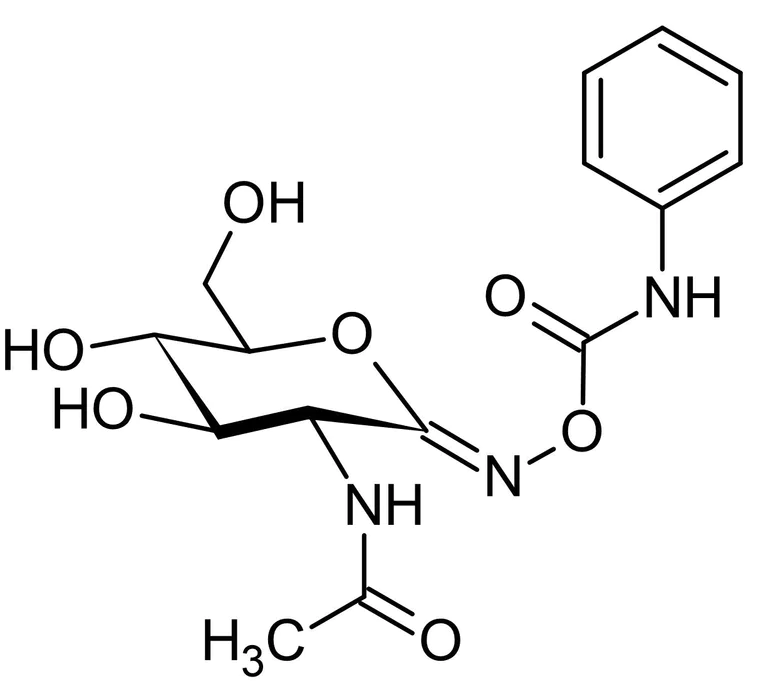
- Chemical Structure
Lab
Chemical Structure - PugNAc, hexosaminidase A and B inhibitor (AB144670)
2D chemical structure image of ab144670, PugNAc, hexosaminidase A and B inhibitor
Complementary Products
Primary Antibodies
AB182858
Anti-Bcl-2 antibody [EPR17509]
BOND RX™ Validated|RabMAb|Recombinant|KO Validated|20ul selling size

- 5
- 13
Primary Antibodies
AB207305
Anti-SQSTM1 / p62 antibody [EPR18351] - Autophagosome Marker
20ul selling size|KO Validated|RabMAb|Recombinant|Lab Essentials|Trial Size

- 5
- 3
Properties and storage information
Shipped at conditions
Appropriate short-term storage conditions
Appropriate long-term storage conditions
Storage information
Handling instructions
Need more advice on solubility, usage and handling? Please visit our our product support page for more details.
|
Wherever possible, you should prepare and use solutions on the same day. However, if you need to make up stock solutions in advance, we recommend that you store the solution as aliquots in tightly sealed vials at -20°C. Generally, these will be useable for up to one month. Before use, and prior to opening the vial we recommend that you allow your product to equilibrate to room temperature for at least 1 hour.
Supplementary information
This supplementary information is collated from multiple sources and compiled automatically.
Biological function summary
NAGPA participates in the formation and processing of mannose-6-phosphate recognition markers essential for lysosomal protein targeting. It functions independently rather than as part of a multi-protein complex. The enzyme helps remove a N-acetylglucosamine (GlcNAc) group exposing the mannose-6-phosphate which is a critical step required for lysosomal enzymes to be recognized and transported to the lysosome.
Pathways
Which include NAGPA the enzyme plays a significant role in the lysosomal enzyme targeting pathway and glycoprotein metabolic processes. The mannose-6-phosphate pathway is important for directing enzymes to lysosomes requiring precise interaction between NAGPA and the phosphotransferase proteins responsible for initial phosphorylation. Its regulatory actions ensure lysosomal enzymes are properly targeted and activated.
Publications (5)
Recent publications for all applications. Explore the full list and refine your search
Molecular medicine (Cambridge, Mass.) 31:228 PubMed40495163
2025
Applications
Unspecified application
Species
Unspecified reactive species
Scientific reports 14:24369 PubMed39420031
2024
Applications
Unspecified application
Species
Unspecified reactive species
Heliyon 9:e22916 PubMed38144265
2023
Applications
Unspecified application
Species
Unspecified reactive species
Cell death and differentiation 29:1970-1981 PubMed35422493
2022
Applications
Unspecified application
Species
Unspecified reactive species
Cell metabolism 33:598-614.e7 PubMed33592173
2021
Applications
Unspecified application
Species
Unspecified reactive species
Product promise
Please note: All products are 'FOR RESEARCH USE ONLY. NOT FOR USE IN DIAGNOSTIC OR THERAPEUTIC PROCEDURES'.
For licensing inquiries, please contact partnerships@abcam.com