JavaScript is disabled in your browser. Please enable JavaScript to view this website.
AB141421

QVD-OPh, caspase inhibitor

5

(1 Review)

|

(10 Publications )
MW 513.5 Da, Purity >95%. Achieve your results faster with highly validated, pure and trusted compounds.
1 Images
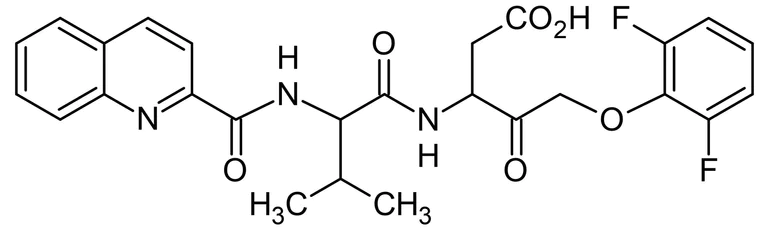
Chemical Structure - QVD-OPh, caspase inhibitor (AB141421)
  • Chemical Structure

Lab

Chemical Structure - QVD-OPh, caspase inhibitor (AB141421)

2D chemical structure image of ab141421, QVD-OPh, caspase inhibitor

Key facts

Purity

>95%

Formulation

Constituents: 100% QVD-OPh

Molecular weight

513.5 Da

Molecular formula

C<sub>2</sub><sub>6</sub>H<sub>2</sub><sub>5</sub>F<sub>2</sub>N<sub>3</sub>O<sub>6</sub>

PubChem

11237609

Nature

Synthetic

Solubility

Soluble in DMSO to 100 mM

Biochemical name

CID 11237609

Canonical smiles

CC(C)C(C(=O)NC(CC(=O)O)C(=O)COC1=C(C=CC=C1F)F)NC(=O)C2=NC3=CC=CC=C3C=C2

InChi

InChI=1S/C26H25F2N3O6/c1-14(2)23(31-25(35)19-11-10-15-6-3-4-9-18(15)29-19)26(36)30-20(12-22(33)34)21(32)13-37-24-16(27)7-5-8-17(24)28/h3-11,14,20,23H,12-13H2,1-2H3,(H,30,36)(H,31,35)(H,33,34)

InChiKey

OOBJCYKITXPCNS-UHFFFAOYSA-N

IUPAC Name

5-(2,6-difluorophenoxy)-3-[[3-methyl-2-(quinoline-2-carbonylamino)butanoyl]amino]-4-oxopentanoic acid

Product details

This product is manufactured by BioVision, an Abcam company and was previously called 1170 Q-VD-OPh. 1170-5 is the same size as the 5 mg size of ab141421.

Properties and storage information

Shipped at conditions
Ambient - Can Ship with Ice
Appropriate short-term storage conditions
-20°C
Appropriate long-term storage conditions
-20°C
Storage information
Store under desiccating conditions|The product can be stored for up to 12 months
Handling instructions

Need more advice on solubility, usage and handling? Please visit our our product support page for more details.

|

Wherever possible, you should prepare and use solutions on the same day. However, if you need to make up stock solutions in advance, we recommend that you store the solution as aliquots in tightly sealed vials at -20°C. Generally, these will be useable for up to one week. Before use, and prior to opening the vial we recommend that you allow your product to equilibrate to room temperature for at least 1 hour.

Product protocols

Publications (10)

Recent publications for all applications. Explore the full listand refine your search

Scientific reports 15:13377 PubMed40251208

2025

Caerin 1.1 and 1.9 peptides induce acute caspase 3/GSDME-mediated pyroptosis in epithelial cancer cells.

Applications

Unspecified application

Species

Unspecified reactive species

Yuandong Luo,Junjie Li,Quanlan Fu,Pingping Zhang,Xinyi Song,Mengqi Liu,Rongmi Mo,Jiawei Fu,Shuxian Tang,Jialing Wu,Xiaodan Yang,Xiaosong Liu,Tianfang Wang,Guoying Ni

JCI insight 10: PubMed40059828

2025

Altered inflammatory mucosal signatures within their spatial and cellular context during active ileal Crohn's disease.

Applications

Unspecified application

Species

Unspecified reactive species

Vasantha L Kolachala,Sushma Chowdary Maddipatla,Shanta Murthy,Yeonjoo Hwang,Anne F Dodd,Garima Sharma,Sachith Munasinghe,Ranjit Singh Pelia,Suresh Venkateswaran,Murugadas Anbazhagan,Tarun Koti,Navdeep Jhita,Gaurav N Joshi,Chrissy A Lopez,Duke Geem,Hong Yin,David J Cutler,Peng Qiu,Jason D Matthews,Subra Kugathasan

Science (New York, N.Y.) 382:eadg2253 PubMed37797010

2023

PIM1 controls GBP1 activity to limit self-damage and to guard against pathogen infection.

Applications

Unspecified application

Species

Unspecified reactive species

Daniel Fisch,Moritz M Pfleiderer,Eleni Anastasakou,Gillian M Mackie,Fabian Wendt,Xiangyang Liu,Barbara Clough,Samuel Lara-Reyna,Vesela Encheva,Ambrosius P Snijders,Hironori Bando,Masahiro Yamamoto,Andrew D Beggs,Jason Mercer,Avinash R Shenoy,Bernd Wollscheid,Kendle M Maslowski,Wojtek P Galej,Eva-Maria Frickel

Oncotarget 14:637-649 PubMed37343056

2023

Diphenyl ditelluride anticancer activity and DNA topoisomerase I poisoning in human colon cancer HCT116 cells.

Applications

Unspecified application

Species

Unspecified reactive species

André Luiz Mendes Juchem,Cristiano Trindade,Juliana Bondan da Silva,Miriana da Silva Machado,Temenouga Nikolova Guecheva,Jaqueline Cesar Rocha,Jenifer Saffi,Iuri Marques de Oliveira,João Antonio Pêgas Henriques,Alexandre Escargueil

Scientific reports 10:17589 PubMed33067541

2020

Caspase inhibition rescues F1Fo ATP synthase dysfunction-mediated dendritic spine elimination.

Applications

Unspecified application

Species

Unspecified reactive species

Hao Chen,Jing Tian,Lan Guo,Heng Du

Cell death & disease 11:483 PubMed32587235

2020

A small-molecule ARTS mimetic promotes apoptosis through degradation of both XIAP and Bcl-2.

Applications

Unspecified application

Species

Unspecified reactive species

Dana Mamriev,Ruqaia Abbas,Franca-Maria Klingler,Juliana Kagan,Nir Kfir,Alastair Donald,Keren Weidenfeld,David W Sheppard,Dalit Barkan,Sarit Larisch

Cell reports 29:225-235.e5 PubMed31577952

2019

PINK1/Parkin Influences Cell Cycle by Sequestering TBK1 at Damaged Mitochondria, Inhibiting Mitosis.

Applications

Unspecified application

Species

Unspecified reactive species

Shireen A Sarraf,Dionisia P Sideris,Nikolaos Giagtzoglou,Lina Ni,Mark W Kankel,Anindya Sen,Lauren E Bochicchio,Chiu-Hui Huang,Samuel C Nussenzweig,Stuart H Worley,Paul D Morton,Spyros Artavanis-Tsakonas,Richard J Youle,Alicia M Pickrell

The EMBO journal 38:e100926 PubMed31268602

2019

Human GBP1 is a microbe-specific gatekeeper of macrophage apoptosis and pyroptosis.

Applications

Unspecified application

Species

Unspecified reactive species

Daniel Fisch,Hironori Bando,Barbara Clough,Veit Hornung,Masahiro Yamamoto,Avinash R Shenoy,Eva-Maria Frickel

Cell chemical biology 24:471-480.e4 PubMed28366621

2017

Rescue of Pink1 Deficiency by Stress-Dependent Activation of Autophagy.

Applications

Unspecified application

Species

Unspecified reactive species

Yuxi Zhang,David T Nguyen,Ellen M Olzomer,Gin P Poon,Nicholas J Cole,Anita Puvanendran,Brigitte R Phillips,Daniel Hesselson

World journal of gastroenterology 22:6509-19 PubMed27605885

2016

c-Jun N-terminal kinase-mediated Rubicon expression enhances hepatocyte lipoapoptosis and promotes hepatocyte ballooning.

Applications

Unspecified application

Species

Unspecified reactive species

Akiko Suzuki,Keisuke Kakisaka,Yuji Suzuki,Ting Wang,Yasuhiro Takikawa
View all publications

Product promise

We are committed to supporting your work with high-quality reagents, and we're here for you every step of the way. In the unlikely event that one of our products does not perform as expected, you're protected by our Product Promise.
For full details, please see our Terms & Conditions

Please note: All products are 'FOR RESEARCH USE ONLY. NOT FOR USE IN DIAGNOSTIC OR THERAPEUTIC PROCEDURES'.

For licensing inquiries, please contact partnerships@abcam.com