JavaScript is disabled in your browser. Please enable JavaScript to view this website.
AB146588

Staurosporine (DMSO solution), protein kinase inhibitor

Be the first to review this product! Submit a review

|

(7 Publications )

Potent, cell-permeable, broad spectrum inhibitor of protein kinases. Kinases inhibited include: protein kinase C (PKC)(IC50 = 3 nM), cAMP-dependent protein kinase (IC50 = 8 nM) and p60v-src (IC50 = 6 nM). MW 466.5.

- Potent inhibitor of phospholipid- and calcium-dependent protein kinase
1 Images
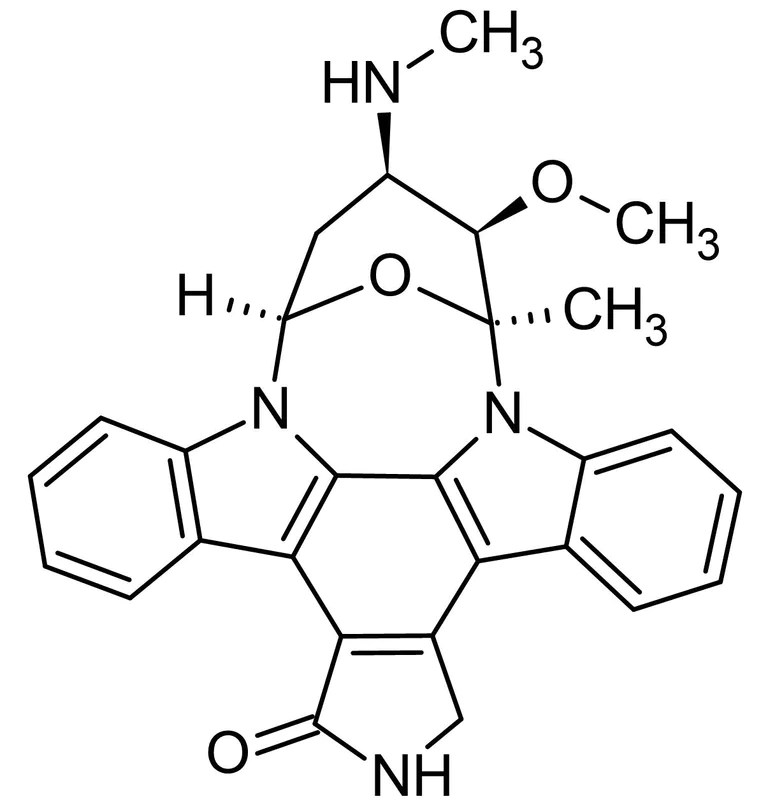
Chemical Structure - Staurosporine (DMSO solution), protein kinase inhibitor (AB146588)
  • Chemical Structure

Lab

Chemical Structure - Staurosporine (DMSO solution), protein kinase inhibitor (AB146588)

2D chemical structure image of ab146588, Staurosporine (DMSO solution), protein kinase inhibitor

Key facts

CAS number

62996-74-1

Purity

>98%

Form

Liquid

form

Formulation

Constituents: 70.2% Dimethylsulfoxide, 29.8% Staurosporine

Molecular weight

466.5 Da

Molecular formula

C<sub>2</sub><sub>8</sub>H<sub>2</sub><sub>6</sub>N<sub>4</sub>O<sub>3</sub>

PubChem

44259

Nature

Synthetic

Biochemical name

Staurosporine

Biological description

Potent, cell-permeable, broad spectrum inhibitor of protein kinases. Kinases inhibited include: protein kinase C (IC50 = 3 nM), cAMP-dependent protein kinase (IC50 = 8 nM) and p60v-src (IC50 = 6 nM).

Canonical smiles

CC12C(C(CC(O1)N3C4=CC=CC=C4C5=C6C(=C7C8=CC=CC=C8N2C7=C53)CNC6=O)NC)OC

Isomeric smiles

C[C@@]12[C@@H]([C@@H](C[C@@H](O1)N3C4=CC=CC=C4C5=C6C(=C7C8=CC=CC=C8N2C7=C53)CNC6=O)NC)OC

InChi

InChI=1S/C28H26N4O3/c1-28-26(34-3)17(29-2)12-20(35-28)31-18-10-6-4-8-14(18)22-23-16(13-30-27(23)33)21-15-9-5-7-11-19(15)32(28)25(21)24(22)31/h4-11,17,20,26,29H,12-13H2,1-3H3,(H,30,33)/t17-,20-,26-,28+/m1/s1

InChiKey

HKSZLNNOFSGOKW-FYTWVXJKSA-N

IUPAC Name

(2S,3R,4R,6R)-3-methoxy-2-methyl-4-(methylamino)-29-oxa-1,7,17-triazaoctacyclo[12.12.2.12,6.07,28.08,13.015,19.020,27.021,26]nonacosa-8,10,12,14,19,21,23,25,27-nonaen-16-one

Concentration

1 mM

Product details

Check out our range of Protein kinase inhibitor biochemicals here

Properties and storage information

Shipped at conditions
Ambient - Can Ship with Ice
Appropriate short-term storage conditions
-20°C
Appropriate long-term storage conditions
-20°C
Storage information
Store in the dark|Store under desiccating conditions|This product is air and light sensitive and impurities can occur as a result of air oxidation or due to metabolism by microbes
Handling instructions

Need more advice on solubility, usage and handling? Please visit our our product support page for more details.

|

Wherever possible, you should prepare and use solutions on the same day. However, if you need to make up stock solutions in advance, we recommend that you store the solution as aliquots in tightly sealed vials at -20°C. Generally, these will be useable for up to one month. Before use, and prior to opening the vial we recommend that you allow your product to equilibrate to room temperature for at least 1 hour.

|

Toxic, refer to SDS for further information.

Supplementary information

This supplementary information is collated from multiple sources and compiled automatically.

PKC isoforms associate with cancer and cardiovascular diseases. PKC epsilon often links with cancer progression particularly breast and lung cancers by interacting with oncogenes that promote tumor growth. PKC beta 2 shows connections with metabolic disorders especially in the context of cardiac dysfunction. Disease links may involve other proteins such as Src kinase which interacts with PKC pathways affecting cell motility and survival in cancerous conditions. Understanding these relationships aids in developing therapeutic strategies targeting PKC-related pathways in disease treatment.
Pathways

Several PKC isoforms engage critical cell signaling pathways such as the MAPK/ERK pathway and the PI3K/AKT pathway. In these pathways PKCs modulate various downstream effectors coordinating signals that influence gene expression and cell survival. PKC delta has significant associations with the MAPK cascade while PKC theta interacts closely with PI3K. These interactions are necessary for linking external signals to intracellular responses thereby acting as converging points for signaling pathways impacting multiple cellular functions.

Biological function summary

PKC isoforms regulate cellular functions like proliferation differentiation and apoptosis. These proteins are part of larger signaling complexes participating in dynamic equilibrium states that determine cellular fate. For example PKC epsilon often interacts within complexes modulating oncogenic pathways while PKC beta 2 plays roles in immune response modulation. The distinct expression patterns and interactions of these isoforms enable them to assume specific biological roles in different tissues.

Protein kinase C (PKC) is a family of serine/threonine kinases essential in cellular signaling. The PKC family includes several isoforms such as PKC delta PKC epsilon PKC beta 2 PKC gamma and PKC theta (also known as PRKCQ). These proteins exhibit diverse molecular masses ranging from about 78 kDa to 82 kDa. PKCs are broadly expressed in various tissues and cells particularly in the brain heart and immune cells. PKC isoforms play significant mechanical roles by phosphorylating various substrate proteins influencing various cellular processes.

Product protocols

Publications (7)

Recent publications for all applications. Explore the full listand refine your search

The Journal of general virology 106: PubMed39928567

2025

The EMCV protein 2B* is required for efficient cell lysis via both caspase-3-dependent and -independent pathways during infection.

Applications

Unspecified application

Species

Unspecified reactive species

Samantha K Nguyen,Edward Long,James R Edgar,Andrew E Firth,Hazel Stewart

Aging 15:14172-14191 PubMed38095632

2023

Gypenoside IX restores Akt/GSK-3β pathway and alleviates Alzheimer's disease-like neuropathology and cognitive deficits.

Applications

Unspecified application

Species

Unspecified reactive species

Ling Lei,Yong Luo,Dongkun Kang,Fumin Yang,Dongli Meng,Jian-Zhi Wang,Rong Liu,Xiaochuan Wang,Hong-Lian Li

NPJ systems biology and applications 8:46 PubMed36443335

2022

Protein painting reveals pervasive remodeling of conserved proteostasis machinery in response to pharmacological stimuli.

Applications

Unspecified application

Species

Unspecified reactive species

Dezerae Cox,Angelique R Ormsby,Gavin E Reid,Danny M Hatters

NAR genomics and bioinformatics 4:lqac065 PubMed36110898

2022

A high-throughput 384-well CometChip platform reveals a role for 3-methyladenine in the cellular response to etoposide-induced DNA damage.

Applications

Unspecified application

Species

Unspecified reactive species

Jianfeng Li,Alison Beiser,Nupur B Dey,Shunichi Takeda,Liton Kumar Saha,Kouji Hirota,L Lynette Parker,Mariah Carter,Martha I Arrieta,Robert W Sobol

Journal of cell science 135: PubMed35274124

2022

Piezo1 activation attenuates thrombin-induced blebbing in breast cancer cells.

Applications

Unspecified application

Species

Unspecified reactive species

Paul O'Callaghan,Adam Engberg,Olle Eriksson,Nikos Fatsis-Kavalopoulos,Christina Stelzl,Gonzalo Sanchez,Olof Idevall-Hagren,Johan Kreuger

Cell reports 26:3323-3335.e4 PubMed30893604

2019

DBC1 Regulates p53 Stability via Inhibition of CBP-Dependent p53 Polyubiquitination.

Applications

Unspecified application

Species

Unspecified reactive species

Oluwatoyin E Akande,Priyadarshan K Damle,Marius Pop,Nicholas E Sherman,Barbara B Szomju,Larisa V Litovchick,Steven R Grossman

PloS one 13:e0206801 PubMed30395621

2018

Mutant myocilin impacts sarcomere ultrastructure in mouse gastrocnemius muscle.

Applications

Unspecified application

Species

Unspecified reactive species

Jeffrey M Lynch,Andrew J Dolman,Chenying Guo,Katie Dolan,Chuanxi Xiang,Samir Reda,Bing Li,Ganesh Prasanna
View all publications

Product promise

We are committed to supporting your work with high-quality reagents, and we're here for you every step of the way. In the unlikely event that one of our products does not perform as expected, you're protected by our Product Promise.
For full details, please see our Terms & Conditions

Please note: All products are 'FOR RESEARCH USE ONLY. NOT FOR USE IN DIAGNOSTIC OR THERAPEUTIC PROCEDURES'.

For licensing inquiries, please contact partnerships@abcam.com