Human LDHB (Lactate Dehydrogenase B) knockout HEK-293T cell line
- Advanced Validation
- What is this?
Be the first to review this product! Submit a review
|
(0 Publication)
- WB
Lab
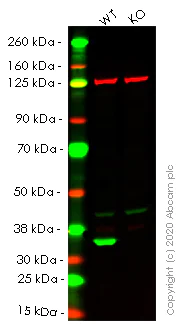
Western blot - Human LDHB (Lactate Dehydrogenase B) knockout HEK-293T cell line (AB255403)
Lanes 1- 2 : Merged signal (red and green). Green - ab53292 observed at 37 kDa. Red - Anti-Vinculin antibody [VIN-54] observed at 124 kDa.
ab53292 was shown to react with Lactate Dehydrogenase B/LDH-B in wild-type HEK-293T cells in western blot. Loss of signal was observed when knockout cell line ab255403 (knockout cell lysate ab263761) was used. Wild-type HEK-293T and LDHB knockout HEK-293T cell lysates were subjected to SDS-PAGE. Membrane was blocked for 1 hour at room temperature in 0.1% TBST with 3% non-fat dried milk. ab53292 and Anti-Vinculin antibody [VIN-54] overnight at 4° at a 1 in 5000 dilution and a 1 in 20000 dilution respectively. Blots were developed with Goat anti-Rabbit IgG H&L (IRDye®800CW) preadsorbed (ab216773) and Goat anti-Mouse IgG H&L (IRDye®680RD) preadsorbed (ab216776) secondary antibodies at 1 in 20000 dilution for 1 hour at room temperature before imaging.
All lanes:
Western blot - Anti-Lactate Dehydrogenase B/LDH-B antibody [EP1565Y] (<a href='/en-us/products/primary-antibodies/lactate-dehydrogenase-b-ldh-b-antibody-ep1565y-ab53292'>ab53292</a>) at 1/5000 dilution
Lane 1:
Wild-type HEK-293T cell lysate at 20 µg
Lane 2:
LDHB knockout HEK-293T cell lysate at 20 µg
Lane 2:
Western blot - Human LDHB (Lactate Dehydrogenase B) knockout HEK-293T cell line (ab255403)
Predicted band size: 37 kDa
Observed band size: 37 kDa
false

- Sanger seq
Unknown
Sanger Sequencing - Human LDHB (Lactate Dehydrogenase B) knockout HEK-293T cell line (AB255403)
Homozygous : 1 bp insertion in exon 2
Complementary Products
Primary Antibodies
AB312318
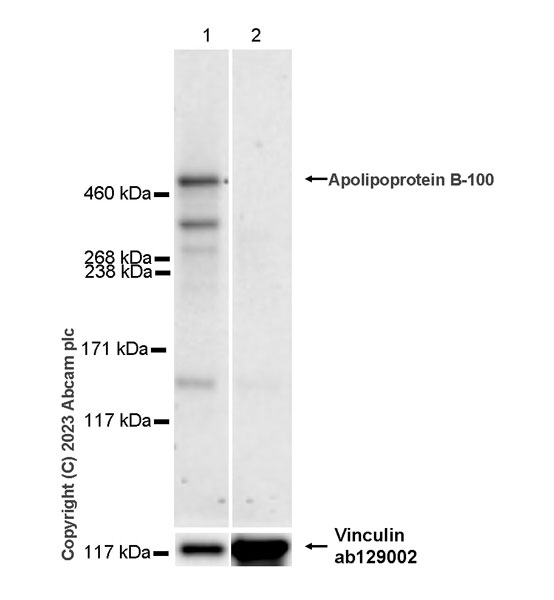
Anti-Apolipoprotein B antibody [EPR27473-49]
20ul selling size|RabMAb|Recombinant
- 0
- 0
Reactivity data
Product details
We will provide viable cells that proliferate on revival.
This product is subject to limited use licenses from The Broad Institute, ERS Genomics Limited and Sigma-Aldrich Co. LLC, and is developed with patented technology. For full details of the licenses and patents please refer to our limited use license and patent pages.
What's included?
Properties and storage information
Gene name
Gene editing type
Gene editing method
Knockout validation
Zygosity
Quality control - STR analysis
Shipped at conditions
Appropriate short-term storage conditions
Appropriate long-term storage conditions
Supplementary information
This supplementary information is collated from multiple sources and compiled automatically.
Biological function summary
LDH-B is essential for cellular energy production processes. It catalyzes the conversion of pyruvate a byproduct of glycolysis into lactate while simultaneously converting NADH to NAD+. This reaction is significant under anaerobic conditions where mitochondria-based ATP production is limited. LDH-B does not function alone and can operate as part of the lactate dehydrogenase complex containing different subunit combinations.
Pathways
Lactate and pyruvate metabolism engage LDH-B facilitating the Cori cycle and the lactate shuttle. These pathways enable lactate transport between tissues such as muscle and liver and they are important in maintaining blood glucose levels and energy balance. LDH-B operates alongside its related isoenzymes such as LDH-A which predominantly act in specific tissues and conditions to optimize energy utilization.
Cell culture
Biosafety level
EU: 2 US: 2
Adherent/suspension
Adherent
Gender
Female
Initial handling guidelines
Upon arrival, the vial should be stored in liquid nitrogen vapor phase and not at -80°C. Storage at -80°C may result in loss of viability. <p>1. Thaw the vial in 37°C water bath for approximately 1-2 minutes.<br>2. Transfer the cell suspension (0.8 mL) to a 15 mL/50 mL conical sterile polypropylene centrifuge tube containing 8.4 mL pre-warmed culture medium, wash vial with an additional 0.8 mL culture medium (total volume 10 mL) to collect remaining cells, and centrifuge at 201 x g (rcf) for 5 minutes at room temperature. 10 mL represents minimum recommended dilution. 20 mL represents maximum recommended dilution.<br>3. Resuspend the cell pellet in 5 mL pre-warmed culture medium and count using a haemocytometer or alternative cell counting method seed all remaining cells into a T25.<br>4. Incubate the culture at 37°C incubator with 5% CO<sub>2</sub>. Check the culture one day after revival and continue to check until 80% confluent. Media change can be given if needed.<br>5. Once confluent passage into an appropriate flask at a density of 2x10<sup>4</sup> cells/cm<sup>2</sup>. Seeding density is given as a guide only and should be scaled to align with individual lab schedules. Cultures should be monitored daily.</p>
Subculture guidelines
- All seeding densities should be based on cell counts gained by established methods.
- A guide seeding density of 2x10⁴ cells/cm2 is recommended.
- Cells should be passaged when they have achieved 80-90% confluence.
Culture medium
DMEM (High Glucose) + 10% FBS
Cryopreservation medium
Cell Freezing Medium-DMSO Serum free media, contains 8.7% DMSO in MEM supplemented with methyl cellulose.
Target data
Alternative Names
Product promise
Please note: All products are 'FOR RESEARCH USE ONLY. NOT FOR USE IN DIAGNOSTIC OR THERAPEUTIC PROCEDURES'.
For licensing inquiries, please contact partnerships@abcam.com