Human TIA1 knockout A549 cell line
Be the first to review this product! Submit a review
|
(0 Publication)
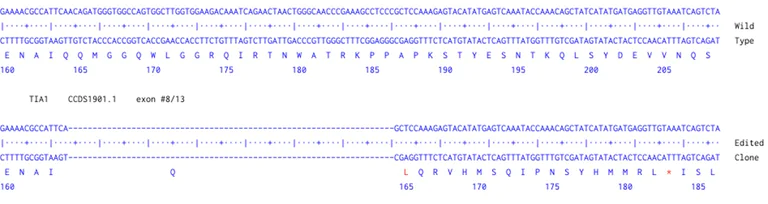
- NGS
Lab
Next Generation Sequencing - Human TIA1 knockout A549 cell line (AB288916)
67 bp deletion after Ile 163 of WT protein
Complementary Products
Primary Antibodies
AB140595
KO Validated|RabMAb|Recombinant|20ul selling size

- 2
- 1


Reactivity data
Product details
Although we aim to provide customers with a homozygous clone, feasibility will be dependent on the biology of the protein. Should only heterozygous edits be achieved, you will be notified of the outcome and be asked to confirm whether the cell line is acceptable. All clones will be accompanied with DNA sequencing data, and the mutation description.
We will provide viable cells that proliferate on revival.
This product is subject to limited use licenses from The Broad Institute and ERS Genomics Limited, and is developed with patented technology. For full details of the limited use licenses and relevant patents please refer to our limited use license and patent pages.
What's included?
Properties and storage information
Gene name
Gene editing type
Gene editing method
Knockout validation
Quality control - STR analysis
Shipped at conditions
Appropriate short-term storage conditions
Appropriate long-term storage conditions
Supplementary information
This supplementary information is collated from multiple sources and compiled automatically.
Biological function summary
TIA1 functions in the assembly of stress granules which are aggregates of proteins and RNAs that form in response to cellular stress. It is part of a complex dynamic system that regulates mRNA translation by directing untranslated mRNAs to stress granules thereby influencing gene expression at the post-transcriptional level. TIA1 is implicated in apoptosis and can bind with other proteins like HuR to affect mRNA stability and translation.
Pathways
TIA1 participates in stress response signaling and apoptotic pathways. It is involved in the regulation of mRNA metabolism playing a critical role in the cellular stress response pathway by modulating the translation and stability of mRNAs during stress. TIA1 interacts with kinases like JNK to mediate these stress responses and works alongside related proteins including G3BP to organize mRNAs into stress granules.
Cell culture
Biosafety level
EU: 1 US: 1
Adherent/suspension
Adherent
Gender
Male
Initial handling guidelines
Upon arrival, the vial should be stored in liquid nitrogen vapor phase and not at -80°C. Storage at -80°C may result in loss of viability. <p>1. Thaw the vial in 37°C water bath for approximately 1-2 minutes.<br>2. Transfer the cell suspension (0.8 mL) to a 15 mL/50 mL conical sterile polypropylene centrifuge tube containing 8.4 mL pre-warmed culture medium, wash vial with an additional 0.8 mL culture medium (total volume 10 mL) to collect remaining cells, and centrifuge at 201 x g (rcf) for 5 minutes at room temperature. 10 mL represents minimum recommended dilution. 20 mL represents maximum recommended dilution.<br>3. Resuspend the cell pellet in 5 mL pre-warmed culture medium and count using a haemocytometer or alternative cell counting method seed all remaining cells into a T25.<br>4. Incubate the culture at 37°C incubator with 5% CO<sub>2</sub>. Check the culture one day after revival and continue to check until 80% confluent. Media change can be given if needed.<br>5. Once confluent passage into an appropriate flask at a density of 2x10<sup>4</sup> cells/cm<sup>2</sup>. Seeding density is given as a guide only and should be scaled to align with individual lab schedules. Cultures should be monitored daily.</p>
Subculture guidelines
- All seeding densities should be based on cell counts gained by established methods.
- A guide seeding density of 2x10⁴ cells/cm2 is recommended.
- Cells should be passaged when they have achieved 80-90% confluence.
- Do not allow the cell density to exceed 7x10⁴ cells/cm2.
Culture medium
F-12K + 10% FBS
Cryopreservation medium
Cell Freezing Medium-DMSO Serum free media, contains 8.7% DMSO in MEM supplemented with methyl cellulose.
Product promise
Please note: All products are 'FOR RESEARCH USE ONLY. NOT FOR USE IN DIAGNOSTIC OR THERAPEUTIC PROCEDURES'.
For licensing inquiries, please contact partnerships@abcam.com