Human ABL1 knockout HeLa cell lysate
Be the first to review this product! Submit a review
|
(0 Publication)

- Sanger seq
Unknown
Sanger Sequencing - Human ABL1 knockout HeLa cell lysate (AB263077)
Allele-2 : 1 bp insertion in exon3

- Sanger seq
Unknown
Sanger Sequencing - Human ABL1 knockout HeLa cell lysate (AB263077)
Allele-1 : 1 bp deletion in exon3
- WB
Lab
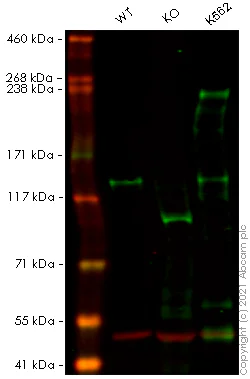
Western blot - Human ABL1 knockout HeLa cell lysate (AB263077)
Lane 1 : Wild-type HeLa cell lysate 20 μg
Lane 2 : ABL1 knockout HeLa cell lysate 20 μg
Lane 3 : K562 cell lysate 20 μg*
Lanes 1 - 3 : Merged signal (red and green). Green - ab254341 observed at 130 kDa. Red - loading control, ab7291 (Mouse anti-Alpha Tubulin [DM1A]) observed at 55 kDa.
ab254341 was shown to react with ABL1 in wild-type HeLa cells in western blot. The bands observed in ABL1 knockout cell line ab265612 (ABL1 knockout cell lysate ab263077) below 130 kDa may represent truncated forms and cleaved fragments. This has not been investigated further. HeLa wild-type and ABL1 knockout cell lysates were subjected to SDS-PAGE. Membranes were blocked in 3% milk in TBS-T (0.1 % Tween®) before incubation with ab254341 and ab7291 (Mouse anti-Alpha Tubulin [DM1A]) overnight at 4°C at a 1 : 1000 dilution and a 1 : 20000 dilution respectively. Blots were incubated with Goat anti-Rabbit IgG H&L (IRDye® 800CW) preabsorbed (ab216773) and Goat anti-Mouse IgG H&L (IRDye® 680RD) preabsorbed (ab216776) secondary antibodies at 1 : 20000 dilution for 1 h at room temperature before imaging.
All lanes:
Western blot - Anti-ABL1 antibody [EPR23406-32] (<a href='/en-us/products/primary-antibodies/abl1-antibody-epr23406-32-ab254341'>ab254341</a>) at 1/1000 dilution
Lane 1:
Wild-type HeLa cell lysate at 20 µg
Lane 2:
Western blot - Human ABL1 knockout HeLa cell lysate (ab263077) at 20 µg
Lane 3:
K562 cell lysate at 20 µg
Predicted band size: 122 kDa
Observed band size: 130 kDa
false
Complementary Products

Primary Antibodies
AB307143
Anti-ABL1 (phospho Y245) antibody [EPR25807-101A] - BSA and Azide free
RabMAb|Recombinant

- 0
- 0
Reactivity data
Product details
Knockout cell lysate achieved by CRISPR/Cas9.
REACH authorisation
Abcam has not and does not intend to apply for the REACH Authorisation of customers' uses of products that contain European Authorisation list (Annex XIV) substances.
It is the responsibility of our customers to check the necessity of application of REACH Authorisation, and any other relevant authorisations, for their intended uses.
Lysate preparation: Our lysates are made using RIPA buffer to which we add a protease inhibitor cocktail and phosphatase inhibitor cocktail (ratio: 300:100:10). This means that the protein of interest is denatured. If you require a native form of the protein please use the live cell version. Please refer to our lysis protocol for further details on how our lysates are prepared.
User storage instructions: Lyophilizate may be stored at 4°C. After reconstitution, store at -20°C for short-term storage or -80°C for long-term storage.
This product is subject to limited use licenses from The Broad Institute, ERS Genomics Limited and Sigma-Aldrich Co. LLC, and is developed with patented technology. For full details of the licenses and patents please refer to our limited use license and patent pages.
What's included?
Properties and storage information
Gene name
Gene editing type
Gene editing method
Knockout validation
Quality control - STR analysis
Shipped at conditions
Appropriate short-term storage conditions
Appropriate long-term storage conditions
Supplementary information
This supplementary information is collated from multiple sources and compiled automatically.
Biological function summary
ABL1 functions by regulating key processes like cell cycle progression actin dynamics and cell adhesion. ABL1 participates as part of larger protein complexes that modulate cellular movement and gene transcription. When activated it phosphorylates a range of substrates that leads to various cellular outcomes. ABL1 operates in the cytoplasm and nucleus influencing both cytoskeletal rearrangement and DNA repair which highlights its critical function in maintaining cellular integrity and response to damage.
Pathways
ABL1 interacts in both the mitogenic and apoptotic pathways including involvement in the MAPK and PI3K/AKT pathways. ABL1 interfaces with proteins like CRK and GRB2 in these pathways integrating signals that determine cell fate decisions. Through its kinase activity ABL1 mediates signaling cascades that impact cellular growth and survival responding dynamically to internal and external cues.
Cell culture
Biosafety level
EU: 2 US: 2
Adherent/suspension
Adherent
Gender
Female
Product promise
Please note: All products are 'FOR RESEARCH USE ONLY. NOT FOR USE IN DIAGNOSTIC OR THERAPEUTIC PROCEDURES'.
For licensing inquiries, please contact partnerships@abcam.com