Human AIFM1 (AIF) knockout HEK-293T cell lysate
Be the first to review this product! Submit a review
|
(0 Publication)
- WB
Lab
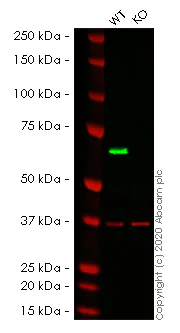
Western blot - Human AIFM1 (AIF) knockout HEK-293T cell lysate (AB256834)
Lane 1 : Wild-type HEK-293T cell lysate (20µg)
Lane 2 : AIFM1 knockout HEK-293T cell lysate (20µg)
Lanes 1- 2 : Merged signal (red and green). Green - ab32516 observed at 67 kDa. Red - loading control ab8245 observed at 37 kDa.
ab32516 Anti-AIF antibody [E20] - Mitochondrial Marker was shown to specifically react with AIF in wild-type HEK-293T cells in western blot. Loss of signal was observed when knockout cell line ab266347 (knockout cell lysate ab256834) was used. Wild-type and AIF knockout samples were subjected to SDS-PAGE. Membrane was blocked for 1 hour at room temperature in 0.1% TBST with 3% non-fat dried milk. ab32516 and Anti-GAPDH antibody [6C5] - Loading Control (ab8245) were incubated overnight at 4°C at 1 in 1000 dilution and 1 in 20000 dilution respectively. Blots were developed with Goat anti-Rabbit IgG H&L (IRDye® 800CW) preadsorbed (ab216773) and Goat anti-Mouse IgG H&L (IRDye® 680RD) preadsorbed (ab216776) secondary antibodies at 1 in 20000 dilution for 1 hour at room temperature before imaging.
All lanes:
Western blot - Anti-AIF antibody [E20] - Mitochondrial Marker (<a href='/en-us/products/primary-antibodies/aif-antibody-e20-mitochondrial-marker-ab32516'>ab32516</a>) at 1/1000 dilution
Lane 1:
Wild-type HEK-293T cell lysate at 20 µg
Lane 2:
AIFM1 knockout HEK-293T cell lysate at 20 µg
Lane 2:
Western blot - Human AIFM1 (AIF) knockout HEK-293T cell line (<a href='/en-us/products/cell-lines/human-aifm1-aif-knockout-hek-293t-cell-line-ab266347'>ab266347</a>)
Predicted band size: 67 kDa
Observed band size: 67 kDa
false

- Sanger seq
Unknown
Sanger Sequencing - Human AIFM1 (AIF) knockout HEK-293T cell lysate (AB256834)
Allele-2 : 1 bp insertion in exon 2

- Sanger seq
Unknown
Sanger Sequencing - Human AIFM1 (AIF) knockout HEK-293T cell lysate (AB256834)
Allele-3 : 2 bp insertion in exon 2

- Sanger seq
Unknown
Sanger Sequencing - Human AIFM1 (AIF) knockout HEK-293T cell lysate (AB256834)
Allele-1 : 23 bp deletion in exon 2
Complementary Products
Reactivity data
Product details
Knockout cell lysate achieved by CRISPR/Cas9.
REACH authorisation
Abcam has not and does not intend to apply for the REACH Authorisation of customers' uses of products that contain European Authorisation list (Annex XIV) substances.
It is the responsibility of our customers to check the necessity of application of REACH Authorisation, and any other relevant authorisations, for their intended uses.
Lysate preparation: Our lysates are made using RIPA buffer to which we add a protease inhibitor cocktail and phosphatase inhibitor cocktail (ratio: 300:100:10). This means that the protein of interest is denatured. If you require a native form of the protein please use the live cell version. Please refer to our lysis protocol for further details on how our lysates are prepared.
User storage instructions: Lyophilizate may be stored at 4°C. After reconstitution, store at -20°C for short-term storage or -80°C for long-term storage.
This product is subject to limited use licenses from The Broad Institute, ERS Genomics Limited and Sigma-Aldrich Co. LLC, and is developed with patented technology. For full details of the licenses and patents please refer to our limited use license and patent pages.
What's included?
Properties and storage information
Gene name
Gene editing type
Gene editing method
Knockout validation
Quality control - STR analysis
Shipped at conditions
Appropriate short-term storage conditions
Appropriate long-term storage conditions
Supplementary information
This supplementary information is collated from multiple sources and compiled automatically.
Biological function summary
AIF functions as an important element in mitochondrial-mediated apoptosis. Once released from mitochondria AIF triggers a caspase-independent pathway of apoptosis making it distinct from other pathways where caspases are central. While not part of a larger protein complex AIF interacts closely with several mitochondrial and nuclear elements to execute its functions. Researchers often monitor AIF activity using apoptosis ELISA kits which help in precise detection and quantification of this protein within cellular systems.
Pathways
The presence and activity of AIF align with the broader apoptotic pathway and mitochondrial respiration. AIF links significantly with other molecules like cytochrome c released during apoptosis although cytochrome c follows a caspase-dependent pathway. It also shows involvement in various cellular injury and stress response pathways reinforcing its role as a major player in cellular fate decisions and intrinsic apoptotic mechanisms.
Cell culture
Biosafety level
EU: 2 US: 2
Adherent/suspension
Adherent
Gender
Female
Product promise
Please note: All products are 'FOR RESEARCH USE ONLY. NOT FOR USE IN DIAGNOSTIC OR THERAPEUTIC PROCEDURES'.
For licensing inquiries, please contact partnerships@abcam.com