Human NPM3 knockout HEK-293T cell lysate
Be the first to review this product! Submit a review
|
(0 Publication)

- Sanger seq
Unknown
Sanger Sequencing - Human NPM3 knockout HEK-293T cell lysate (AB258539)
Homozygous : 11 bp deletion in exon 1
Complementary Products


Primary Antibodies
AB140632
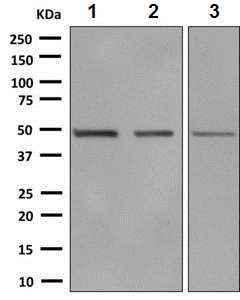
Anti-eEF1A1/EF-Tu + eEF1A1 + EE1AL3/EEF1A1P5 antibody [EPR9470]
RabMAb|Recombinant
- 5
- 2
Product details
Knockout cell lysate achieved by CRISPR/Cas9.
REACH authorisation
Abcam has not and does not intend to apply for the REACH Authorisation of customers' uses of products that contain European Authorisation list (Annex XIV) substances.
It is the responsibility of our customers to check the necessity of application of REACH Authorisation, and any other relevant authorisations, for their intended uses.
Lysate preparation: Our lysates are made using RIPA buffer to which we add a protease inhibitor cocktail and phosphatase inhibitor cocktail (ratio: 300:100:10). This means that the protein of interest is denatured. If you require a native form of the protein please use the live cell version. Please refer to our lysis protocol for further details on how our lysates are prepared.
User storage instructions: Lyophilizate may be stored at 4°C. After reconstitution, store at -20°C for short-term storage or -80°C for long-term storage.
This product is subject to limited use licenses from The Broad Institute and ERS Genomics Limited, and is developed with patented technology. For full details of the limited use licenses and relevant patents please refer to our limited use license and patent pages.
What's included?
Properties and storage information
Gene name
Gene editing type
Gene editing method
Knockout validation
Zygosity
Quality control - STR analysis
Shipped at conditions
Appropriate short-term storage conditions
Appropriate long-term storage conditions
Supplementary information
This supplementary information is collated from multiple sources and compiled automatically.
Biological function summary
NPM3 plays a role in the regulation of chromatin structure and gene expression. It forms complexes with other proteins to facilitate the proper folding and deposition of histone proteins onto DNA. This process is essential for maintaining the dynamic nature of chromatin allowing genes to be accessed and transcribed as needed. NPM3's function contributes to the efficiency of DNA replication and repair mechanisms within the cell potentially affecting cell cycle progression.
Pathways
NPM3 is involved in key cellular mechanisms such as DNA replication and repair as well as the regulation of transcription. It interacts with proteins involved in the nucleosome assembly pathway including NPM1 which enhances its role in these critical tasks. NPM3's association with these pathways highlights its influence on maintaining genomic integrity and proper cellular function by ensuring accurate DNA duplication and protection from genomic instability.
Cell culture
Biosafety level
EU: 2 US: 2
Adherent/suspension
Adherent
Gender
Female
Product promise
Please note: All products are 'FOR RESEARCH USE ONLY. NOT FOR USE IN DIAGNOSTIC OR THERAPEUTIC PROCEDURES'.
For licensing inquiries, please contact partnerships@abcam.com