Human RHOG knockout HEK-293T cell lysate
Be the first to review this product! Submit a review
|
(0 Publication)
- WB
Lab
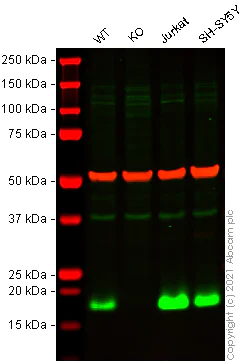
Western blot - Human RHOG knockout HEK-293T cell lysate (AB263328)
Lane 1 : Wild-type HEK-293T cell lysate 20 μg
Lane 2 : RHOG knockout HEK-293T cell lysate 20 μg
Lane 3 : Jurkat cell lysate 20 μg
Lane 4 : SH-SY5Y cell lysate 20 μg
False colour image of Western blot : Anti-RHOG antibody [1F3-RHOG] staining at 1/1000 dilution, shown in green; Rabbit anti-alpha Tubulin antibody [EP1332Y] (ab52866) loading control staining at 1/20000 dilution, shown in red. In Western blot, ab254147 was shown to bind specifically to RHOG. A band was observed at 18 kDa in wild-type HEK-293T cell lysates with no signal observed at this size in RHOG knockout cell line ab266753 (knockout cell lysate ab263328). To generate this image, wild-type and RHOG knockout HEK-293T cell lysates were analysed. First, samples were run on an SDS-PAGE gel then transferred onto a nitrocellulose membrane. Membranes were blocked in 3 % milk in TBS-0.1 % Tween® 20 (TBS-T) before incubation with primary antibodies overnight at 4 °C. Blots were washed four times in TBS-T, incubated with secondary antibodies for 1 h at room temperature, washed again four times then imaged. Secondary antibodies used were Goat anti-Mouse IgG H&L (IRDye® 800CW) preabsorbed (ab216772) and Goat anti-Rabbit IgG H&L (IRDye® 680RD) preabsorbed (ab216777) at 1/20000 dilution.
All lanes:
Western blot - Anti-RHOG antibody [1F3-RHOG] (<a href='/en-us/products/primary-antibodies/rhog-antibody-1f3-rhog-ab254147'>ab254147</a>) at 1/1000 dilution
Lane 1:
Wild-type HEK-293T cell lysate at 20 µg
Lane 2:
RHOG knockout HEK-293T cell lysate at 20 µg
Lane 2:
Western blot - Human RHOG knockout HEK-293T cell line (<a href='/en-us/products/cell-lines/human-rhog-knockout-hek-293t-cell-line-ab266753'>ab266753</a>)
Lane 3:
Jurkat cell lysate at 20 µg
Lane 4:
SH-SY5Y cell lysate at 20 µg
Predicted band size: 21 kDa
Observed band size: 18 kDa
false

- Sanger seq
Unknown
Sanger Sequencing - Human RHOG knockout HEK-293T cell lysate (AB263328)
Homozygous : 1 bp insertion in exon 2
Complementary Products
Primary Antibodies
AB79823
20ul selling size|BOND RX™ Validated|RabMAb|Recombinant|KO Validated

- 5
- 8

Primary Antibodies
AB281587
BOND RX™ Validated|20ul selling size|RabMAb|Recombinant

- 2
- 1

Reactivity data
Product details
Knockout cell lysate achieved by CRISPR/Cas9.
REACH authorisation
Abcam has not and does not intend to apply for the REACH Authorisation of customers' uses of products that contain European Authorisation list (Annex XIV) substances.
It is the responsibility of our customers to check the necessity of application of REACH Authorisation, and any other relevant authorisations, for their intended uses.
Lysate preparation: Our lysates are made using RIPA buffer to which we add a protease inhibitor cocktail and phosphatase inhibitor cocktail (ratio: 300:100:10). This means that the protein of interest is denatured. If you require a native form of the protein please use the live cell version. Please refer to our lysis protocol for further details on how our lysates are prepared.
User storage instructions: Lyophilizate may be stored at 4°C. After reconstitution, store at -20°C for short-term storage or -80°C for long-term storage.
This product is subject to limited use licenses from The Broad Institute, ERS Genomics Limited and Sigma-Aldrich Co. LLC, and is developed with patented technology. For full details of the licenses and patents please refer to our limited use license and patent pages.
What's included?
Properties and storage information
Gene name
Gene editing type
Gene editing method
Knockout validation
Zygosity
Quality control - STR analysis
Shipped at conditions
Appropriate short-term storage conditions
Appropriate long-term storage conditions
Supplementary information
This supplementary information is collated from multiple sources and compiled automatically.
Biological function summary
RHOG regulates cell shape and motility. It is involved in forming membrane protrusions such as filopodia and lamellipodia. RHOG can act as a part of a protein complex with other GTPases. It controls actin cytoskeleton dynamics by activating pathways needed for cell migration and chemotaxis. This protein significantly aids immune cell function during immune surveillance and inflammatory responses.
Pathways
RHOG interacts with diverse signaling cascades. It activates the Rac1 pathway influencing cellular migration and growth processes. RHOG collaborates with proteins like PI3-kinase in these pathways contributing to the regulation of cytoskeletal organization. RHOG involvement in these signaling networks ensures cells respond aptly to external cues maintaining cellular integrity and function.
Cell culture
Biosafety level
EU: 2 US: 2
Adherent/suspension
Adherent
Gender
Female
Product promise
Please note: All products are 'FOR RESEARCH USE ONLY. NOT FOR USE IN DIAGNOSTIC OR THERAPEUTIC PROCEDURES'.
For licensing inquiries, please contact partnerships@abcam.com