JavaScript is disabled in your browser. Please enable JavaScript to view this website.
AB157706

Human alpha 1 Antichymotrypsin ELISA Kit

Be the first to review this product! Submit a review

|

(8 Publications )
Human alpha 1 Antichymotrypsin ELISA Kit is a Sandwich ELISA for the measurement of Human alpha 1 Antichymotrypsin in Human in Biofluids samples.
1 Images
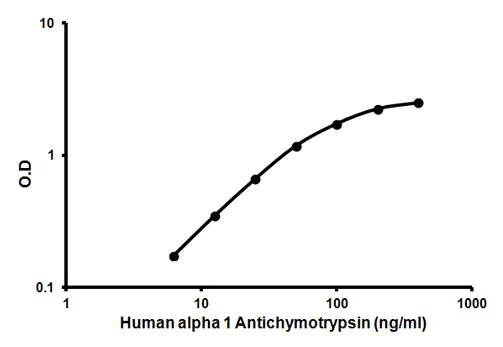
Sandwich ELISA - Human alpha 1 Antichymotrypsin ELISA Kit (AB157706)
  • sELISA

Supplier Data

Sandwich ELISA - Human alpha 1 Antichymotrypsin ELISA Kit (AB157706)

Representative standard curve using ab157706 alpha 1 Antichymotrypsin Human ELISA Kit.

Key facts

Detection method

Colorimetric

Sample types

Plasma, Serum, Other biological fluids

Reacts with

Human

Assay type

Sandwich

Results type

Quantitative

Sensitivity

= 1.7215 ng/mL

Range

6.25 - 400 ng/mL

Assay Platform

Microplate

Reactivity data

{ "title": "Reactivity Data", "filters": { "stats": ["", "Reactivity", "Dilution Info", "Notes"] }, "values": { "sELISA": { "reactivity":"TESTED_AND_REACTS", "dilution-info":"", "notes":"<p></p>" } } }

Product details

Abcam's alpha 1 Antichymotrypsin Human ELISA Kit is an in vitro enzyme-linked immunosorbent assay (ELISA) for the quantitative measurement of alpha 1 Antichymotrypsin levels in Human serum and plasma.

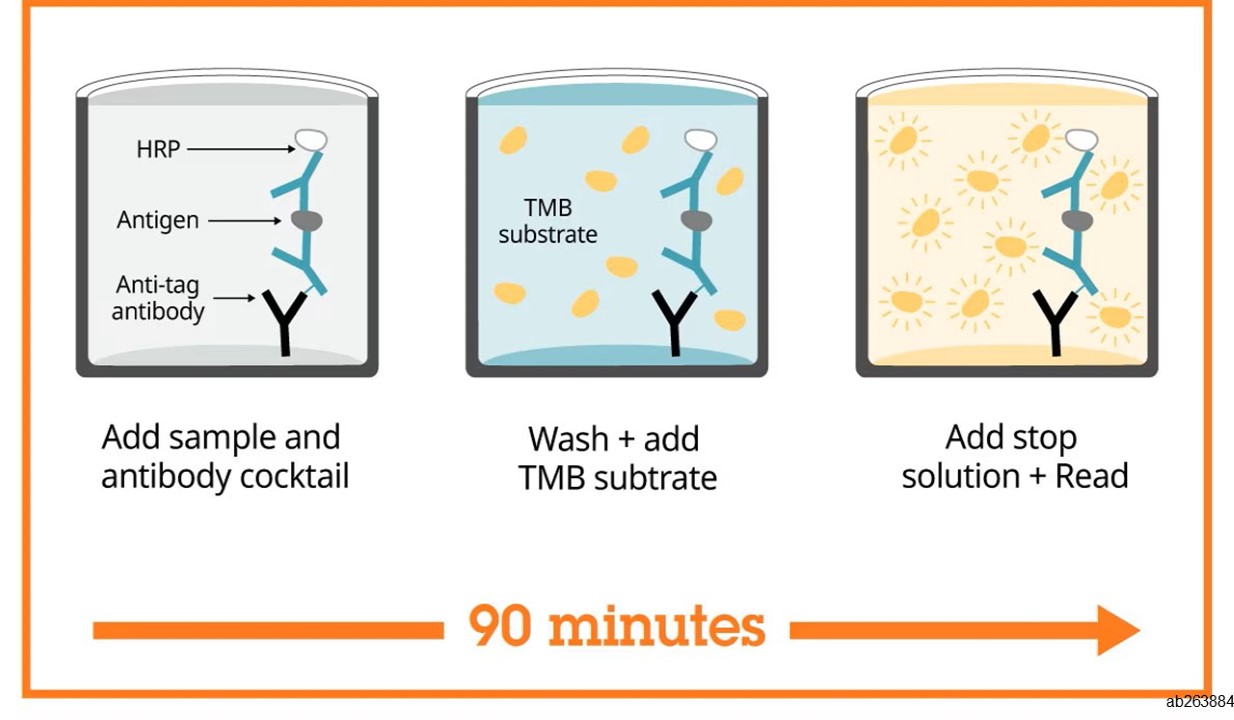
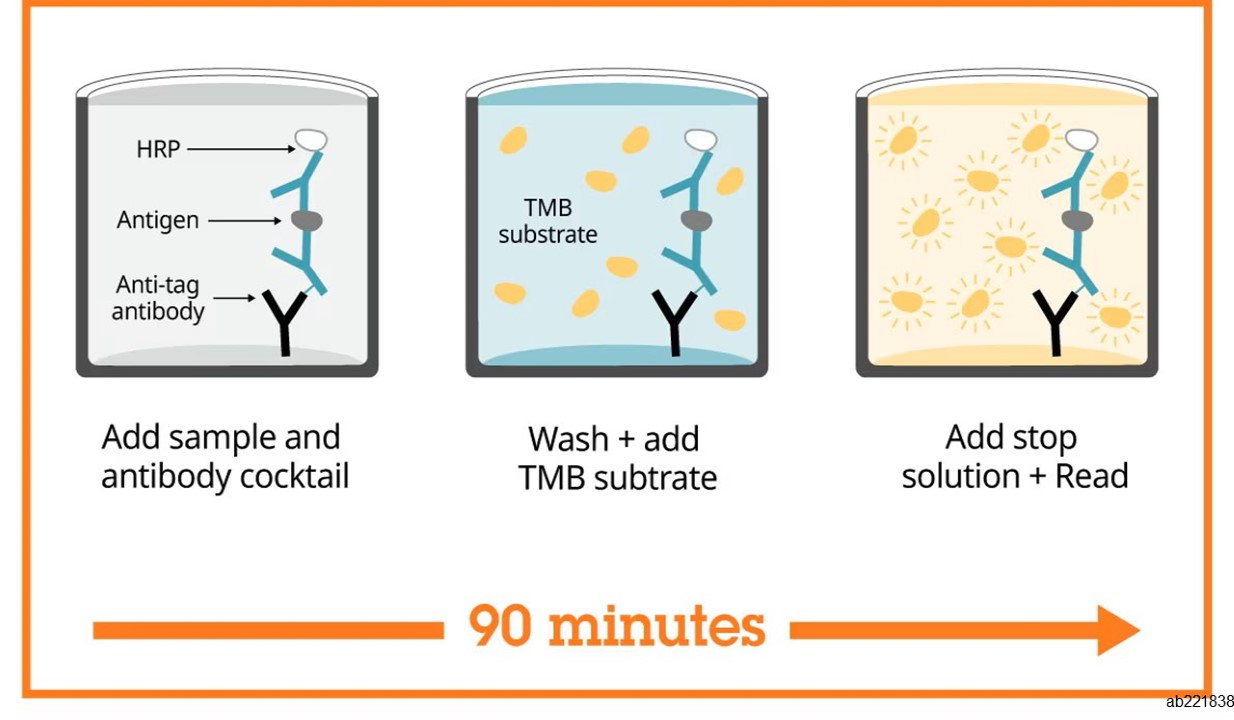
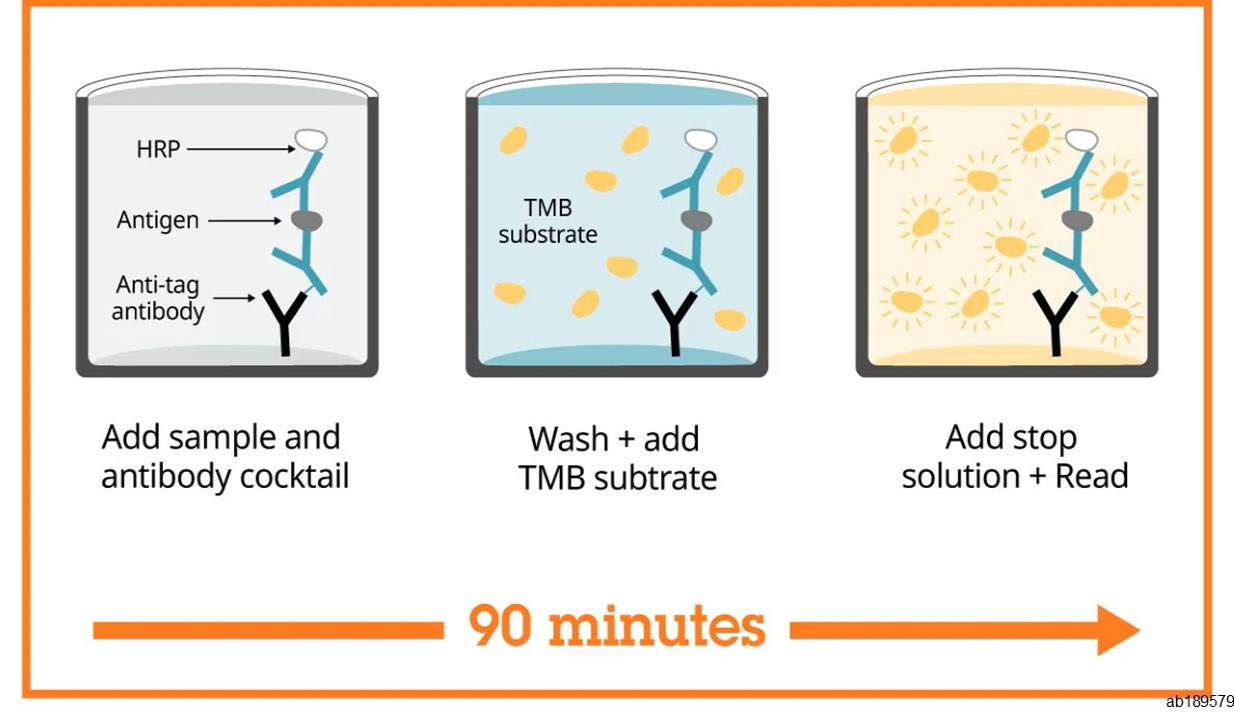
In this assay the alpha 1 Antichymotrypsin present in samples reacts with the anti-alpha 1 Antichymotrypsin antibodies which have been adsorbed to the surface of polystyrene microtiter wells. After the removal of unbound proteins by washing, anti-alpha 1 Antichymotrypsin antibodies conjugated with horseradish peroxidase (HRP), are added. These enzyme-labeled antibodies form complexes with the previously bound alpha 1 Antichymotrypsin. Following another washing step, the enzyme bound to the immunosorbent is assayed by the addition of a chromo­genic substrate, 3,3',5,5'-tetramethylbenzidine (TMB). The quantity of bound enzyme varies directly with the concentration of alpha 1 Antichymotrypsin in the sample tested; thus, the absorbance, at 450 nm, is a measure of the concentration of alpha 1 Antichymotrypsin in the test sample. The quantity of alpha 1 Antichymotrypsin in the test sample can be interpolated from the standard curve constructed from the standards, and corrected for sample dilution.

Precision & recovery information

Precision

[ { "reproducibilityType": "Inter", "sample": "Overall", "replicates": 0, "mean": null, "standardDeviation": null, "coefficientOfVariability": "< 10" }, { "reproducibilityType": "Intra", "sample": "Overall", "replicates": 0, "mean": null, "standardDeviation": null, "coefficientOfVariability": "< 10" } ]

Recovery

[ { "sample": "Serum", "range": null, "average": "> 85" } ]

What's included?

{ "values": { "1x96Tests": { "sellingSize": "1 x 96 Tests", "publicAssetCode":"ab157706-1x96Tests", "assetComponentDetails": [ { "size":"1 x 12 mL", "name":"Chromogen Substrate Solution", "number":"AB157706-CMP02", "productcode":"" }, { "size":"1 x 50 mL", "name":"5X Diluent Concentrate", "number":"AB157706-CMP07", "productcode":"" }, { "size":"1 x 1 Unit", "name":"Human alpha 1 Antichymotrypsin ELISA Microplate", "number":"AB157706-CMP05", "productcode":"" }, { "size":"1 x 50 mL", "name":"20X Wash Buffer Concentrate", "number":"AB157706-CMP06", "productcode":"" }, { "size":"1 x 12 mL", "name":"Stop Solution", "number":"AB157706-CMP01", "productcode":"" }, { "size":"1 x 150 µL", "name":"100X HRP-conjugated anti-Human alpha 1 Antichymotrypsin antibody", "number":"AB157706-CMP03", "productcode":"" }, { "size":"1 x 1 Vial", "name":"Human alpha 1 Antichymotrypsin Calibrator (lyophilized)", "number":"AB157706-CMP04", "productcode":"" } ] } } }

Properties and storage information

Shipped at conditions
Blue Ice
Appropriate short-term storage conditions
+4°C
Appropriate long-term storage conditions
+4°C
Storage information
+4°C

Supplementary information

This supplementary information is collated from multiple sources and compiled automatically.

The target protein Alpha-1-antichymotrypsin (AACT) also known as ACT is a serpin family member with a mass of approximately 68 kDa. This protein functions as an inhibitor of serine proteases particularly targeting chymotrypsin-like enzymes. AACT is expressed in the liver and secreted into the plasma where it carries out its inhibitory role. It is a significant component of the antiprotease shield in human physiology guarding tissues against proteolytic damage.
Biological function summary

Alpha-1-antichymotrypsin plays a role in regulating protease activity to maintain tissue integrity. AACT forms part of a complex that involves other protease inhibitors and enzymes contributing to the balance of protein breakdown and regeneration. Its presence in the extracellular matrix highlights its structural and protective functions supporting cells against enzyme-mediated degradation.

Pathways

Alpha-1-antichymotrypsin takes part in inflammatory and immune response pathways. It interacts within the acute phase response pathway a system activated during inflammatory events. This protein's relationship with other protease inhibitors such as alpha-1-antitrypsin accentuates its role in controlling proteolytic enzymes that could otherwise propagate unchecked inflammation and tissue damage.

Alpha-1-antichymotrypsin associates with neurodegenerative diseases such as Alzheimer's disease and pulmonary disorders. Its elevated levels have been observed in Alzheimer's disease cases where it might participate alongside amyloid-beta precursor protein influencing amyloid plaque formation. In lung-related disorders its collaboration with proteins like elastase can affect tissue breakdown emphasizing its role in maintaining pulmonary health.

Product protocols

Target data

Although its physiological function is unclear, it can inhibit neutrophil cathepsin G and mast cell chymase, both of which can convert angiotensin-1 to the active angiotensin-2.
See full target information SERPINA3

Alternative Names

AACT, GIG24, GIG25, SERPINA3, Alpha-1-antichymotrypsin, ACT, Cell growth-inhibiting gene 24/25 protein, Serpin A3

Publications (8)

Recent publications for all applications. Explore the full listand refine your search

Molecular oncology 17:2147-2167 PubMed37408474

2023

Osteoblast-derived extracellular vesicles exert osteoblastic and tumor-suppressive functions via SERPINA3 and LCN2 in prostate cancer.

Applications

Unspecified application

Species

Unspecified reactive species

Kagenori Ito,Tomofumi Yamamoto,Yusuke Hayashi,Shun Sato,Jun Nakayama,Fumihiko Urabe,Takeo Shimasaki,Eijiro Nakamura,Yoshiyuki Matui,Hiroyuki Fujimoto,Takahiro Kimura,Shin Egawa,Takahiro Ochiya,Yusuke Yamamoto

Molecules (Basel, Switzerland) 27: PubMed36144640

2022

Translational Proteomic Approach for Cholangiocarcinoma Biomarker Discovery, Validation, and Multiplex Assay Development: A Pilot Study.

Applications

Unspecified application

Species

Unspecified reactive species

Kamolwan Watcharatanyatip,Somchai Chutipongtanate,Daranee Chokchaichamnankit,Churat Weeraphan,Kanokwan Mingkwan,Virat Luevisadpibul,David S Newburg,Ardythe L Morrow,Jisnuson Svasti,Chantragan Srisomsap

Frontiers in neurology 13:886040 PubMed36003300

2022

Identification of protein biomarkers in host cerebrospinal fluid for differential diagnosis of tuberculous meningitis and other meningitis.

Applications

Unspecified application

Species

Unspecified reactive species

Mailing Huang,Zeyu Ding,Wensheng Li,Weibi Chen,Yadong Du,Hongyan Jia,Qi Sun,Boping Du,Rongrong Wei,Aiying Xing,Qi Li,Naihui Chu,Liping Pan

Journal of neuroinflammation 19:44 PubMed35135578

2022

Posttranslational modifications of proteins are key features in the identification of CSF biomarkers of multiple sclerosis.

Applications

Unspecified application

Species

Unspecified reactive species

Ivan L Salazar,Ana S T Lourenço,Bruno Manadas,Inês Baldeiras,Cláudia Ferreira,Anabela Claro Teixeira,Vera M Mendes,Ana Margarida Novo,Rita Machado,Sónia Batista,Maria do Carmo Macário,Mário Grãos,Lívia Sousa,Maria João Saraiva,Alberto A C C Pais,Carlos B Duarte

EBioMedicine 75:103802 PubMed34990893

2022

Blood levels of adiponectin and IL-1Ra distinguish type 3c from type 2 diabetes: Implications for earlier pancreatic cancer detection in new-onset diabetes.

Applications

Unspecified application

Species

Unspecified reactive species

Lucy Oldfield,Anthony Evans,Rohith Gopala Rao,Claire Jenkinson,Tejpal Purewal,Eftychia E Psarelli,Usha Menon,John F Timms,Stephen P Pereira,Paula Ghaneh,William Greenhalf,Christopher Halloran,Eithne Costello

Frontiers in cardiovascular medicine 8:756889 PubMed34957248

2021

The Association and Pathogenesis of SERPINA3 in Coronary Artery Disease.

Applications

Unspecified application

Species

Unspecified reactive species

Bo Li,Zhijun Lei,You Wu,Bingyu Li,Ming Zhai,Yuan Zhong,Peinan Ju,Wenxin Kou,Yefei Shi,Xianling Zhang,Wenhui Peng

International journal of chronic obstructive pulmonary disease 16:1497-1508 PubMed34113087

2021

A Proteomics-Based Analysis of Blood Biomarkers for the Diagnosis of COPD Acute Exacerbation.

Applications

Unspecified application

Species

Unspecified reactive species

Soo Han Kim,Hee-Sung Ahn,Jin-Soo Park,Jeonghun Yeom,Jiyoung Yu,Kyunggon Kim,Yeon-Mok Oh

Journal of proteome research 13:1873-84 PubMed24571389

2014

Glycoprotein biomarker panel for pancreatic cancer discovered by quantitative proteomics analysis.

Applications

Unspecified application

Species

Unspecified reactive species

Song Nie,Andy Lo,Jing Wu,Jianhui Zhu,Zhijing Tan,Diane M Simeone,Michelle A Anderson,Kerby A Shedden,Mack T Ruffin,David M Lubman
View all publications
websiteProtocolBooklet
en

Product promise

We are committed to supporting your work with high-quality reagents, and we're here for you every step of the way. In the unlikely event that one of our products does not perform as expected, you're protected by our Product Promise.
For full details, please see our Terms & Conditions

Please note: All products are 'FOR RESEARCH USE ONLY. NOT FOR USE IN DIAGNOSTIC OR THERAPEUTIC PROCEDURES'.

For licensing inquiries, please contact partnerships@abcam.com