JavaScript is disabled in your browser. Please enable JavaScript to view this website.
AB155427

Human Cathepsin S ELISA Kit (CTSS)

Be the first to review this product! Submit a review

|

(4 Publications )

Human Cathepsin S ELISA Kit (CTSS) is a Sandwich ELISA for the measurement of Human Cathepsin S (CTSS) in Human in Biofluids, Cell Culture Media samples.

View Alternative Names

Cathepsin S, CTSS
2 Images
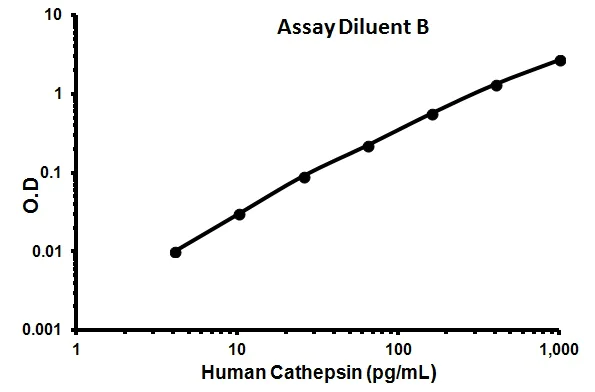
Sandwich ELISA - Human Cathepsin S ELISA Kit (CTSS) (AB155427)
  • sELISA

Unknown

Sandwich ELISA - Human Cathepsin S ELISA Kit (CTSS) (AB155427)

Representative standard curve using ab155427 - Assay Diluent B
Sandwich ELISA - Human Cathepsin S ELISA Kit (CTSS) (AB155427)
  • sELISA

Unknown

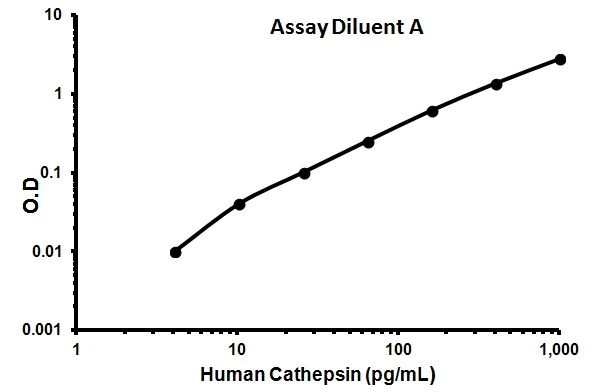
Sandwich ELISA - Human Cathepsin S ELISA Kit (CTSS) (AB155427)

Representative standard curve using ab155427 - Assay Diluent A

Key facts

Detection method

Colorimetric

Sample types

Plasma, Cell culture supernatant, Serum

Reacts with

Human

Assay type

Sandwich

Results type

Quantitative

Sensitivity

< 4 pg/mL

Range

4 - 1000 pg/mL

Assay Platform

Microplate

Reactivity data

{ "title": "Reactivity Data", "filters": { "stats": ["", "Reactivity", "Dilution Info", "Notes"] }, "values": { "sELISA": { "reactivity":"TESTED_AND_REACTS", "dilution-info":"", "notes":"<p></p>" } } }

Product details

Abcam's Cathepsin S (CTSS) Human ELISA (Enzyme-Linked Immunosorbent Assay) kit is an in vitro enzyme-linked immunosorbent assay designed for the quantitative measurement of Human Cathepsin S in serum, plasma and cell culture supernatants.

This assay employs an antibody specific for Human Cathepsin S (CTSS) coated on a 96-well plate. Standards and samples are pipetted into the wells and Cathepsin S present in a sample is bound to the wells by the immobilized antibody. The wells are washed and biotinylated anti-Human Cathepsin S antibody is added. After washing away unbound biotinylated antibody, HRP-conjugated streptavidin is pipetted to the wells. The wells are again washed, a TMB substrate solution is added to the wells and color develops in proportion to the amount of Cathepsin S bound. The Stop Solution changes the color from blue to yellow, and the intensity of the color is measured at 450 nm.

Optimization may be required with urine samples.

Precision

[ { "reproducibilityType": "Inter", "sample": "Overall", "replicates": 0, "mean": null, "standardDeviation": null, "coefficientOfVariability": "< 12" }, { "reproducibilityType": "Intra", "sample": "Overall", "replicates": 0, "mean": null, "standardDeviation": null, "coefficientOfVariability": "< 10" } ]

Recovery

[ { "sample": "Cell culture media", "range": "104 - 139 %", "average": "= 128.5" }, { "sample": "Plasma", "range": "115 - 140 %", "average": "= 127.8" }, { "sample": "Serum", "range": "106 - 138 %", "average": "= 126.3" } ]

What's included?

{ "values": { "1x96Tests": { "sellingSize": "1 x 96 Tests", "publicAssetCode":"ab155427-1x96Tests", "assetComponentDetails": [ { "size":"1 x 12 mL", "name":"TMB One-Step Substrate Reagent", "number":"AB155427-CMP08", "productcode":"" }, { "size":"1 x 15 mL", "name":"5X Assay Diluent B", "number":"AB155427-CMP04", "productcode":"" }, { "size":"1 x 30 mL", "name":"Assay Diluent A", "number":"AB155427-CMP03", "productcode":"" }, { "size":"1 x 1 Unit", "name":"Cathepsin S Microplate (12 x 8 wells)", "number":"AB155427-CMP07", "productcode":"" }, { "size":"1 x 25 mL", "name":"20X Wash Buffer", "number":"AB155427-CMP01", "productcode":"" }, { "size":"1 x 8 mL", "name":"Stop Solution", "number":"AB155427-CMP05", "productcode":"" }, { "size":"2 x 1 Vial", "name":"Biotinylated anti-Human Cathepsin S", "number":"AB155427-CMP09", "productcode":"" }, { "size":"2 x 1 Vial", "name":"Recombinant Human Cathepsin S Standard (lyophilized)", "number":"AB155427-CMP06", "productcode":"" }, { "size":"1 x 200 µL", "name":"300X HRP-Streptavidin Concentrate", "number":"AB155427-CMP02", "productcode":"" } ] } } }

Properties and storage information

Shipped at conditions
Blue Ice
Appropriate short-term storage conditions
-20°C
Appropriate long-term storage conditions
-20°C
Storage information
-20°C

Supplementary information

This supplementary information is collated from multiple sources and compiled automatically.

Cathepsin S sometimes referred to as CTSS is a cysteine protease enzyme weighing about 24-29 kDa part of the papain family. It occurs mainly in lysosomes and is expressed in a variety of cells including antigen-presenting cells like macrophages dendritic cells and B lymphocytes. Cathepsin S functions to cleave proteins at lysines playing a central role in protein degradation and antigen processing. It distinguishes itself from other cathepsins by maintaining activity in an alkaline environment and is essential for the processing of invariant chain (Ii) in MHC class II molecules.
Biological function summary

Cathepsin S participates in immune system modulation and matrix degradation. It stands out in its role in the immune response cleaving antigenic proteins for presentation by MHC class II therefore influencing T-cell activation. Although synonymous with lysosomal activity it also operates extracellularly contributing to tissue remodeling and inflammation. Cathepsin S is not part of a larger complex but interacts with MHC class II impacting antigen presentation.

Pathways

This protease is critical in the immune system and extracellular matrix degradation pathways. In the context of the immune pathway CTSS interacts with other proteases such as Cathepsin L and Cathepsin B to perform antigen trimming and processing. Moreover CTSS supports the activation of T lymphocytes by ensuring the correct presentation of peptide fragments on MHC class II molecules. In matrix degradation CTSS indirectly influences collagen breakdown and interaction with other matrix metalloproteinases.

Cathepsin S is associated with autoimmune diseases like rheumatoid arthritis where it contributes to tissue inflammation and joint damage. It also relates to atherosclerosis promoting instability in atherosclerotic plaques which could result in heart disease. In rheumatoid arthritis interactions with cytokines like TNF-alpha amplify inflammatory responses while in atherosclerosis CTSS links with other proteases to degrade extracellular matrix components leading to vulnerable lesions.

Product protocols

Target data

Thiol protease (PubMed : 30612035). Key protease responsible for the removal of the invariant chain from MHC class II molecules and MHC class II antigen presentation (PubMed : 30612035). The bond-specificity of this proteinase is in part similar to the specificities of cathepsin L (PubMed : 30612035). Elicits itch by mediating cleavage and activation of MRGPRX1 (By similarity).
See full target information CTSS

Publications (4)

Recent publications for all applications. Explore the full list and refine your search

Diagnostics (Basel, Switzerland) 12: PubMed35453881

2022

Elevated Serum Cystatin C and Decreased Cathepsin S/Cystatin C Ratio Are Associated with Severe Peripheral Arterial Disease and Polyvascular Involvement.

Applications

Unspecified application

Species

Unspecified reactive species

Előd Ernő Nagy,Attila Puskás,Piroska Kelemen,Katalin Makó,Zoltán Brassai,Jolán Hársfalvi,Attila Frigy

BMC gastroenterology 22:72 PubMed35183119

2022

Excess fatty acids induce pancreatic acinar cell pyroptosis through macrophage M1 polarization.

Applications

Unspecified application

Species

Unspecified reactive species

Wenwen Xia,Zhaomin Lu,Wei Chen,Jianjun Zhou,Yan Zhao

Cancers 13: PubMed34572924

2021

Cathepsin S Evokes PAR-Dependent Pain in Oral Squamous Cell Carcinoma Patients and Preclinical Mouse Models.

Applications

Unspecified application

Species

Unspecified reactive species

Nguyen Huu Tu,Kenji Inoue,Elyssa Chen,Bethany M Anderson,Caroline M Sawicki,Nicole N Scheff,Hung D Tran,Dong H Kim,Robel G Alemu,Lei Yang,John C Dolan,Cheng Z Liu,Malvin N Janal,Rocco Latorre,Dane D Jensen,Nigel W Bunnett,Laura E Edgington-Mitchell,Brian L Schmidt

Scientific reports 9:19202 PubMed31844116

2019

Circulating proteomic signature of early death in heart failure patients with reduced ejection fraction.

Applications

Unspecified application

Species

Unspecified reactive species

Marie Cuvelliez,Vincent Vandewalle,Maxime Brunin,Olivia Beseme,Audrey Hulot,Pascal de Groote,Philippe Amouyel,Christophe Bauters,Guillemette Marot,Florence Pinet
View all publications
websiteProtocolBooklet
en

Product promise

We are committed to supporting your work with high-quality reagents, and we're here for you every step of the way. In the unlikely event that one of our products does not perform as expected, you're protected by our Product Promise.
For full details, please see our Terms & Conditions

Please note: All products are 'FOR RESEARCH USE ONLY. NOT FOR USE IN DIAGNOSTIC OR THERAPEUTIC PROCEDURES'.

For licensing inquiries, please contact partnerships@abcam.com