Mouse CD5L / CT-2 ELISA Kit is a Sandwich ELISA for the measurement of Mouse CD5L / CT-2 in Mouse in Cell/Tissue Extracts, Cell Culture Media, Biofluids samples.
View Alternative Names
Aim, Api6, Cd5l, CD5 antigen-like, Apoptosis inhibitor expressed by macrophages, Apoptosis inhibitory 6, SP-alpha, mAIM
- sELISA
Supplier Data
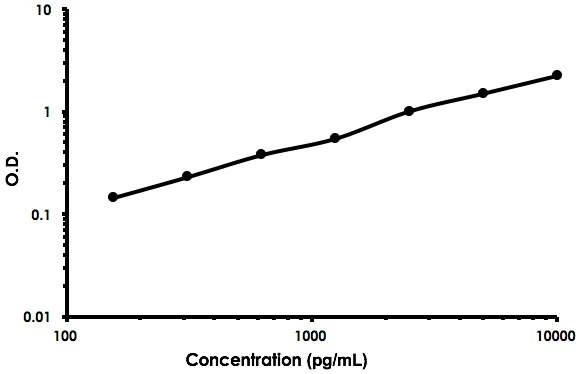
Sandwich ELISA - Mouse CD5L / CT-2 ELISA Kit (AB213852)
Mouse CD5L / CT-2 ELISA Kit (ab213852) Standard Curve.
Complementary Products


Reactivity data
Product details
The Mouse CD5L / CT-2 Enzyme-Linked Immunosorbent Assay (ELISA) kit (ab213852) is designed for the quantitative measurement of activated Mouse CD5L / CT-2 in cell culture supernatants, cell lysates, serum and plasma (heparin, EDTA).
The ELISA kit is based on standard sandwich enzyme-linked immune-sorbent assay technology. A polyclonal antibody from goat specific for CD5L / CT-2 has been pre-coated onto 96-well plates. Standards (Expression system for standard: NSO; Immunogen sequence: E22-V352) and test samples are added to the wells, a biotinylated detection polyclonal antibody from goat specific for CD5L / CT-2 is added subsequently and then followed by washing with PBS or TBS buffer. Avidin-Biotin-Peroxidase Complex is added and unbound conjugates are washed away with PBS or TBS buffer. HRP substrate TMB is used to visualize HRP enzymatic reaction. TMB is catalyzed by HRP to produce a blue color product that changed into yellow after adding acidic stop solution. The density of yellow is proportional to the Mouse CD5L / CT-2 amount of sample captured in plate.
CD5 antigen-like, also known as Sp alpha and AIM, is a protein that in humans is encoded by the CD5L gene. It is mapped to 1q21-q23 by fluorescence in situ hybridization. It is found that Aim expression is induced in mouse macrophages in response to loading with highly oxidized low density lipoprotein (oxLDL), and that Aim is expressed in foam cells within atherosclerotic lesions. Both the expression of Aim in lesions and its induction by oxLDL require Lxr/Rxr heterodimers. Aim-null macrophages are highly susceptible to oxLDL-induced apoptosis in vitro and undergo accelerated apoptosis in atherosclerotic lesions in vivo. Double knockout of Aim and Ldlr reduce atherosclerotic lesions. Therefore, it is concluded that AIM expression protects macrophages from apoptosis within atherosclerotic lesions, promoting early lesion development.
Precision
What's included?
Properties and storage information
Shipped at conditions
Appropriate short-term storage conditions
Appropriate long-term storage conditions
Storage information
Supplementary information
This supplementary information is collated from multiple sources and compiled automatically.
Biological function summary
CD5L influences several immune processes modulating macrophage function and lipid metabolism. It plays a role within a complex system transforming macrophages into an anti-inflammatory phenotype. This helps the clearance of apoptotic cells and prevents tissue damage during inflammation. CD5L also impacts cholesterol homeostasis contributing to lipid clearance and influencing foam cell formation which serves a significant role in atherosclerosis development.
Pathways
This protein integrates into the lipid metabolism pathway and the immune regulation pathway. Within the lipid metabolism pathway interaction with proteins such as apolipoprotein AI demonstrates its role in controlling cholesterol and triglyceride levels. In the immune regulation pathway CD5L collaborates with other immune-related proteins including CD36 and TLR2 to regulate immune response and inflammation affecting macrophage activation and phagocytosis.
Product protocols
- Visit the General protocols
- Visit the Troubleshooting
- Download websiteProtocolBooklet|en
Target data
Product promise
Please note: All products are 'FOR RESEARCH USE ONLY. NOT FOR USE IN DIAGNOSTIC OR THERAPEUTIC PROCEDURES'.
For licensing inquiries, please contact partnerships@abcam.com