JavaScript is disabled in your browser. Please enable JavaScript to view this website.
AB64912

Anti-4-1BBL/CD137L antibody

Be the first to review this product! Submit a review

|

(6 Publications )
Rabbit Polyclonal 4-1BBL antibody. Suitable for ELISA, WB, IHC-P, ICC/IF and reacts with Human samples. Cited in 6 publications. Immunogen corresponding to Synthetic Peptide within Human TNFSF9.
2 Images
Immunocytochemistry/ Immunofluorescence - Anti-4-1BBL/CD137L antibody (AB64912)
  • ICC/IF

Unknown

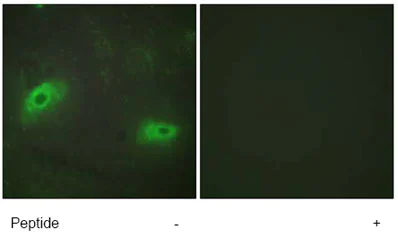
Immunocytochemistry/ Immunofluorescence - Anti-4-1BBL/CD137L antibody (AB64912)

ab64912, at a 1/500 dilution, staining Human 4-1BBL in HeLa cells, by Immunofluorescence, with (+) or without (-) immunising peptide.
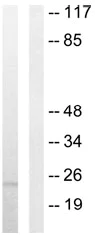
Western blot - Anti-4-1BBL/CD137L antibody (AB64912)
  • WB

Unknown

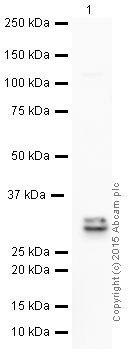
Western blot - Anti-4-1BBL/CD137L antibody (AB64912)

All lanes:

Western blot - Anti-4-1BBL/CD137L antibody (ab64912) at 1/500 dilution

Lane 1:

Extracts from HUVEC cells at 5 µg

Lane 2:

Extracts from HUVEC cells at 5 µg with immunising peptide

Predicted band size: 27 kDa

Observed band size: 25 kDa

false

Key facts

Host species

Rabbit

Clonality

Polyclonal

Isotype

IgG

Carrier free

No

Reacts with

Human

Applications

ICC/IF, IHC-P, ELISA, WB

applications

Immunogen

Synthetic Peptide within Human TNFSF9. The exact immunogen used to generate this antibody is proprietary information.

P41273

Reactivity data

{ "title": "Reactivity Data", "filters": { "stats": ["", "Species", "Dilution Info", "Notes"], "tabs": { "all-applications": {"fullname" : "All Applications", "shortname": "All Applications"}, "ELISA" : {"fullname" : "ELISA", "shortname":"ELISA"}, "WB" : {"fullname" : "Western blot", "shortname":"WB"}, "IHCP" : {"fullname" : "Immunohistochemistry (Formalin/PFA-fixed paraffin-embedded sections)", "shortname":"IHC-P"}, "ICCIF" : {"fullname" : "Immunocytochemistry/ Immunofluorescence", "shortname":"ICC/IF"} }, "product-promise": { "all": "all", "testedAndGuaranteed": "tested", "guaranteed": "expected", "predicted": "predicted", "notRecommended": "not-recommended" } }, "values": { "Human": { "ELISA-species-checked": "guaranteed", "ELISA-species-dilution-info": "", "ELISA-species-notes": "<p></p>", "WB-species-checked": "testedAndGuaranteed", "WB-species-dilution-info": "1/500 - 1/1000", "WB-species-notes": "<p></p>", "IHCP-species-checked": "guaranteed", "IHCP-species-dilution-info": "", "IHCP-species-notes": "<p></p>", "ICCIF-species-checked": "testedAndGuaranteed", "ICCIF-species-dilution-info": "1/500 - 1/1000", "ICCIF-species-notes": "<p></p>" } } }

Properties and storage information

Form
Liquid
Purification technique
Affinity purification Immunogen
Storage buffer
pH: 7.4 Preservative: 0.02% Sodium azide Constituents: PBS, 50% Glycerol (glycerin, glycerine), 0.87% Sodium chloride
Shipped at conditions
Blue Ice
Appropriate short-term storage conditions
+4°C
Appropriate long-term storage conditions
-20°C
Storage information
Stable for 12 months at -20°C

Supplementary information

This supplementary information is collated from multiple sources and compiled automatically.

The 4-1BBL protein also known as CD137L or 4-1BB ligand acts mechanically as a member of the tumor necrosis factor (TNF) superfamily. The 4-1BBL with a mass of around 36 kDa exists as a type II transmembrane protein. It gets expressed on activated antigen-presenting cells like dendritic cells macrophages and B cells. This costimulatory molecule primarily interacts with its receptor 4-1BB (CD137) on T cells promoting their activation.
Biological function summary

The 4-1BBL protein plays an important role in mediating the co-stimulatory signal needed for T-cell proliferation survival and cytokine production. This protein contributes to the formation of the immunological synapse and doesn't exist alone but rather interacts directly with its receptor CD137 forming a receptor-ligand complex. The 4-1BBL-CD137 interaction strengthens signals delivered by the T-cell receptor enhancing immune responses.

Pathways

The 4-1BBL protein integrates into immune-related signaling pathways. It significantly impacts the NF-kB and MAPK pathways important for T cell survival and activation. The interaction between 4-1BBL and its related proteins such as the 4-1BB/CD137 receptor initiates downstream cascades that lead to the activation of transcription factors involved in immune response.

The 4-1BBL protein connects to conditions such as cancer and autoimmune diseases. Overexpression or dysregulation of 4-1BBL has associations with autoimmune conditions like rheumatoid arthritis due to prolonged T cell activation. In cancer 4-1BBL's interaction with CD137 has potential therapeutic implications with efforts to harness this axis to bolster anti-tumor immunity. The modulation of 4-1BBL activity can influence disease outcomes highlighting its significance as a target for therapeutic interventions.

Product protocols

For this product, it's our understanding that no specific protocols are required. You can visit:

Target data

Cytokine that binds to TNFRSF9. Induces the proliferation of activated peripheral blood T-cells. May have a role in activation-induced cell death (AICD). May play a role in cognate interactions between T-cells and B-cells/macrophages.
See full target information TNFSF9

Alternative Names

Tumor necrosis factor ligand superfamily member 9, 4-1BB ligand, 4-1BBL, TNFSF9

Publications (6)

Recent publications for all applications. Explore the full listand refine your search

International journal of molecular sciences 24: PubMed37762039

2023

Single-Cell RNA-Sequencing Reveals Peripheral T Helper Cells Promoting the Development of IgG4-Related Disease by Enhancing B Cell Activation and Differentiation.

Applications

Unspecified application

Species

Unspecified reactive species

Zongfei Ji,Weiqi Lu,Sifan Wu,Yong Zhang,Dan Meng,Xiao Zhang,Xiaojuan Dai,Huiyong Chen,Lili Ma,Ying Sun,Lindi Jiang,Xiufang Kong

The Journal of experimental medicine 219: PubMed35657354

2022

Inherited TNFSF9 deficiency causes broad Epstein-Barr virus infection with EBV+ smooth muscle tumors.

Applications

Unspecified application

Species

Unspecified reactive species

Benjamin Fournier,Akihiro Hoshino,Julie Bruneau,Camille Bachelet,Mathieu Fusaro,Roman Klifa,Romain Lévy,Christelle Lenoir,Claire Soudais,Capucine Picard,Stéphane Blanche,Martin Castelle,Despina Moshous,Thierry Molina,Anne-Sophie Defachelles,Bénédicte Neven,Sylvain Latour

Experimental cell research 405:112677 PubMed34111474

2021

CD47 blockade enhances therapeutic efficacy of cisplatin against lung carcinoma in a murine model.

Applications

Unspecified application

Species

Unspecified reactive species

Zhilei Cui,Dengfei Xu,Fafu Zhang,Jinyuan Sun,Lin Song,Wenjing Ye,Junxiang Zeng,Min Zhou,Zhengshang Ruan,Linlin Zhang,Rongrong Ren

Stem cells translational medicine 8:430-440 PubMed30707002

2019

Metabolic Syndrome Interferes with Packaging of Proteins within Porcine Mesenchymal Stem Cell-Derived Extracellular Vesicles.

Applications

Unspecified application

Species

Unspecified reactive species

Alfonso Eirin,Xiang-Yang Zhu,John R Woollard,Hui Tang,Surendra Dasari,Amir Lerman,Lilach O Lerman

PloS one 9:e112564 PubMed25409517

2014

CD137 expression is induced by Epstein-Barr virus infection through LMP1 in T or NK cells and mediates survival promoting signals.

Applications

IHC-P

Species

Unspecified reactive species

Mayumi Yoshimori,Ken-Ichi Imadome,Honami Komatsu,Ludan Wang,Yasunori Saitoh,Shoji Yamaoka,Tetsuya Fukuda,Morito Kurata,Takatoshi Koyama,Norio Shimizu,Shigeyoshi Fujiwara,Osamu Miura,Ayako Arai

Circulation research 110:857-69 PubMed22282196

2012

High levels of costimulatory receptors OX40 and 4-1BB characterize CD4+CD28null T cells in patients with acute coronary syndrome.

Applications

Unspecified application

Species

Unspecified reactive species

Ingrid E Dumitriu,Paramita Baruah,Caroline J Finlayson,Ian M Loftus,Ricardo F Antunes,Pitt Lim,Nicholas Bunce,Juan Carlos Kaski
View all publications

Product promise

We are committed to supporting your work with high-quality reagents, and we're here for you every step of the way. In the unlikely event that one of our products does not perform as expected, you're protected by our Product Promise.
For full details, please see our Terms & Conditions

Please note: All products are 'FOR RESEARCH USE ONLY. NOT FOR USE IN DIAGNOSTIC OR THERAPEUTIC PROCEDURES'.

For licensing inquiries, please contact partnerships@abcam.com