Anti-5-methyl cytosine adenosine di-nucleoside (5-mCpA) antibody [2C8H8A6] - BSA and Azide free
- Recombinant
- What is this?
Be the first to review this product! Submit a review
|
(0 Publication)
- Dot
Supplier Data
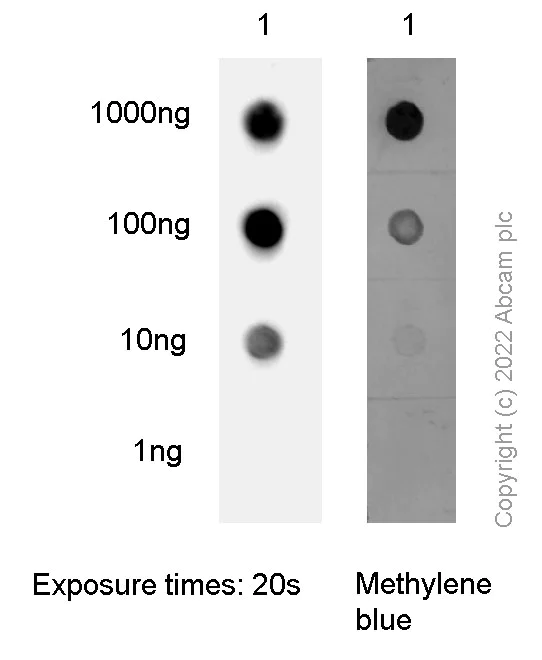
Dot Blot - Anti-5-methyl cytosine adenosine di-nucleoside (5-mCpA) antibody [2C8H8A6] - BSA and Azide free (AB307566)
This data was produced using ab307565, the same antibody clone but in a different buffer. Dot blot analysis of 5-methyl cytosine adenosine di-nucleoside (5-mCpA) using ab307565 at 1 : 1000 (1.043 ug/ml) followed by a Peroxidase-Conjugated Goat anti-Mouse IgG (H+L) at 1 : 10,000 dilution. Lane 1 : ES-D3 [D3] gDNA Exposure time : 20 seconds. Blocking and diluting buffer and concentration : 5% NFDM/TBST.
- Dot
Supplier Data
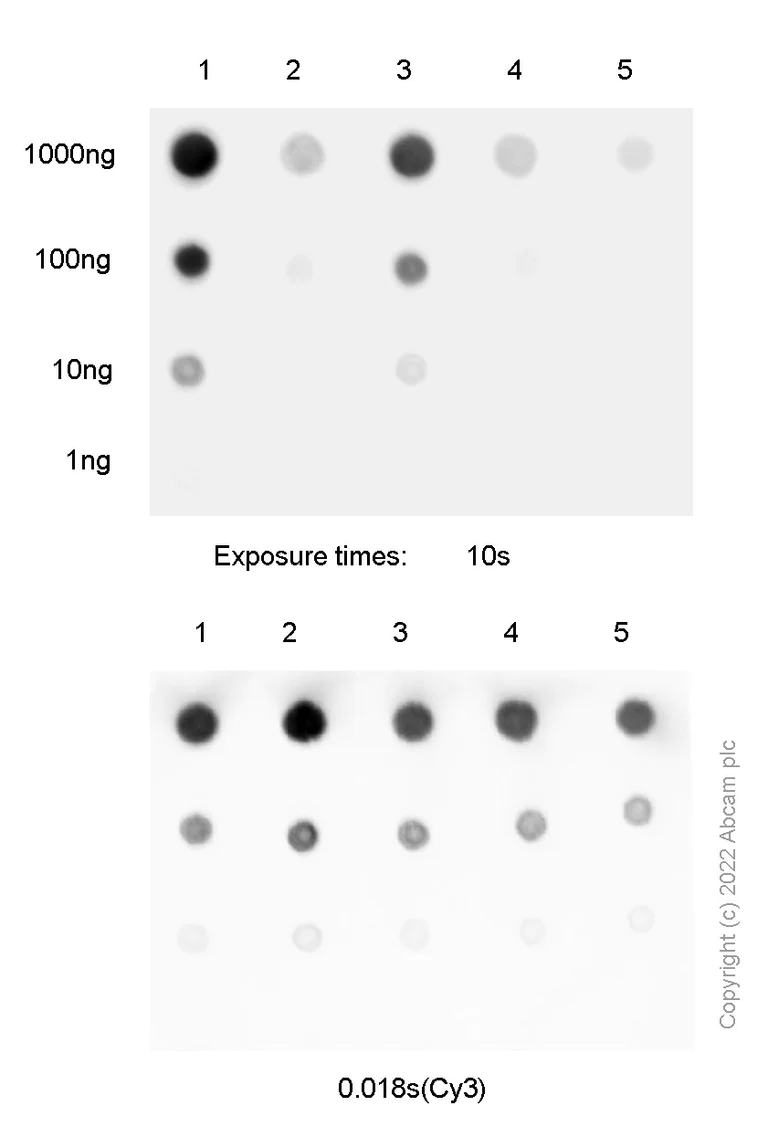
Dot Blot - Anti-5-methyl cytosine adenosine di-nucleoside (5-mCpA) antibody [2C8H8A6] - BSA and Azide free (AB307566)
This data was produced using ab307565, the same antibody clone but in a different buffer. Dot blot analysis of 5-methyl cytosine adenosine di-nucleoside (5-mCpA) using ab307565 at 1 : 1000 (1.043 ug/ml) followed by a Peroxidase-Conjugated Goat anti-Mouse IgG (H+L) at 1 : 10,000 dilution. Lane 1 : 5-mCpA-oligo Lane 2 : 5-mCpG-oligo Lane 3 : 5mC-oligo Lane 4 : dC-oligo Lane 5 : 5hmC-oligo Exposure time : 10 seconds. Blocking and diluting buffer and concentration : 5% NFDM/TBST.
Related conjugates and formulations (1)
-
Anti-5-methyl cytosine adenosine di-nucleoside (5-mCpA) antibody [2C8H8A6]
Reactivity data
Product details
What are the advantages of a recombinant monoclonal antibody?
This product is a recombinant monoclonal antibody, which offers several advantages including:
- - High batch-to-batch consistency and reproducibility
- - Improved sensitivity and specificity
- - Long-term security of supply
- - Animal-free batch production
For more information, read more on recombinant antibodies.
Conjugation ready
Our carrier-free antibodies are typically supplied in a PBS-only formulation, purified and free of BSA, sodium azide and glycerol. This conjugation-ready format is designed for use with fluorochromes, metal isotopes, oligonucleotides, and enzymes, which makes them ideal for antibody labelling, functional and cell-based assays, flow-based assays (e.g. mass cytometry) and Multiplex Imaging applications.
Use our conjugation kits for antibody conjugates that are ready-to-use in as little as 20 minutes with 1 minute hands-on-time and 100% antibody recovery: available for fluorescent dyes, HRP, biotin and gold.
Compatibility
This product is compatible with the Maxpar® Antibody Labeling Kit from Fluidigm, without the need for antibody preparation. Maxpar® is a trademark of Fluidigm Canada Inc.
Want a custom formulation?
This antibody clone is manufactured by Abcam. If you require a custom buffer formulation or conjugation for your experiments, please contact orders@abcam.com
Properties and storage information
Form
Purification technique
Storage buffer
Shipped at conditions
Appropriate short-term storage conditions
Appropriate long-term storage conditions
Supplementary information
This supplementary information is collated from multiple sources and compiled automatically.
Biological function summary
The mechanism involving this dinucleoside affects gene expression regulation. 5-mCpA functions as part of a complex involved in chromatin remodeling. Additionally this complex interacts with other modified nucleotides such as 5-methyl cytosine. Its role is to influence the transcriptional activation or repression of associated genes by altering structural proteins that bind to the chromatin. The presence of these methylated nucleosides including methyl azide-modified versions indicates an important control mechanism in developmental processes and differentiation within organisms.
Pathways
5-mCpA plays an essential part in epigenetic regulation and the DNA methylation pathway. The DNA methylation pathway runs in parallel with histone modification to alter chromatin structure and gene accessibility. Proteins such as DNA methyltransferases are closely related to the formation and maintenance of 5-mCpA within these pathways. The interaction between methylation paths and transcription factors contributes significantly to controlling cell cycle progression and other cellular processes.
Product protocols
- Visit the General protocols
- Visit the Troubleshooting
Target data
Product promise
Please note: All products are 'FOR RESEARCH USE ONLY. NOT FOR USE IN DIAGNOSTIC OR THERAPEUTIC PROCEDURES'.
For licensing inquiries, please contact partnerships@abcam.com