JavaScript is disabled in your browser. Please enable JavaScript to view this website.
AB245561

Anti-67kDa Laminin Receptor antibody

Be the first to review this product! Submit a review

|

(2 Publications )
Rabbit Polyclonal 67kDa Laminin Receptor antibody. Suitable for IP, WB and reacts with Human, Mouse samples. Cited in 2 publications. Immunogen corresponding to Synthetic Peptide within Human RPSA aa 1-50.
2 Images
Immunoprecipitation - Anti-67kDa Laminin Receptor antibody (AB245561)
  • IP

Supplier Data

Immunoprecipitation - Anti-67kDa Laminin Receptor antibody (AB245561)

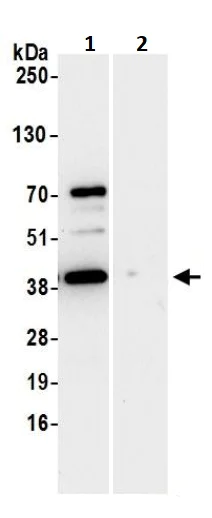
67kDa Laminin Receptor was immunoprecipitated from HEK-293T (Human epithelial cell line from embryonic kidney transformed with large T antigen) whole cell lysate (1 mg per IP reaction; 20% of IP loaded) prepared using NETN lysis buffer.
ab245561 used for IP at 6 μg per reaction. For WB 0.4 μg/ml.

Lane 1 : ab245561 IP in HEK-293T whole cell lysate.
Lane 2 : Control IgG IP in HEK-293T whole cell lysate.

Chemiluminescence detection : 10 seconds.

All lanes:

Immunoprecipitation - Anti-67kDa Laminin Receptor antibody (ab245561)

Predicted band size: 33 kDa

false
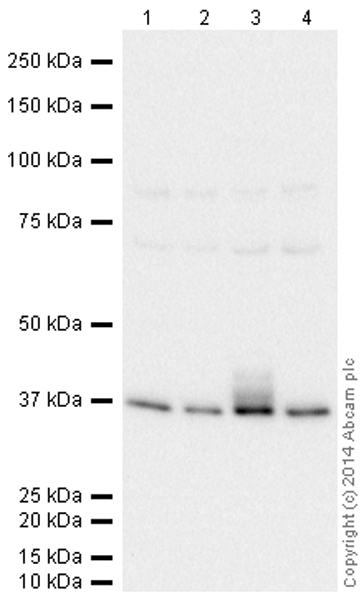
Western blot - Anti-67kDa Laminin Receptor antibody (AB245561)
  • WB

Supplier Data

Western blot - Anti-67kDa Laminin Receptor antibody (AB245561)

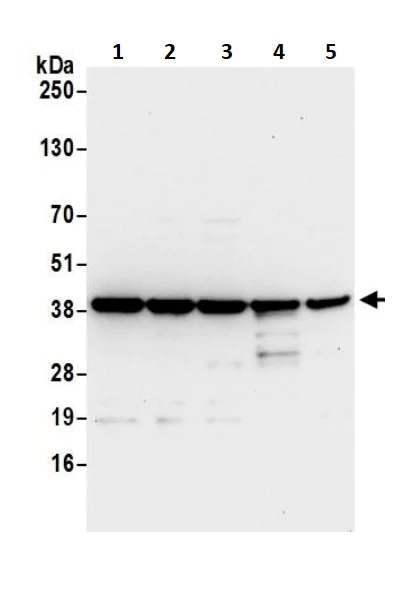
Prepared using NETN lysis buffer.

All lanes:

Western blot - Anti-67kDa Laminin Receptor antibody (ab245561) at 0.1 µg/mL

Lane 1:

HeLa (Human epithelial cell line from cervix adenocarcinoma) whole cell lysate at 50 µg

Lane 2:

HEK-293T (Human epithelial cell line from embryonic kidney transformed with large T antigen) whole cell lysate at 50 µg

Lane 3:

Jurkat (Human T cell leukemia cell line from peripheral blood) whole cell lysate at 50 µg

Lane 4:

TCMK-1 (Mouse kidney epithelial cell line) whole cell lysate at 50 µg

Lane 5:

NIH/3T3 (Mouse embryo fibroblast cell line) whole cell lysate at 50 µg

Predicted band size: 33 kDa

true

Exposure time: 10s

Key facts

Host species

Rabbit

Clonality

Polyclonal

Isotype

IgG

Carrier free

No

Reacts with

Mouse, Human

Applications

IP, WB

applications

Immunogen

Synthetic Peptide within Human RPSA aa 1-50. The exact immunogen used to generate this antibody is proprietary information.

P08865

Reactivity data

{ "title": "Reactivity Data", "filters": { "stats": ["", "Species", "Dilution Info", "Notes"], "tabs": { "all-applications": {"fullname" : "All Applications", "shortname": "All Applications"}, "IP" : {"fullname" : "Immunoprecipitation", "shortname":"IP"}, "WB" : {"fullname" : "Western blot", "shortname":"WB"} }, "product-promise": { "all": "all", "testedAndGuaranteed": "tested", "guaranteed": "expected", "predicted": "predicted", "notRecommended": "not-recommended" } }, "values": { "Human": { "IP-species-checked": "testedAndGuaranteed", "IP-species-dilution-info": "2-10 µg/mg of lysate", "IP-species-notes": "<p></p>", "WB-species-checked": "testedAndGuaranteed", "WB-species-dilution-info": "1/2000 - 1/10000", "WB-species-notes": "<p></p>" }, "Mouse": { "IP-species-checked": "guaranteed", "IP-species-dilution-info": "", "IP-species-notes": "", "WB-species-checked": "testedAndGuaranteed", "WB-species-dilution-info": "1/2000 - 1/10000", "WB-species-notes": "<p></p>" }, "Cow": { "IP-species-checked": "predicted", "IP-species-dilution-info": "", "IP-species-notes": "", "WB-species-checked": "predicted", "WB-species-dilution-info": "", "WB-species-notes": "" }, "Pig": { "IP-species-checked": "predicted", "IP-species-dilution-info": "", "IP-species-notes": "", "WB-species-checked": "predicted", "WB-species-dilution-info": "", "WB-species-notes": "" }, "Sheep": { "IP-species-checked": "predicted", "IP-species-dilution-info": "", "IP-species-notes": "", "WB-species-checked": "predicted", "WB-species-dilution-info": "", "WB-species-notes": "" } } }

Properties and storage information

Form
Liquid
Purification technique
Affinity purification Immunogen
Purification notes
ab245561 was affinity purified using an epitope specific to 67kDa Laminin Receptor immobilized on solid support.
Storage buffer
pH: 7 - 8 Preservative: 0.09% Sodium azide Constituents: Tris citrate/phosphate
Shipped at conditions
Blue Ice
Appropriate short-term storage duration
1-2 weeks
Appropriate short-term storage conditions
+4°C
Appropriate long-term storage conditions
+4°C
Aliquoting information
Upon delivery aliquot
Storage information
Avoid freeze / thaw cycle

Supplementary information

This supplementary information is collated from multiple sources and compiled automatically.

The 67kDa Laminin Receptor also known as the laminin binding protein or protein laminin functions as a receptor for laminin an important component of the extracellular matrix. This receptor is expressed in many tissue types serving an important mechanical role by mediating the adhesion and migration of cells. The receptor anchors cells to laminin molecules thereby influencing cell differentiation and proliferation. The molecular weight of the laminin receptor is approximately 67 kilodaltons which signifies it as a critical player in various cellular processes.
Biological function summary

This receptor engages in cellular interactions that are essential for maintaining the integrity and architecture of tissues. It often associates with other proteins to form complexes which further strengthen its functional capabilities. By anchoring laminin to the cell surface it regulates cell signaling pathways that influence cell motility invasion and survival. These interactions suggest that the 67kDa Laminin Receptor's function goes beyond simple adhesion impacting cellular responsiveness to external matrix cues.

Pathways

The receptor influences the MAPK and PI3K/Akt signaling pathways which are significant in cell survival and proliferation. Through such pathways it interacts with numerous proteins including integrins and fibronectin receptors facilitating orchestrated cell signaling. This connectivity highlights the receptor's role in cellular communication networks contributing to dynamic processes like wound healing and angiogenesis.

Aberrant expression of the 67kDa Laminin Receptor relates to conditions such as cancer and Alzheimer's disease. In cancer its overexpression links to increased tumor invasiveness likely due to enhanced cell motility mediated through integrin interactions. In Alzheimer's disease its relationship with amyloid precursor protein influences plaque formation exacerbating disease progression. Understanding these connections highlights potential therapeutic targets for disease intervention.

Product protocols

For this product, it's our understanding that no specific protocols are required. You can visit:

Target data

Required for the assembly and/or stability of the 40S ribosomal subunit. Required for the processing of the 20S rRNA-precursor to mature 18S rRNA in a late step of the maturation of 40S ribosomal subunits. Also functions as a cell surface receptor for laminin. Plays a role in cell adhesion to the basement membrane and in the consequent activation of signaling transduction pathways. May play a role in cell fate determination and tissue morphogenesis. Acts as a PPP1R16B-dependent substrate of PPP1CA.. (Microbial infection) Acts as a receptor for the Adeno-associated viruses 2,3,8 and 9.. (Microbial infection) Acts as a receptor for the Dengue virus.. (Microbial infection) Acts as a receptor for the Sindbis virus.. (Microbial infection) Acts as a receptor for the Venezuelan equine encephalitis virus.. (Microbial infection) Acts as a receptor for the pathogenic prion protein.. (Microbial infection) Acts as a receptor for bacteria.
See full target information RPSA

Alternative Names

LAMBR, LAMR1, RPSA, Small ribosomal subunit protein uS2, 37 kDa laminin receptor precursor, 37/67 kDa laminin receptor, 40S ribosomal protein SA, 67 kDa laminin receptor, Colon carcinoma laminin-binding protein, Laminin receptor 1, Laminin-binding protein precursor p40, Multidrug resistance-associated protein MGr1-Ag, NEM/1CHD4, 37LRP, LRP/LR, 67LR, LamR, LBP/p40

Publications (2)

Recent publications for all applications. Explore the full listand refine your search

Cellular & molecular immunology 19:516-526 PubMed34983952

2022

Enhancing the HSV-1-mediated antitumor immune response by suppressing Bach1.

Applications

Unspecified application

Species

Unspecified reactive species

Chaohu Pan,Qiaomei Cai,Xiaorong Li,Lili Li,Liping Yang,Yu Chen,Junxiao Liu,Wancheng Liu,Meiling Gao,Tianqi Sui,Xiaoyang Wang,Huiming Fan,Jiayin Ruan,Yueyue Shi,Saihua Chen,Lucy S Cheng,Jiayong Liu,Heng Yang,Genhong Cheng

Journal of virology 94: PubMed31694957

2020

Foot-and-Mouth Disease Virus Capsid Protein VP1 Interacts with Host Ribosomal Protein SA To Maintain Activation of the MAPK Signal Pathway and Promote Virus Replication.

Applications

Unspecified application

Species

Unspecified reactive species

Zixiang Zhu,Weiwei Li,Xiangle Zhang,Congcong Wang,Lili Gao,Fan Yang,Weijun Cao,Kangli Li,Hong Tian,Xiangtao Liu,Keshan Zhang,Haixue Zheng
View all publications

Product promise

We are committed to supporting your work with high-quality reagents, and we're here for you every step of the way. In the unlikely event that one of our products does not perform as expected, you're protected by our Product Promise.
For full details, please see our Terms & Conditions

Please note: All products are 'FOR RESEARCH USE ONLY. NOT FOR USE IN DIAGNOSTIC OR THERAPEUTIC PROCEDURES'.

For licensing inquiries, please contact partnerships@abcam.com