Anti-8-Hydroxy-2'-deoxyguanosine antibody [N45.1]
5
(10 Reviews)
|
(203 Publications )
- Over 140 publications
- Trusted since 2007
- IHC-P
PubMed
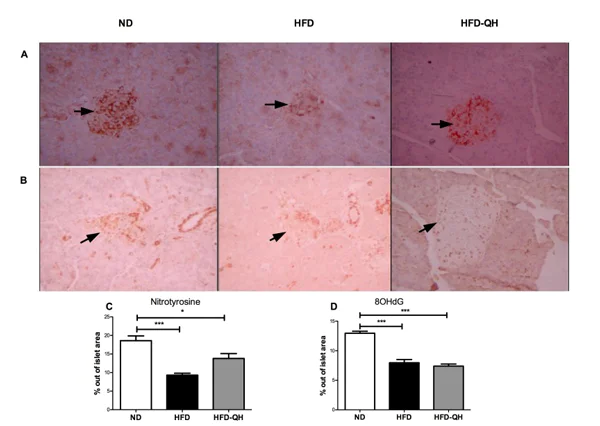
Immunohistochemistry (Formalin/PFA-fixed paraffin-embedded sections) - Anti-8-Hydroxy-2'-deoxyguanosine antibody [N45.1] (AB48508)
De-paraffinized and dehydrated sections were treated in a microwave oven at low power for 10 min in 0.01 M sodium citrate buffer (pH 6.0) to retrieve antigen, and inactivated endogenous peroxidase using 3% hydrogen peroxide in methanol for 10 min, and blocked with blocking solution for 1 hour at room temperature. Sections were then incubated with 1∶20 dilution of mouse monoclonal antibody to 8-Hydroxy-2'-deoxyguanosine (ab48508) overnight at 4°C. For detection, a biotinylated anti-mouse and HRP-labeled Streptavidin, and staining with DAB was used.
Immunohistochemical staining of nitrotyrosine (A) and 8-hydroxy-2′-deoxyguanosine (B) was performed on 5 rats randomly chosen from each group (ND : chow diet group, HFD : High fat diet, HFD-QH : High fat diet treated with Qing Huo Yi Hao" (QHYH)). An islet is encircled in each quandrant. Black arrows point to islets of Langerhans (Original magnification ×200). Percentage of immunohistochemial positive staining area in islet out of the area of corresponding islet (C, D) was presented. Values and bars represent means±SEM. * and ** denote P<0.05 and P<0.001 versus group ND.
Image from Wu L et al., PLoS ONE 8(4): e60262. Fig 6 doi:10.1371/journal.pone.0060262 Reproduced under the Creative Commons license http://creativecommons.org/licenses/by/4.0/
- IHC-P
AbReview23178****
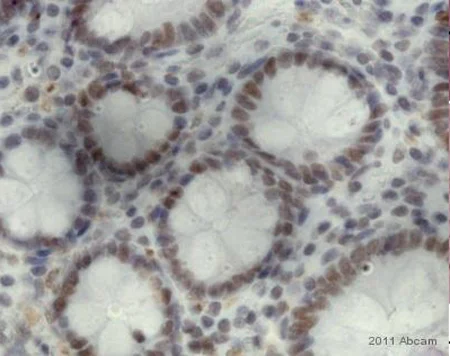
Immunohistochemistry (Formalin/PFA-fixed paraffin-embedded sections) - Anti-8-Hydroxy-2'-deoxyguanosine antibody [N45.1] (AB48508)
ab48508 staining 8-Hydroxy-2'-deoxyguanosine in human colon tissue sections by Immunohistochemistry (IHC-P - paraformaldehyde-fixed, paraffin-embedded sections). Tissue was fixed with paraformaldehyde and antigen retrieval was by heat mediation in a TE buffer. Samples were incubated with primary antibody (1/50) for 30 mins at 20°C. A HRP-conjugated Goat anti-mouse IgG was used as the secondary antibody.
This image is courtesy of an Abreview submitted by Rudolf Jung
- IHC-P
Unknown
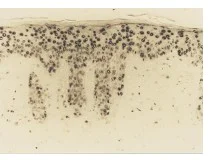
Immunohistochemistry (Formalin/PFA-fixed paraffin-embedded sections) - Anti-8-Hydroxy-2'-deoxyguanosine antibody [N45.1] (AB48508)
ab48508, at a concentration of 5 μg/ml, staining 8-Hydroxy-2'-deoxyguanosine in epidermis from hairless mouse after 4 weeks of treatment by chronic UVB irradiation.
Complementary Products


Reactivity data
Product details
Anti-8-Hydroxy-2'-deoxyguanosine antibody [N45.1] (ab48508) is a mouse monoclonal antibody and is validated for use in IHC-P.
Anti-8-Hydroxy-2'-deoxyguanosine antibody [N45.1] (ab48508) has been cited over 145 times in peer reviewed journals and is trusted by the scientific community.
Abcam's high quality validation processes ensure Anti-8-Hydroxy-2'-deoxyguanosine antibody [N45.1] (ab48508) has high sensitivity and specificity.
Anti-8-Hydroxy-2'-deoxyguanosine antibody [N45.1] (ab48508) has 9 independent reviews from customers.
Anti-8-Hydroxy-2'-deoxyguanosine antibody [N45.1] (ab48508) specifically detects 8-Hydroxy-2'-deoxyguanosine (UniProt ID: ; Molecular weight: kDa) and is sold in 50 µg selling sizes.
This product was changed from ascites to tissue culture supernatant on 27th February 2018. Please note that the dilutions may need to be adjusted accordingly. If you have any questions, please do not hesitate to contact our scientific support team.
Properties and storage information
Form
Purity
Storage buffer
Shipped at conditions
Appropriate short-term storage conditions
Appropriate long-term storage conditions
Aliquoting information
Storage information
Supplementary information
This supplementary information is collated from multiple sources and compiled automatically.
Biological function summary
Oxidative stress impacts DNA integrity and the formation of 8-OHdG indicates damage within the DNA. It does not form part of a larger complex but it results from the interacting effects of ROS on nucleic acids. The presence of 8-OHdG in DNA may also trigger repair processes to fix these oxidized lesions and maintain genomic stability.
Pathways
8-OHdG plays a significant role in pathways responsible for DNA damage response and repair. It involves the base excision repair (BER) pathway important for correcting oxidative lesions. Proteins such as OGG1 (8-oxoguanine glycosylase) recognize and excise 8-OHdG initiating further repair steps to protect genetic information.
Product protocols
- Visit the General protocols
- Visit the Troubleshooting
Publications (203)
Recent publications for all applications. Explore the full listand refine your search
Wound repair and regeneration : official publication of the Wound Healing Society [and] the European Tissue Repair Society 33:e70082 PubMed40880422
2025
Applications
Unspecified application
Species
Unspecified reactive species
Antioxidants (Basel, Switzerland) 14: PubMed40867851
2025
Applications
Unspecified application
Species
Unspecified reactive species
Pediatric research : PubMed40817291
2025
Applications
Unspecified application
Species
Unspecified reactive species
Molecular medicine (Cambridge, Mass.) 31:253 PubMed40618046
2025
Applications
Unspecified application
Species
Unspecified reactive species
Materials today. Bio 33:101972 PubMed40585033
2025
Applications
Unspecified application
Species
Unspecified reactive species
Theranostics 15:6719-6736 PubMed40585986
2025
Applications
Unspecified application
Species
Unspecified reactive species
IUBMB life 77:e70030 PubMed40476370
2025
Applications
Unspecified application
Species
Unspecified reactive species
Redox biology 84:103670 PubMed40373621
2025
Applications
Unspecified application
Species
Unspecified reactive species
Journal of orthopaedic translation 52:220-232 PubMed40337550
2025
Applications
Unspecified application
Species
Unspecified reactive species
Liver cancer 14:518-538 PubMed40242795
2025
Applications
Unspecified application
Species
Unspecified reactive species
Product promise
Please note: All products are 'FOR RESEARCH USE ONLY. NOT FOR USE IN DIAGNOSTIC OR THERAPEUTIC PROCEDURES'.
For licensing inquiries, please contact partnerships@abcam.com