Anti-ACOT7 antibody [EPR11317(B)]
- RabMAb
- Recombinant
- What is this?
Be the first to review this product! Submit a review
|
(2 Publications )
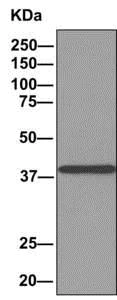
- IP
Unknown
Immunoprecipitation - Anti-ACOT7 antibody [EPR11317(B)] (AB156576)
WB analysis of immunoprecipites
ab156576, at a 1/1000 dilution, staining ACOT7 in Jurkat cell lysate immunoprecipitated using ab156576 at 1/100 dilution.
All lanes:
Immunoprecipitation - Anti-ACOT7 antibody [EPR11317(B)] (ab156576)
Predicted band size: 42 kDa
false
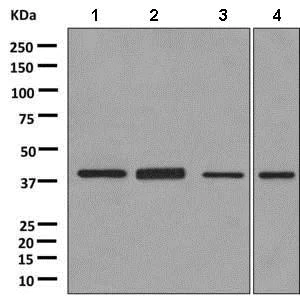
- WB
Unknown
Western blot - Anti-ACOT7 antibody [EPR11317(B)] (AB156576)
All lanes:
Western blot - Anti-ACOT7 antibody [EPR11317(B)] (ab156576) at 1/1000 dilution
Lane 1:
fetal brain cell lysate at 10 µg/mL
Lane 2:
A375 cell lysate at 10 µg/mL
Lane 3:
293T cell lysate at 10 µg/mL
Lane 4:
Jurkat cell lysate at 10 µg/mL
Secondary
All lanes:
HRP labelled goat anti-rabbit at 1/2000 dilution
Predicted band size: 42 kDa
false
Related conjugates and formulations (1)
-
Anti-ACOT7 antibody [EPR11317(B)] - BSA and Azide free
Alternative Products

Complementary Products

Primary Antibodies
AB108602
BOND RX™ Validated|RabMAb|Recombinant|20ul selling size
- 5
- 9
Primary Antibodies
AB126758
20ul selling size|RabMAb|Recombinant|KO Validated
- 0
- 0
Reactivity data
Product details
Patented technology
Our RabMAb® technology is a patented hybridoma-based technology for making rabbit monoclonal antibodies. For details on our patents, please refer to RabMAb® patents.
What are the advantages of a recombinant monoclonal antibody?
This product is a recombinant monoclonal antibody, which offers several advantages including:
- - High batch-to-batch consistency and reproducibility
- - Improved sensitivity and specificity
- - Long-term security of supply
- - Animal-free batch production
For more information, read more on recombinant antibodies.
Properties and storage information
Form
Purification technique
Storage buffer
Shipped at conditions
Appropriate short-term storage conditions
Appropriate long-term storage conditions
Aliquoting information
Storage information
Supplementary information
This supplementary information is collated from multiple sources and compiled automatically.
Biological function summary
ACOT7 influences the regulation of lipid pools and fatty acid signaling in neural cells. It participates in the modulation of free fatty acid concentrations affecting energy metabolism and neuronal function. While ACOT7 does not typically associate with larger protein complexes its enzymatic action impacts the availability and signaling of lipid molecules within the cell potentially influencing cellular responses and energy dynamics.
Pathways
ACOT7 plays a role in fatty acid metabolism and energy homeostasis pathways. It connects with lipid metabolism processes involving enzymes like fatty acid synthase and acyl-CoA synthetase enzymes. By modulating the levels of acyl-CoA and free fatty acids ACOT7 affects broader metabolic pathways that control cellular energy balance and lipid synthesis in brain tissues.
Product protocols
- Visit the General protocols
- Visit the Troubleshooting
Target data
Alternative Names
Publications (2)
Recent publications for all applications. Explore the full listand refine your search
Pharmaceuticals (Basel, Switzerland) 17: PubMed39338366
2024
Applications
Unspecified application
Species
Unspecified reactive species
Cell death & disease 15:573 PubMed39117605
2024
Applications
Unspecified application
Species
Unspecified reactive species
Product promise
Please note: All products are 'FOR RESEARCH USE ONLY. NOT FOR USE IN DIAGNOSTIC OR THERAPEUTIC PROCEDURES'.
For licensing inquiries, please contact partnerships@abcam.com