Anti-AGRP antibody [EPR18155-110]
- BOND RX™ Validated
- RabMAb
- Recombinant
- What is this?
Be the first to review this product! Submit a review
|
(3 Publications )
- Biophysical QC for unrivalled batch-batch consistency
- IHC-P
Unknown
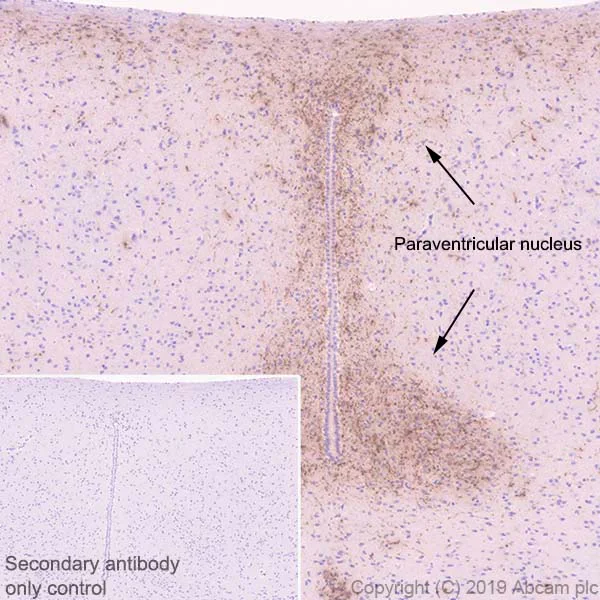
Immunohistochemistry (Formalin/PFA-fixed paraffin-embedded sections) - Anti-AGRP antibody [EPR18155-110] (AB254558)
Immunohistochemical analysis of paraffin-embedded mouse hypothalamus tissue labeling AGRP with ab254558 at 1/100 dilution (5.58 μg/ml) followed by a ready to use Rabbit specific IHC polymer detection kit HRP/DAB (ab209101). Positive staining on paraventricular nucleus of mouse hypothalamus (PMID : 10433222; 9311920) is observed. The section was incubated with ab254558 for 30 mins at room temperature. The immunostaining was performed on a Leica Biosystems BOND® RX instrument. Counterstained with hematoxylin.
Heat mediated antigen retrieval with Tris-EDTA buffer (pH 9.0, epitope retrieval solution 2) for 20 mins.
Secondary antibody only control : Used PBS instead of primary antibody, secondary antibody is a ready to use Rabbit specific IHC polymer detection kit HRP/DAB (ab209101).
- IHC-Fr
Unknown
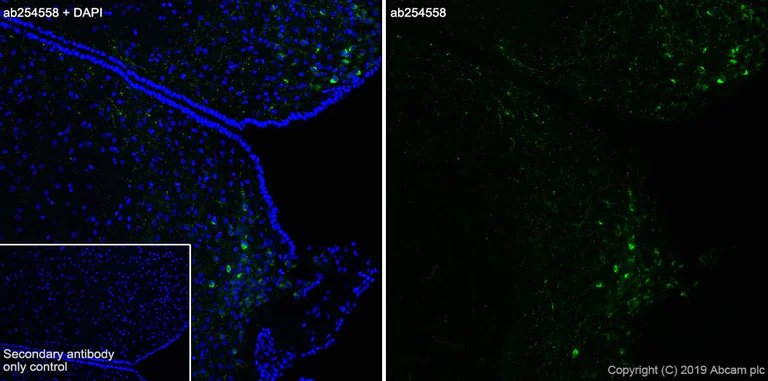
Immunohistochemistry (Frozen sections) - Anti-AGRP antibody [EPR18155-110] (AB254558)
Immunohistochemical analysis of 4% PFA fixed 0.2% Triton X-100 permeabilized frozen mouse hypothalamus tissue labeling ab254558 with AGRP at 1/500 (1.12 μg/ml) dilution followed by ab150077 AlexaFluor®488 Goat anti-Rabbit secondary at 1/1000 (2 μg/ml) dilution. The nuclear counterstain was DAPI (Blue). Heat mediated antigen retrieval using sodium citrate buffer (10mM citrate pH 6.0 + 0.05% Tween-20). Specific staining on arcuate hypothalamic nucleus (PMID : 23638108) is observed.
Secondary antibody only control : Used PBS instead of primary antibody, secondary antibody was ab150077 AlexaFluor®488 Goat anti-Rabbit secondary at 1/1000 (2 μg/ml) dilution.
- IHC-P
Unknown
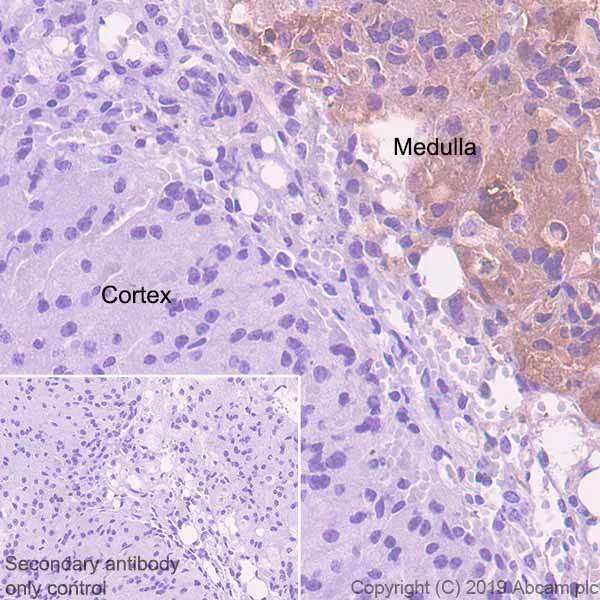
Immunohistochemistry (Formalin/PFA-fixed paraffin-embedded sections) - Anti-AGRP antibody [EPR18155-110] (AB254558)
Immunohistochemical analysis of paraffin-embedded mouse adrenal gland tissue labeling AGRP with ab254558 at 1/100 dilution (5.58 μg/ml) followed by a ready to use Rabbit specific IHC polymer detection kit HRP/DAB (ab209101). Positive staining on medullary cells of mouse adrenal gland (PMID : 28531318; 9311920) is observed. The section was incubated with ab254558 for 30 mins at room temperature. The immunostaining was performed on a Leica Biosystems BOND® RX instrument. Counterstained with hematoxylin.
Heat mediated antigen retrieval with Tris-EDTA buffer (pH 9.0, epitope retrieval solution 2) for 20 mins.
Secondary antibody only control : Used PBS instead of primary antibody, secondary antibody is a ready to use Rabbit specific IHC polymer detection kit HRP/DAB (ab209101) .
Related conjugates and formulations (1)
-
Anti-AGRP antibody [EPR18155-110] - BSA and Azide free
Alternative Products

Complementary Products
Primary Antibodies
AB254257
Anti-POMC antibody [EPR22534-165]
20ul selling size|BOND RX™ Validated|RabMAb|Recombinant

- 4
- 1
Primary Antibodies
AB221145
Anti-Neuropeptide Y antibody [EPR21877]
BOND RX™ Validated|20ul selling size|RabMAb|Advanced Validation|Recombinant

- 4
- 2
Primary Antibodies
AB302667
BOND RX™ Validated|Recombinant|Lab Essentials|KO Validated

- 0
- 0

Reactivity data
Product details
What is this antibody validated in?
Anti-AGRP antibody [EPR18155-110] (ab254558) is a rabbit recombinant monoclonal antibody and is validated for use in Immunohistochemistry (IHC-P), Immunohistochemistry (IHC-Fr) in Mouse samples.
Other related products
We have a range of other formats of antibody clone [EPR18155-110] also available for your convenience: ab254558, Carrier free - ab255686
Patented technology
Our RabMAb® technology is a patented hybridoma-based technology for making rabbit monoclonal antibodies. For details on our patents, please refer to RabMAb® patents.
What are the advantages of a recombinant monoclonal antibody?
This product is a recombinant monoclonal antibody, which offers several advantages including:
- - High batch-to-batch consistency and reproducibility
- - Improved sensitivity and specificity
- - Long-term security of supply
- - Animal-free batch production
For more information, read more on recombinant antibodies.
Properties and storage information
Form
Purification technique
Storage buffer
Shipped at conditions
Appropriate short-term storage duration
Appropriate short-term storage conditions
Appropriate long-term storage conditions
Aliquoting information
Storage information
Supplementary information
This supplementary information is collated from multiple sources and compiled automatically.
Biological function summary
AGRP is involved in the regulation of feeding behavior and body weight. It does not function as part of a larger complex but operates effectively as an antagonist in its own right. When expressed AGRP influences energy expenditure and food intake contributing to how the body regulates hunger and satiety. Its activity helps to modulate signaling pathways that can increase the desire to eat when energy stores are depleted.
Pathways
AGRP plays a notable role in the melanocortin pathway and influences the hypothalamic signaling pathways related to energy balance. It interacts with melanocortin receptors as part of this system modulating signals that maintain energy homeostasis. AGRP is closely related to orexigenic pathways working alongside other proteins like neuropeptide Y (NPY) which further stimulate appetite and food intake.
Product protocols
- Visit the General protocols
- Visit the Troubleshooting
Target data
Alternative Names
Publications (3)
Recent publications for all applications. Explore the full listand refine your search
Journal of lipid research 66:100736 PubMed39724960
2024
Applications
Unspecified application
Species
Unspecified reactive species
Theranostics 14:6605-6624 PubMed39479445
2024
Applications
Unspecified application
Species
Unspecified reactive species
Frontiers in oncology 11:650054 PubMed34277403
2021
Applications
Unspecified application
Species
Unspecified reactive species
Product promise
Please note: All products are 'FOR RESEARCH USE ONLY. NOT FOR USE IN DIAGNOSTIC OR THERAPEUTIC PROCEDURES'.
For licensing inquiries, please contact partnerships@abcam.com