Alexa Fluor® 488 Anti-Ras antibody [EPR23474-20]
- BOND RX™ Validated
- RabMAb
- Recombinant
- What is this?
Be the first to review this product! Submit a review
|
(0 Publication)
- IHC-P
Lab
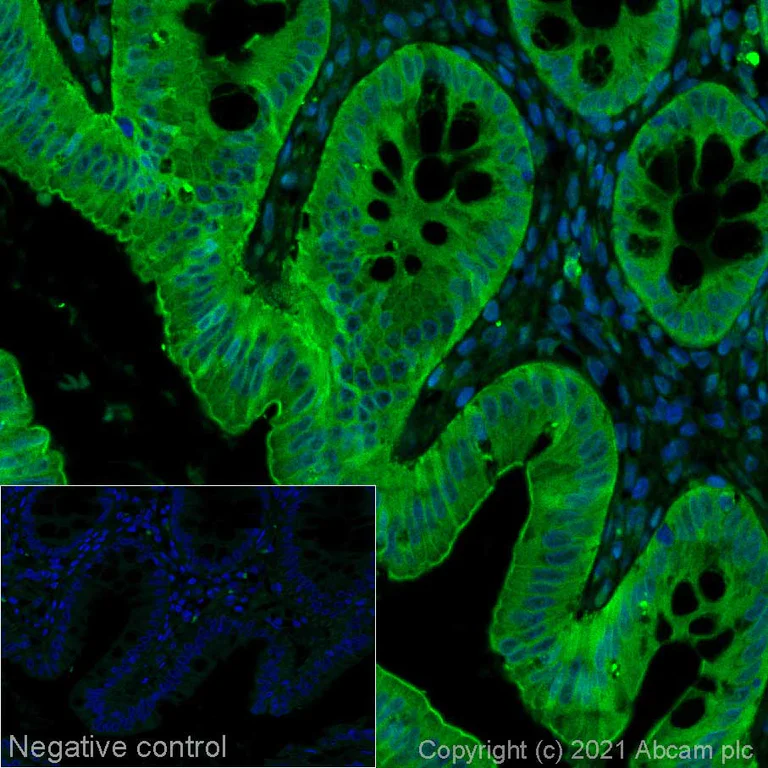
Immunohistochemistry (Formalin/PFA-fixed paraffin-embedded sections) - Alexa Fluor® 488 Anti-Ras antibody [EPR23474-20] (AB281755)
Immunofluorescence staining of KRAS+HRAS+NRAS staining in a section of formalin-fixed paraffin-embedded human normal colon*.
Performed on a Leica BOND. The section was pre-treated using heat mediated antigen retrieval with EDTA (pH9.0) using retrieval settings of 110°C for 20 minutes. The section was then incubated at room temperature for 1 hour with ab281755 at 1/200 dilution (shown in green). Nuclear DNA was labelled with DAPI (shown in blue). The section was then mounted using Dako Fluorescence Mounting Medium®.
Image was taken with a confocal microscope (Leica-Microsystems, TCS SP8).
For other IHC staining systems (automated and non-automated), customers should optimize variable parameters such as antigen retrieval conditions, antibody concentrations and incubation times.
*Tissue obtained from the Human Research Tissue Bank, supported by the NIHR Cambridge Biomedical Research Centre.
Related conjugates and formulations (2)
-
Anti-Ras antibody [EPR23474-20]
-
Anti-Ras antibody [EPR23474-20] - BSA and Azide free
Complementary Products
Primary Antibodies
AB209606
Alexa Fluor® 647 Anti-TOMM20 antibody [EPR15581-54] - Mitochondrial Marker
RabMAb|Recombinant

- 5
- 2
Primary Antibodies
AB275876
Anti-KRAS antibody [EPR23474-76]
20ul selling size|KO Validated|RabMAb|Recombinant
- 3
- 8
Primary Antibodies
AB202709
Alexa Fluor® 647 Anti-Nucleolin antibody [EPR7952]
RabMAb|Recombinant
- 0
- 0
Primary Antibodies
AB194119
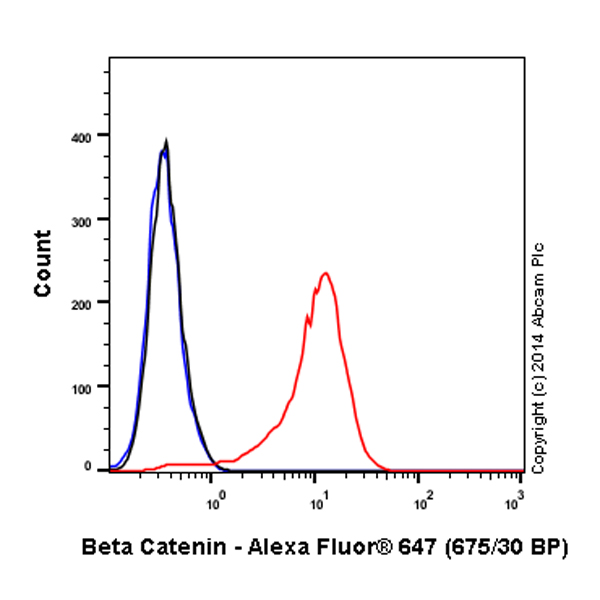
Alexa Fluor® 647 Anti-beta Catenin antibody [E247]
RabMAb|Recombinant|KO Validated
- 0
- 0
Reactivity data
Product details
Patented technology
Our RabMAb® technology is a patented hybridoma-based technology for making rabbit monoclonal antibodies. For details on our patents, please refer to RabMAb® patents.
What are the advantages of a recombinant monoclonal antibody?
This product is a recombinant monoclonal antibody, which offers several advantages including:
- - High batch-to-batch consistency and reproducibility
- - Improved sensitivity and specificity
- - Long-term security of supply
- - Animal-free batch production
For more information, read more on recombinant antibodies.
Alexa Fluor® is a registered trademark of Molecular Probes, Inc, a Thermo Fisher Scientific Company. The Alexa Fluor® dye included in this product is provided under an intellectual property license from Life Technologies Corporation. As this product contains the Alexa Fluor® dye, the purchase of this product conveys to the buyer the non-transferable right to use the purchased product and components of the product only in research conducted by the buyer (whether the buyer is an academic or for-profit entity). As this product contains the Alexa Fluor® dye the sale of this product is expressly conditioned on the buyer not using the product or its components, or any materials made using the product or its components, in any activity to generate revenue, which may include, but is not limited to use of the product or its components: in manufacturing; (ii) to provide a service, information, or data in return for payment (iii) for therapeutic, diagnostic or prophylactic purposes; or (iv) for resale, regardless of whether they are sold for use in research. For information on purchasing a license to this product for purposes other than research, contact Life Technologies Corporation, 5781 Van Allen Way, Carlsbad, CA 92008 USA or outlicensing@thermofisher.com.
Properties and storage information
Form
Storage buffer
Shipped at conditions
Appropriate short-term storage duration
Appropriate short-term storage conditions
Appropriate long-term storage conditions
Aliquoting information
Storage information
Supplementary information
This supplementary information is collated from multiple sources and compiled automatically.
Biological function summary
Ras proteins are pivotal in regulating cell proliferation differentiation and survival. They are often part of larger protein complexes that facilitate signal transduction across cell membranes. These proteins function as binary molecular switches toggling between active (GTP-bound) and inactive (GDP-bound) states. Mutations in Ras proteins such as NRAS Q61R can lead the protein to assume permanently active conformations disrupting normal cellular signaling processes and contributing to oncogenesis.
Pathways
Ras proteins play significant roles in the MAPK/ERK and PI3K/AKT signaling pathways. Their activation leads to a cascade of phosphorylation events that ultimately regulate gene expression. Within these pathways Ras proteins interact with various molecules including RAF kinases and the PI3K protein further illustrating their complex roles in signal propagation. These pathways control many cellular processes including growth differentiation and survival illustrating how Ras proteins integrate multiple signals to modulate cellular outcomes.
Product protocols
- Visit the General protocols
- Visit the Troubleshooting
Target data
Alternative Names
Product promise
Please note: All products are 'FOR RESEARCH USE ONLY. NOT FOR USE IN DIAGNOSTIC OR THERAPEUTIC PROCEDURES'.
For licensing inquiries, please contact partnerships@abcam.com