JavaScript is disabled in your browser. Please enable JavaScript to view this website.
AB151474

Anti-alpha Adducin antibody - N-terminal

3

(1 Review)

|

(1 Publication)

Rabbit Polyclonal alpha Adducin antibody. Suitable for WB, IHC-P and reacts with Mouse, Human samples. Cited in 1 publication. Immunogen corresponding to Recombinant Fragment Protein within Human ADD1 aa 1-250.

View Alternative Names

ADDA, ADD1, Alpha-adducin, Erythrocyte adducin subunit alpha
2 Images
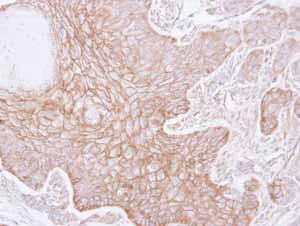
Immunohistochemistry (Formalin/PFA-fixed paraffin-embedded sections) - Anti-alpha Adducin antibody - N-terminal (AB151474)
  • IHC-P

Unknown

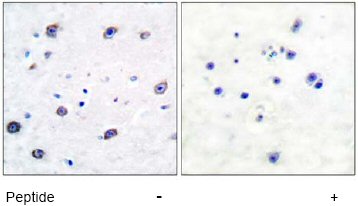
Immunohistochemistry (Formalin/PFA-fixed paraffin-embedded sections) - Anti-alpha Adducin antibody - N-terminal (AB151474)

Immunohistochemical analysis of paraffin-embedded SG xenograft labeling alpha Adducin with ab151474 at 1/100.
Western blot - Anti-alpha Adducin antibody - N-terminal (AB151474)
  • WB

Unknown

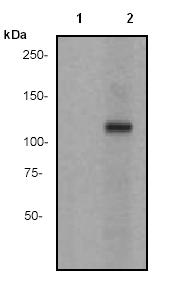
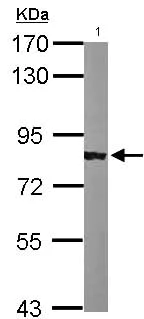
Western blot - Anti-alpha Adducin antibody - N-terminal (AB151474)

7.5% SDS PAGE

All lanes:

Western blot - Anti-alpha Adducin antibody - N-terminal (ab151474) at 1/1000 dilution

All lanes:

Mouse liver whole cell lysate at 50 µg

Predicted band size: 81 kDa

false

Key facts

Host species

Rabbit

Clonality

Polyclonal

Isotype

IgG

Carrier free

No

Reacts with

Mouse, Human

Applications

WB, IHC-P

applications

Immunogen

Recombinant Fragment Protein within Human ADD1 aa 1-250. The exact immunogen used to generate this antibody is proprietary information.

P35611

Reactivity data

{ "title": "Reactivity Data", "filters": { "stats": ["", "Species", "Dilution Info", "Notes"], "tabs": { "all-applications": {"fullname" : "All Applications", "shortname": "All Applications"}, "WB" : {"fullname" : "Western blot", "shortname":"WB"}, "IHCP" : {"fullname" : "Immunohistochemistry (Formalin/PFA-fixed paraffin-embedded sections)", "shortname":"IHC-P"} }, "product-promise": { "all": "all", "testedAndGuaranteed": "tested", "guaranteed": "expected", "predicted": "predicted", "notRecommended": "not-recommended" } }, "values": { "Human": { "WB-species-checked": "guaranteed", "WB-species-dilution-info": "1/500 - 1/3000", "WB-species-notes": "<p></p>", "IHCP-species-checked": "testedAndGuaranteed", "IHCP-species-dilution-info": "1/100 - 1/1000", "IHCP-species-notes": "<p></p>" }, "Mouse": { "WB-species-checked": "testedAndGuaranteed", "WB-species-dilution-info": "1/500 - 1/3000", "WB-species-notes": "<p></p>", "IHCP-species-checked": "guaranteed", "IHCP-species-dilution-info": "", "IHCP-species-notes": "" }, "Rat": { "WB-species-checked": "predicted", "WB-species-dilution-info": "", "WB-species-notes": "", "IHCP-species-checked": "predicted", "IHCP-species-dilution-info": "", "IHCP-species-notes": "" }, "Chicken": { "WB-species-checked": "predicted", "WB-species-dilution-info": "", "WB-species-notes": "", "IHCP-species-checked": "predicted", "IHCP-species-dilution-info": "", "IHCP-species-notes": "" }, "Cow": { "WB-species-checked": "predicted", "WB-species-dilution-info": "", "WB-species-notes": "", "IHCP-species-checked": "predicted", "IHCP-species-dilution-info": "", "IHCP-species-notes": "" }, "Xenopus laevis": { "WB-species-checked": "predicted", "WB-species-dilution-info": "", "WB-species-notes": "", "IHCP-species-checked": "predicted", "IHCP-species-dilution-info": "", "IHCP-species-notes": "" }, "Xenopus tropicalis": { "WB-species-checked": "predicted", "WB-species-dilution-info": "", "WB-species-notes": "", "IHCP-species-checked": "predicted", "IHCP-species-dilution-info": "", "IHCP-species-notes": "" } } }

Properties and storage information

Form
Liquid
Purification technique
Affinity purification Immunogen
Storage buffer
pH: 7 Preservative: 0.01% Thimerosal (merthiolate) Constituents: 10% Glycerol (glycerin, glycerine), 1.21% Tris, 0.75% Glycine
Shipped at conditions
Blue Ice
Appropriate short-term storage conditions
+4°C
Appropriate long-term storage conditions
-20°C
Aliquoting information
Upon delivery aliquot
Storage information
Avoid freeze / thaw cycle

Supplementary information

This supplementary information is collated from multiple sources and compiled automatically.

Alpha Adducin also known as ADD1 is a cytoskeletal protein of roughly 80 kDa. It plays a significant mechanical role in the assembly of the spectrin-actin network which stabilizes the membrane of erythrocytes and other cells. It is expressed in various tissues with high levels in neurons and kidney cells. Maintenance of cytoskeletal integrity is an important mechanical function of alpha Adducin.
Biological function summary

This protein influences cellular shape and motility. It forms a complex with spectrin and actin to strengthen cell membranes and facilitate intercellular connectivity. Alpha Adducin modulates the dynamics of membrane skeleton structures impacting not only the stability but also the function of cells under both physiological and pathophysiological conditions.

Pathways

Alpha Adducin is integral in the regulation of the Rho and calcium signaling pathways. These pathways influence cytoskeletal organization and cell life processes. In the Rho pathway alpha Adducin interacts with proteins such as Rho GTPases which are involved in signal transduction for cytoskeletal rearrangement. This interaction shows its importance in cellular reaction to environmental stimuli and stress.

Alpha Adducin shows significant connections to hypertension and certain neurological disorders. Variants of ADD1 have been linked to altered blood pressure regulation implicating its role in hypertension through interactions with sodium-potassium ATPases. It also connects to spectrin in neurological disorders highlighting its involvement in maintaining neuronal architecture and function.

Product protocols

For this product, it's our understanding that no specific protocols are required. You can visit:

Target data

Membrane-cytoskeleton-associated protein that promotes the assembly of the spectrin-actin network. Binds to calmodulin.
See full target information ADD1

Publications (1)

Recent publications for all applications. Explore the full list and refine your search

PloS one 16:e0247169 PubMed33596246

2021

Downregulation of PAICS due to loss of chromosome 4q is associated with poor survival in stage III colorectal cancer.

Applications

Unspecified application

Species

Unspecified reactive species

Yusuke Kobayashi,Kensuke Kumamoto,Hirokazu Okayama,Takuro Matsumoto,Hiroshi Nakano,Katsuharu Saito,Yoshiko Matsumoto,Eisei Endo,Yasuyuki Kanke,Yohei Watanabe,Hisashi Onozawa,Shotaro Fujita,Wataru Sakamoto,Motonobu Saito,Tomoyuki Momma,Seiichi Takenoshita,Koji Kono
View all publications

Product promise

We are committed to supporting your work with high-quality reagents, and we're here for you every step of the way. In the unlikely event that one of our products does not perform as expected, you're protected by our Product Promise.
For full details, please see our Terms & Conditions

Please note: All products are 'FOR RESEARCH USE ONLY. NOT FOR USE IN DIAGNOSTIC OR THERAPEUTIC PROCEDURES'.

For licensing inquiries, please contact partnerships@abcam.com