JavaScript is disabled in your browser. Please enable JavaScript to view this website.
AB89119

Anti-Amphiregulin antibody [MM0089-8K16]

Be the first to review this product! Submit a review

|

(3 Publications )

Anti-Amphiregulin antibody [MM0089-8K16] (ab89119) is a mouse monoclonal antibody detecting Amphiregulin in Western Blot. Suitable for Human.

- Trusted since 2010

Key facts

Host species

Mouse

Clonality

Monoclonal

Clone number

MM0089-8K16

Isotype

IgG1

Carrier free

Yes

Reacts with

Human

Applications

WB

applications

Immunogen

Recombinant Full Length Protein corresponding to Human AREG.

P15514

Reactivity data

{ "title": "Reactivity Data", "filters": { "stats": ["", "Species", "Dilution Info", "Notes"], "tabs": { "all-applications": {"fullname" : "All Applications", "shortname": "All Applications"}, "WB" : {"fullname" : "Western blot", "shortname":"WB"} }, "product-promise": { "all": "all", "testedAndGuaranteed": "tested", "guaranteed": "expected", "predicted": "predicted", "notRecommended": "not-recommended" } }, "values": { "Human": { "WB-species-checked": "testedAndGuaranteed", "WB-species-dilution-info": "1/500 - 1/1000", "WB-species-notes": "<p></p>" } } }

Product details

What is this antibody validated in?
Anti-Amphiregulin antibody [MM0089-8K16] (ab89119) is a mouse monoclonal antibody and is validated for use in Western Blot (WB) in Human samples.

What is the molecular weight of Amphiregulin?
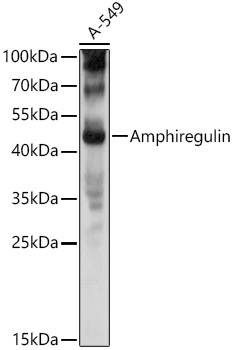
Anti-Amphiregulin [MM0089-8K16] (ab89119) specifically detects a band for Amphiregulin (UniProt: P15514) at a molecular weight of 28kDa.

Properties and storage information

Form
Liquid
Purification technique
Affinity purification Protein G
Storage buffer
Constituents: PBS
Shipped at conditions
Blue Ice
Appropriate short-term storage conditions
+4°C
Appropriate long-term storage conditions
-20°C
Aliquoting information
Upon delivery aliquot
Storage information
Avoid freeze / thaw cycle

Supplementary information

This supplementary information is collated from multiple sources and compiled automatically.

'Amphiregulin' also known as 'AREG' or 'Amphiregulin protein' is a member of the epidermal growth factor (EGF) family. It is a 252 amino acid protein with a predicted mass of approximately 27-29 kDa. Amphiregulin shows expression in various tissues including epithelial cells fibroblasts and immune cells. This protein functions as a ligand for the EGF receptor (EGFR) leading to receptor dimerization and subsequent activation of downstream signaling pathways.
Biological function summary

'Amphiregulin' plays a critical role in cell proliferation differentiation and tissue remodeling. It is not part of a constitutive complex but rather exerts its effects through interaction with EGFR a receptor tyrosine kinase. Amphiregulin contributes significantly to mammary gland development and has a notable role in wound healing. Beyond its developmental roles Amphiregulin can impact immune modulation and inflammation processes.

Pathways

'Amphiregulin' significantly contributes to the mitogen-activated protein kinase (MAPK) and phosphoinositide 3-kinase (PI3K) pathways. These pathways influence cell survival growth and proliferation. Amphiregulin interacts with EGFR and by extension has relationships with other EGFR ligands such as EGF and transforming growth factor-alpha (TGF-alpha). These pathways underline the importance of Amphiregulin in maintaining cellular functions and responding to external stimuli.

'Amphiregulin' has strong associations with cancer and asthma. Overexpression of Amphiregulin can lead to increased cancer cell proliferation and it has been implicated in diverse cancers such as breast and colorectal cancer. Additionally the protein plays a role in airway remodeling in asthma contributing to bronchial hyper-responsiveness. In these contexts Amphiregulin's interactions with EGFR are central influencing disease progression and response to treatment.

Product protocols

For this product, it's our understanding that no specific protocols are required. You can visit:

Target data

Ligand of the EGF receptor/EGFR. Autocrine growth factor as well as a mitogen for a broad range of target cells including astrocytes, Schwann cells and fibroblasts.
See full target information AREG

Alternative Names

AREGB, SDGF, AREG, Amphiregulin, AR, Colorectum cell-derived growth factor, CRDGF

Publications (3)

Recent publications for all applications. Explore the full listand refine your search

Archives of endocrinology and metabolism 68:e240094 PubMed39876971

2025

Triiodothyronine (T3) increases the expression of the amphiregulin (AREG) oncogene by activating extranuclear pathways in MCF-7 breast cancer cells.

Applications

Unspecified application

Species

Unspecified reactive species

Maria Teresa De Sibio,Fernanda Cristina Fontes Moretto,Regiane Marques Castro Olimpio,Miriane de Oliveira,Lucas Solla Mathias,Vinícius Vigliazzi Peghinelli,Helena Paim Tilli,Bianca Mariani Gonçalves,Dariane Beatriz Marino Cardoso,Larissa Silva Dall Aqua,Igor de Carvalho Depra,Mariana Menezes Lourenço,Aline Carbonera Luvizon,Paula de Oliveira Montandon Hokama,Maria Tereza Nunes,Marna Eliana Sakalem,Célia Regina Nogueira

Nature 617:386-394 PubMed37100912

2023

A druggable copper-signalling pathway that drives inflammation.

Applications

Unspecified application

Species

Unspecified reactive species

Stéphanie Solier,Sebastian Müller,Tatiana Cañeque,Antoine Versini,Arnaud Mansart,Fabien Sindikubwabo,Leeroy Baron,Laila Emam,Pierre Gestraud,G Dan Pantoș,Vincent Gandon,Christine Gaillet,Ting-Di Wu,Florent Dingli,Damarys Loew,Sylvain Baulande,Sylvère Durand,Valentin Sencio,Cyril Robil,François Trottein,David Péricat,Emmanuelle Näser,Céline Cougoule,Etienne Meunier,Anne-Laure Bègue,Hélène Salmon,Nicolas Manel,Alain Puisieux,Sarah Watson,Mark A Dawson,Nicolas Servant,Guido Kroemer,Djillali Annane,Raphaël Rodriguez

Journal of oncology 2022:5456016 PubMed36164345

2022

miR-187/PDLIM1 Gets Involved in Gastric Cancer Progression and Cisplatin Sensitivity of Cisplatin by Mediating the Hippo-YAP Signaling Pathway.

Applications

Unspecified application

Species

Unspecified reactive species

Yeru Tan,Yuehua Li,Hongbo Zhu,Xiaoping Wu,Kai Mei,Pian Li,Qiao Yang
View all publications

Product promise

We are committed to supporting your work with high-quality reagents, and we're here for you every step of the way. In the unlikely event that one of our products does not perform as expected, you're protected by our Product Promise.
For full details, please see our Terms & Conditions

Please note: All products are 'FOR RESEARCH USE ONLY. NOT FOR USE IN DIAGNOSTIC OR THERAPEUTIC PROCEDURES'.

For licensing inquiries, please contact partnerships@abcam.com