Anti-ANP32C/PP32R1 antibody [EPR13354]
- RabMAb
- Recombinant
- What is this?
Be the first to review this product! Submit a review
|
(5 Publications )
Rabbit Recombinant Monoclonal ANP32C/PP32R1 antibody. Suitable for IP, WB, ICC/IF, Flow Cyt (Intra) and reacts with Human samples. Cited in 5 publications.
View Alternative Names
PP32R1, ANP32CP, Putative uncharacterized protein ANP32CP, Acidic leucine-rich nuclear phosphoprotein 32 family member C, Phosphoprotein 32-related protein 1, Tumorigenic protein pp32r1
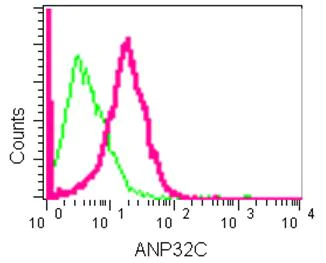
- Flow Cyt (Intra)
Supplier Data
Flow Cytometry (Intracellular) - Anti-ANP32C/PP32R1 antibody [EPR13354] (AB181242)
Intracellular flow cytometric analysis of 2% paraformaldehyde-fixed MCF-7 cells labeling ANP32C/PP32R1 with ab181242 at 1/20 dilution (red), compared to a Rabbit monoclonal IgG isotype control (green), followed by Goat anti rabbit IgG (FITC) secondary antibodyat 1/150 dilution.
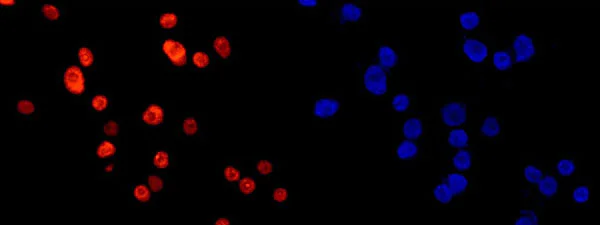
- ICC/IF
Supplier Data
Immunocytochemistry/ Immunofluorescence - Anti-ANP32C/PP32R1 antibody [EPR13354] (AB181242)
Immunofluorescent analysis of 4% paraformaldehyde-fixed PC-3 cells labeling ANP32C/PP32R1 with ab181242 at 1/250 dilution followed by Goat anti rabbit IgG (Alexa Fluor®555) secondary antibody at 1/200 dilution. Counter stained with Dapi (blue).
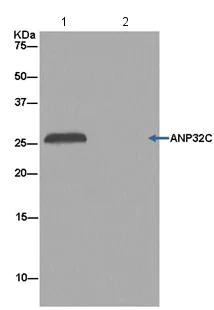
- IP
Supplier Data
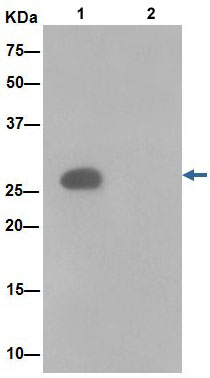
Immunoprecipitation - Anti-ANP32C/PP32R1 antibody [EPR13354] (AB181242)
Western blot analysis of ANP32C/PP32R1 in MCF-7 cell lysate immunoprecipitated with ab181242 at 1/50 dilution.
Secondary : Anti-Rabbit IgG (HRP), specific to the non-reduced form of IgG at 1/1500 dilution.
All lanes:
Immunoprecipitation - Anti-ANP32C/PP32R1 antibody [EPR13354] (ab181242)
Predicted band size: 27 kDa
Observed band size: 27 kDa
false
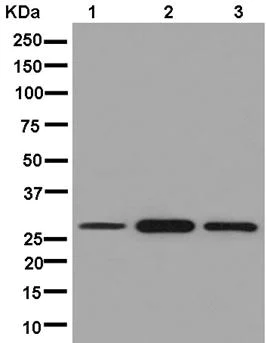
- WB
Supplier Data
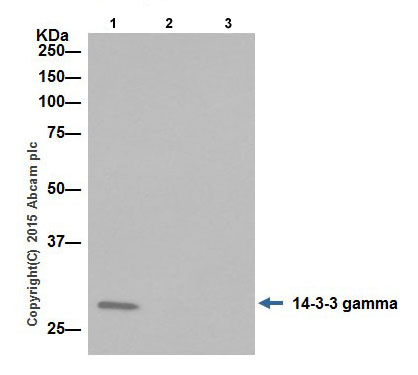
Western blot - Anti-ANP32C/PP32R1 antibody [EPR13354] (AB181242)
All lanes:
Western blot - Anti-ANP32C/PP32R1 antibody [EPR13354] (ab181242) at 1/10000 dilution
Lane 1:
HUVEC cell lysate at 20 µg
Lane 2:
PC-3 cell lysate at 20 µg
Lane 3:
BxPC-3 cell lysate at 20 µg
Secondary
All lanes:
Goat anti-rabbit IgG, (H+L), peroxidase conjugate at 1/1000 dilution
Predicted band size: 27 kDa
Observed band size: 27 kDa
false
Related conjugates and formulations (1)
-
Anti-ANP32C/PP32R1 antibody [EPR13354] - BSA and Azide free
Alternative Products
Complementary Products
Primary Antibodies
AB181602
Anti-GAPDH antibody [EPR16891] - Loading Control
RabMAb|Recombinant|Lab Essentials|20ul selling size

- 5
- 23
Primary Antibodies
AB16667
BOND RX™ Validated|KO Validated|RabMAb|Advanced Validation|Recombinant|20ul selling size

- 5
- 133
Primary Antibodies
AB32083
20ul selling size|RabMAb|Recombinant|KO Validated
- 4
- 1
Reactivity data
Product details
Patented technology
Our RabMAb® technology is a patented hybridoma-based technology for making rabbit monoclonal antibodies. For details on our patents, please refer to RabMAb® patents.
What are the advantages of a recombinant monoclonal antibody?
This product is a recombinant monoclonal antibody, which offers several advantages including:
- - High batch-to-batch consistency and reproducibility
- - Improved sensitivity and specificity
- - Long-term security of supply
- - Animal-free batch production
For more information, read more on recombinant antibodies.
Properties and storage information
Form
Purity
Storage buffer
Shipped at conditions
Appropriate short-term storage duration
Appropriate short-term storage conditions
Appropriate long-term storage conditions
Aliquoting information
Storage information
Supplementary information
This supplementary information is collated from multiple sources and compiled automatically.
Biological function summary
ANP32C influences multiple cellular events including regulation of gene expression apoptosis and chromatin modification. It is part of several multiprotein complexes which contribute to its role in transcriptional regulation and cell cycle progression. The interaction of ANP32C with histone acetyltransferases plays a significant role in chromatin remodeling affecting gene expression patterns. This protein's actions are critical for maintaining normal cellular functions and responding to stress conditions.
Pathways
ANP32C engages in the apoptotic and inflammatory signaling pathways. It associates with proteins such as caspases and NF-kappa B influencing cell survival and immune responses. ANP32C's participation in the apoptotic pathway reflects its role in regulating programmed cell death a fundamental process for tissue homeostasis and development. Its interaction with inflammatory mediators highlights its contribution to immune responses and potential implications in inflammatory conditions.
Product protocols
- Visit the General protocols
- Visit the Troubleshooting
Target data
Publications (5)
Recent publications for all applications. Explore the full list and refine your search
Journal of virology 99:e0180424 PubMed39846741
2025
Applications
Unspecified application
Species
Unspecified reactive species
Cellular and molecular biology (Noisy-le-Grand, France) 70:116-120 PubMed39262254
2024
Applications
Unspecified application
Species
Unspecified reactive species
BMC cardiovascular disorders 24:197 PubMed38580957
2024
Applications
Unspecified application
Species
Unspecified reactive species
Cardiovascular therapeutics 2022:2715084 PubMed35599721
2022
Applications
Unspecified application
Species
Unspecified reactive species
Journal of cellular and molecular medicine 25:7867-7877 PubMed34190420
2021
Applications
Unspecified application
Species
Unspecified reactive species
Product promise
Please note: All products are 'FOR RESEARCH USE ONLY. NOT FOR USE IN DIAGNOSTIC OR THERAPEUTIC PROCEDURES'.
For licensing inquiries, please contact partnerships@abcam.com