JavaScript is disabled in your browser. Please enable JavaScript to view this website.
AB126598

Anti-Antithrombin III/ATIII antibody [EP5372]

Be the first to review this product! Submit a review

|

(17 Publications )
Rabbit Recombinant Monoclonal Antithrombin III/ATIII antibody. Suitable for WB and reacts with Human, Mouse, Rat samples. Cited in 17 publications.
2 Images
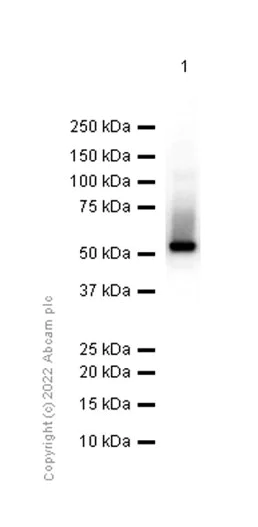
Western blot - Anti-Antithrombin III/ATIII antibody [EP5372] (AB126598)
  • WB

Supplier Data

Western blot - Anti-Antithrombin III/ATIII antibody [EP5372] (AB126598)

Blocking and diluting buffer and concentration : 5% NFDM/TBST.

All lanes:

Western blot - Anti-Antithrombin III/ATIII antibody [EP5372] (ab126598) at 1/10000 dilution

All lanes:

Human plasma lysate at 15 µg

Secondary

All lanes:

Goat Anti-Rabbit IgG (HRP) with minimal cross-reactivity with Human IgG at 1/2000 dilution

Observed band size: 52 kDa

false

Exposure time: 3s
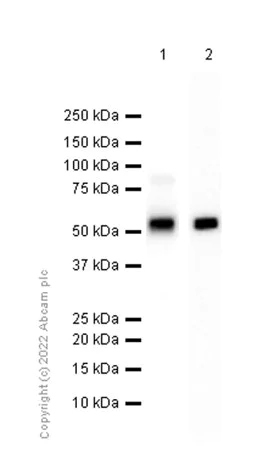
Western blot - Anti-Antithrombin III/ATIII antibody [EP5372] (AB126598)
  • WB

Supplier Data

Western blot - Anti-Antithrombin III/ATIII antibody [EP5372] (AB126598)

Blocking and diluting buffer and concentration : 5% NFDM/TBST.

All lanes:

Western blot - Anti-Antithrombin III/ATIII antibody [EP5372] (ab126598) at 1/10000 dilution

Lane 1:

Mouse lung lysate at 15 µg

Lane 2:

Rat lung lysate at 15 µg

Secondary

All lanes:

Western blot - Goat Anti-Rabbit IgG H&L (HRP) (<a href='/en-us/products/secondary-antibodies/goat-rabbit-igg-h-l-hrp-ab97051'>ab97051</a>) at 1/2000 dilution

Observed band size: 52 kDa

false

  • Carrier free

    Anti-Antithrombin III/ATIII antibody [EP5372] - BSA and Azide free (Capture)

  • Carrier free

    Anti-Antithrombin III/ATIII antibody [EP5372] - BSA and Azide free

Key facts

Host species

Rabbit

Clonality

Monoclonal

Clone number

EP5372

Isotype

IgG

Carrier free

No

Reacts with

Mouse, Rat, Human

Applications

WB

applications

Immunogen

The exact immunogen used to generate this antibody is proprietary information.

Reactivity data

{ "title": "Reactivity Data", "filters": { "stats": ["", "Species", "Dilution Info", "Notes"], "tabs": { "all-applications": {"fullname" : "All Applications", "shortname": "All Applications"}, "WB" : {"fullname" : "Western blot", "shortname":"WB"}, "ICCIF" : {"fullname" : "Immunocytochemistry/ Immunofluorescence", "shortname":"ICC/IF"}, "FlowCyt" : {"fullname" : "Flow Cytometry", "shortname":"Flow Cyt"} }, "product-promise": { "all": "all", "testedAndGuaranteed": "tested", "guaranteed": "expected", "predicted": "predicted", "notRecommended": "not-recommended" } }, "values": { "Human": { "WB-species-checked": "testedAndGuaranteed", "WB-species-dilution-info": "1/10000", "WB-species-notes": "<p></p>", "ICCIF-species-checked": "notRecommended", "ICCIF-species-dilution-info": "", "ICCIF-species-notes": "<p></p>", "FlowCyt-species-checked": "notRecommended", "FlowCyt-species-dilution-info": "", "FlowCyt-species-notes": "<p></p>" }, "Mouse": { "WB-species-checked": "testedAndGuaranteed", "WB-species-dilution-info": "1/10000", "WB-species-notes": "<p></p>", "ICCIF-species-checked": "notRecommended", "ICCIF-species-dilution-info": "", "ICCIF-species-notes": "", "FlowCyt-species-checked": "notRecommended", "FlowCyt-species-dilution-info": "", "FlowCyt-species-notes": "" }, "Rat": { "WB-species-checked": "testedAndGuaranteed", "WB-species-dilution-info": "1/10000", "WB-species-notes": "<p></p>", "ICCIF-species-checked": "notRecommended", "ICCIF-species-dilution-info": "", "ICCIF-species-notes": "", "FlowCyt-species-checked": "notRecommended", "FlowCyt-species-dilution-info": "", "FlowCyt-species-notes": "" } } }

Product details

Patented technology
Our RabMAb® technology is a patented hybridoma-based technology for making rabbit monoclonal antibodies. For details on our patents, please refer to RabMAb® patents.

What are the advantages of a recombinant monoclonal antibody?
This product is a recombinant monoclonal antibody, which offers several advantages including:

  • - High batch-to-batch consistency and reproducibility
  • - Improved sensitivity and specificity
  • - Long-term security of supply
  • - Animal-free batch production

For more information, read more on recombinant antibodies.

Properties and storage information

Form
Liquid
Purification technique
Affinity purification Protein A
Storage buffer
pH: 7.2 - 7.4 Preservative: 0.01% Sodium azide Constituents: PBS, 40% Glycerol (glycerin, glycerine), 0.05% BSA
Shipped at conditions
Conditional Ambient
Appropriate short-term storage conditions
+4°C
Appropriate long-term storage conditions
-20°C
Storage information
Stable for 12 months at -20°C

Supplementary information

This supplementary information is collated from multiple sources and compiled automatically.

Antithrombin III also known as ATIII or antithrombin 3 is a glycoprotein with a mass of approximately 58 kDa. This protein is mainly synthesized in the liver and circulates in the blood plasma. Antithrombin III functions as a serine protease inhibitor targeting and inhibiting several key enzymes involved in blood coagulation including thrombin and Factor Xa. Its activity is influenced by the presence of heparin which increases its inhibitory effects on these enzymes. This interaction is essential for regulating blood clot formation and maintaining hemostatic balance.
Biological function summary

Antithrombin III plays a critical role in blood clotting by specifically inhibiting clotting factors. It forms complexes with its target enzymes leading to their inactivation and preventing excessive thrombin production. The protein does not form part of larger complexes but acts independently to exert its anticoagulant function. The normal range for antithrombin 3 levels in plasma is important for ensuring a balanced blood coagulation system. Its function helps prevent inappropriate clot formation and ensures smooth blood flow through the circulatory system.

Pathways

Antithrombin III is integral to the coagulation cascade. It is primarily involved in the intrinsic and common coagulation pathways where it regulates thrombin and Factor Xa activity. This regulation prevents the unchecked formation of fibrin clots which can lead to thrombosis. ATIII works closely with proteins like heparin cofactor II and protein C which also modulate the coagulation pathway emphasizing its role in maintaining hemostatic balance. Its function is essential in controlling the coagulation cascade and ensuring that it proceeds appropriately without leading to pathology.

Antithrombin III deficiency can lead to coagulation disorders such as thrombophilia characterized by an increased risk of forming clots. Inherited or acquired deficiencies in antithrombin 3 can result in life-threatening thrombotic events. Furthermore liver diseases which affect the production of ATIII can also result in decreased antithrombin activity compounding coagulation problems. Other proteins related to this process include protein S and plasminogen which also play roles in clot regulation and fibrinolysis. Understanding the connection of antithrombin III to these pathways and diseases is important for developing effective therapeutic strategies.

Product protocols

For this product, it's our understanding that no specific protocols are required. You can visit:

Target data

Most important serine protease inhibitor in plasma that regulates the blood coagulation cascade (PubMed : 15140129, PubMed : 15853774). AT-III inhibits thrombin, matriptase-3/TMPRSS7, as well as factors IXa, Xa and XIa (PubMed : 15140129). Its inhibitory activity is greatly enhanced in the presence of heparin.
See full target information SERPINC1

Alternative Names

AT3, PRO0309, SERPINC1, Antithrombin-III, ATIII, Serpin C1

Publications (17)

Recent publications for all applications. Explore the full listand refine your search

Acta neuropathologica communications 13:187 PubMed40898360

2025

Identification and validation of a tear fluid-derived protein biomarker signature in patients with amyotrophic lateral sclerosis.

Applications

Unspecified application

Species

Unspecified reactive species

Lena-Sophie Scholl,Antonia F Demleitner,Jenny Riedel,Seren Adachi,Lisa Neuenroth,Clara Meijs,Laura Tzeplaeff,Lucas Caldi Gomes,Ana Galhoz,Isabell Cordts,Christof Lenz,Michael Menden,Paul Lingor

Cancer reports (Hoboken, N.J.) 7:e2079 PubMed38923313

2024

SERPINC1, a new prognostic predictor of colon cancer, promote colon cancer progression through EMT.

Applications

Unspecified application

Species

Unspecified reactive species

Zhenghong Le,Shuran Chen,Yan Feng,Weichen Lu,Mulin Liu

Scientific data 10:121 PubMed36879013

2023

Protein interactors of 3-O sulfated heparan sulfates in human MCI and age-matched control cerebrospinal fluid.

Applications

Unspecified application

Species

Unspecified reactive species

Andreia Ferreira,Evy Timmerman,An Staes,Marnik Vuylsteke,Louis De Muynck,Kris Gevaert

Frontiers in oncology 11:738607 PubMed34881176

2021

Serpinc1 Acts as a Tumor Suppressor in Hepatocellular Carcinoma Through Inducing Apoptosis and Blocking Macrophage Polarization in an Ubiquitin-Proteasome Manner.

Applications

Unspecified application

Species

Unspecified reactive species

Dacai Xu,Jiawen Wu,Liang Dong,Wenwen Luo,Lanying Li,Daolin Tang,Jinbao Liu

Bioengineered 12:11156-11168 PubMed34783290

2021

Downregulation of microRNA-200c-3p alleviates the aggravation of venous thromboembolism by targeting serpin family C member 1.

Applications

Unspecified application

Species

Unspecified reactive species

Xiaorong Jian,Dehua Yang,Li Wang,Hongxiang Wang

FASEB journal : official publication of the Federation of American Societies for Experimental Biology 35:e21800 PubMed34324733

2021

Cullin 2-RBX1 E3 ligase and USP2 regulate antithrombin ubiquitination and stability.

Applications

Unspecified application

Species

Unspecified reactive species

Dacai Xu,Jiawen Wu,Jinghong Chen,Liling Jiang,Juan Chen,Wenhao Bao,Xin Chen,Qianqian Yang,Xiaolan Zhang,Leyi Yao,Huabo Su,Jinbao Liu

Experimental and therapeutic medicine 22:1058 PubMed34434272

2021

Establishment of incontinence-associated dermatitis rat models and assessment of the therapeutic effects of zinc oxide, painless skin protective film and silicone dressing.

Applications

Unspecified application

Species

Unspecified reactive species

Guiyuan Chen,Liquan Huang,Yingxun Chen,Shufeng Zheng,Louying Zhu,Mingxing Ding

PeerJ 9:e11009 PubMed33763303

2021

Screening and identification of endometrial proteins as novel potential biomarkers for repeated implantation failure.

Applications

Unspecified application

Species

Unspecified reactive species

Chong Wang,Ying Feng,Wen-Jing Zhou,Zhao-Jun Cheng,Mei-Yan Jiang,Yan Zhou,Xiao-Yang Fei

Molecular medicine reports 22:3607-3620 PubMed32901873

2020

iTRAQ‑based proteomic analysis reveals potential regulatory networks in dust mite‑related asthma treated with subcutaneous allergen immunotherapy.

Applications

Unspecified application

Species

Unspecified reactive species

Jun Bai,Jia-Yong Zhong,Wang Liao,Ruo Hu,Liang Chen,Xian-Jin Wu,Shuang-Ping Liu

International journal of molecular sciences 21: PubMed32235718

2020

Proteomic Profiles and Biological Processes of Relapsed vs. Non-Relapsed Pediatric Hodgkin Lymphoma.

Applications

Unspecified application

Species

Unspecified reactive species

Ombretta Repetto,Valli De Re,Lara Mussolin,Massimo Tedeschi,Caterina Elia,Maurizio Bianchi,Salvatore Buffardi,Alessandra Sala,Roberta Burnelli,Maurizio Mascarin
View all publications

Product promise

We are committed to supporting your work with high-quality reagents, and we're here for you every step of the way. In the unlikely event that one of our products does not perform as expected, you're protected by our Product Promise.
For full details, please see our Terms & Conditions

Please note: All products are 'FOR RESEARCH USE ONLY. NOT FOR USE IN DIAGNOSTIC OR THERAPEUTIC PROCEDURES'.

For licensing inquiries, please contact partnerships@abcam.com