JavaScript is disabled in your browser. Please enable JavaScript to view this website.
AB176536

APC Anti-CCR5/CD195 antibody [T21/8]

Be the first to review this product! Submit a review

|

(3 Publications )

Anti-CCR5/CD195 antibody [T21/8] conjugated to APC - suitable for flow cytometry, and reacts with human samples. Clone [T21/8] is a mouse monoclonal antibody cited in 3 publications.

Design your panel with our interactive flow cytometry panel builder. Click here.
1 Images
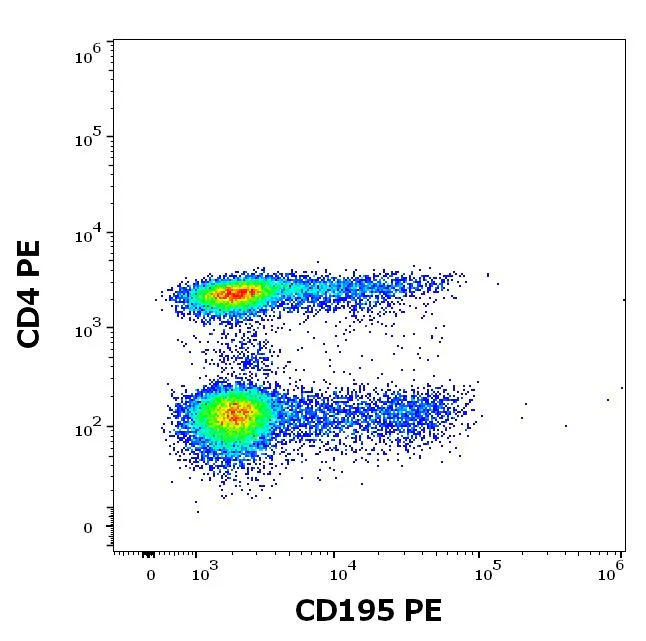
Flow Cytometry - APC Anti-CCR5/CD195 antibody [T21/8] (AB176536)
  • Flow Cyt

Supplier Data

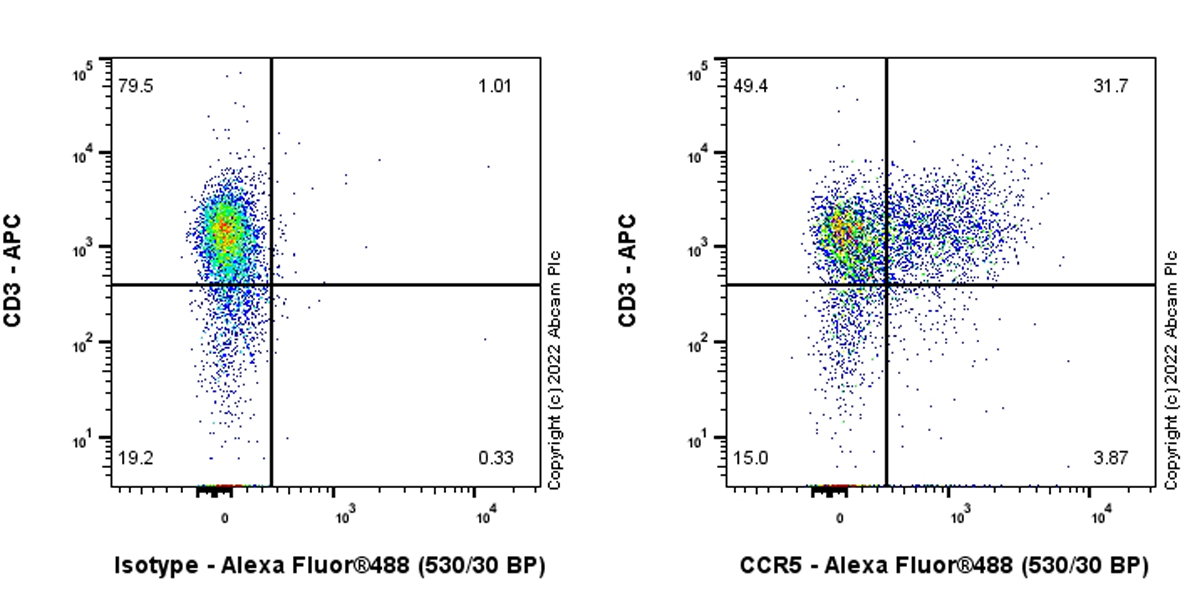
Flow Cytometry - APC Anti-CCR5/CD195 antibody [T21/8] (AB176536)

Flow cytometry multicolor surface staining pattern of human lymphocytes stained using anti-human CD4 (MEM-241) PE antibody (20 µl reagent / 100 µl of peripheral whole blood) and ab176536 (10 µl reagent / 100 µl of peripheral whole blood).

Key facts

Host species

Mouse

Clonality

Monoclonal

Clone number

T21/8

Isotype

IgG1

Conjugation

APC

Excitation/Emission

Ex: 650nm, Em: 660nm

Carrier free

No

Reacts with

Human

Applications

Flow Cyt

applications

Immunogen

Synthetic Peptide within Human CCR5/CD195 aa 1-50 conjugated to Keyhole Limpet Haemocyanin. The exact immunogen used to generate this antibody is proprietary information.

P51681

Reactivity data

{ "title": "Reactivity Data", "filters": { "stats": ["", "Species", "Dilution Info", "Notes"], "tabs": { "all-applications": {"fullname" : "All Applications", "shortname": "All Applications"}, "FlowCyt" : {"fullname" : "Flow Cytometry", "shortname":"Flow Cyt"} }, "product-promise": { "all": "all", "testedAndGuaranteed": "tested", "guaranteed": "expected", "predicted": "predicted", "notRecommended": "not-recommended" } }, "values": { "Human": { "FlowCyt-species-checked": "testedAndGuaranteed", "FlowCyt-species-dilution-info": "", "FlowCyt-species-notes": "<p></p>" }, "Chimpanzee": { "FlowCyt-species-checked": "predicted", "FlowCyt-species-dilution-info": "", "FlowCyt-species-notes": "" }, "Primates": { "FlowCyt-species-checked": "predicted", "FlowCyt-species-dilution-info": "", "FlowCyt-species-notes": "" } } }

Properties and storage information

Form
Liquid
Purification technique
Size-exclusion chromatography
Storage buffer
pH: 7.4 Preservative: 0.098% Sodium azide Constituents: PBS, 0.2% BSA
Shipped at conditions
Blue Ice
Appropriate short-term storage conditions
+4°C
Appropriate long-term storage conditions
+4°C
Storage information
Do Not Freeze|Store in the dark

Supplementary information

This supplementary information is collated from multiple sources and compiled automatically.

CCR5 also known as the C-C chemokine receptor type 5 is a protein that functions as a receptor on the surface of cells predominantly immune cells like T-cells macrophages and dendritic cells. The approximate molecular weight of CCR5 is 40 kDa. This protein belongs to the G-protein-coupled receptor family and it mainly binds to β-chemokines. CCR5 is abundantly expressed in immune tissues such as the spleen thymus and lymph nodes. Researchers often use assays like the CCR5 ELISA kit to detect or quantify its presence in various samples.
Biological function summary

CCR5 acts as a receptor for various chemokines specifically CCL3 CCL4 and CCL5 which are involved in leukocyte trafficking and immune response modulation. It plays an important role in the migration of immune cells to sites of inflammation or injury. This protein does not function in isolation; it sometimes forms part of larger complexes with other cell surface proteins to mediate responses to external signals. For example anti-CCR5 antibodies like 12D1 can modulate its activity and influence immune cell behavior.

Pathways

CCR5 is intricately involved in chemokine signaling pathways and inflammatory response pathways. Through these pathways it interacts with proteins such as CXCR4 and CCR1. CCR5 and CXCR4 another chemokine receptor are well-documented for their role in HIV entry into host cells. These pathways are critical for orchestrating immune cell movement and activating signaling cascades that promote immune defense mechanisms.

CCR5 has a significant association with HIV infection and is a known co-receptor facilitating the virus's entry into immune cells. The presence of mutations like the Δ32 allele in the CCR5 gene provides resistance against HIV infection highlighting its importance in disease dynamics. CCR5 also plays a role in inflammatory diseases such as rheumatoid arthritis where it contributes to the migration of immune cells into joints exacerbating inflammation. In these contexts CCR5 interacts with other inflammatory mediators offering potential therapeutic targets for drug development.

Product protocols

For this product, it's our understanding that no specific protocols are required. You can visit:

Target data

Receptor for a number of inflammatory CC-chemokines including CCL3/MIP-1-alpha, CCL4/MIP-1-beta and RANTES and subsequently transduces a signal by increasing the intracellular calcium ion level. May play a role in the control of granulocytic lineage proliferation or differentiation. Participates in T-lymphocyte migration to the infection site by acting as a chemotactic receptor (PubMed : 30713770).. (Microbial infection) Acts as a coreceptor (CD4 being the primary receptor) of human immunodeficiency virus-1/HIV-1.
See full target information CCR5/CD195

Alternative Names

CD195, CMKBR5, CCR5, C-C chemokine receptor type 5, C-C CKR-5, CC-CKR-5, CCR-5, CHEMR13, HIV-1 fusion coreceptor

Publications (3)

Recent publications for all applications. Explore the full listand refine your search

Journal of immunology research 2024:6343757 PubMed38715844

2024

Bystander Effects and Profibrotic Interactions in Hepatic Stellate Cells during HIV and HCV Coinfection.

Applications

Unspecified application

Species

Unspecified reactive species

Cintia Cevallos,Patricio Jarmoluk,Franco Sviercz,Cinthya A M López,Rosa N Freiberger,M Victoria Delpino,Jorge Quarleri

Nature communications 14:5590 PubMed37696831

2023

Single-cell transcriptome analysis indicates fatty acid metabolism-mediated metastasis and immunosuppression in male breast cancer.

Applications

Unspecified application

Species

Unspecified reactive species

Handong Sun,Lishen Zhang,Zhonglin Wang,Danling Gu,Mengyan Zhu,Yun Cai,Lu Li,Jiaqi Tang,Bin Huang,Bakwatanisa Bosco,Ning Li,Lingxiang Wu,Wei Wu,Liangyu Li,Yuan Liang,Lin Luo,Quanzhong Liu,Yanhui Zhu,Jie Sun,Liang Shi,Tiansong Xia,Chuang Yang,Qitong Xu,Xue Han,Weiming Zhang,Jianxia Liu,Dong Meng,Hua Shao,Xiangxin Zheng,Shuqin Li,Hua Pan,Jing Ke,Wenying Jiang,Xiaolan Zhang,Xuedong Han,Jian Chu,Hongyin An,Juyan Ge,Chi Pan,Xiuxing Wang,Kening Li,Qianghu Wang,Qiang Ding

Frontiers in immunology 14:1206099 PubMed37404829

2023

Massively HIV-1-infected macrophages exhibit a severely hampered ability to differentiate into osteoclasts.

Applications

Unspecified application

Species

Unspecified reactive species

Franco A Sviercz,Patricio Jarmoluk,Cintia G Cevallos,Cynthia A M López,Rosa N Freiberger,Alex Guano,Alan Adamczyk,Matías Ostrowski,M Victoria Delpino,Jorge Quarleri
View all publications

Product promise

We are committed to supporting your work with high-quality reagents, and we're here for you every step of the way. In the unlikely event that one of our products does not perform as expected, you're protected by our Product Promise.
For full details, please see our Terms & Conditions

Please note: All products are 'FOR RESEARCH USE ONLY. NOT FOR USE IN DIAGNOSTIC OR THERAPEUTIC PROCEDURES'.

For licensing inquiries, please contact partnerships@abcam.com