JavaScript is disabled in your browser. Please enable JavaScript to view this website.
AB239306

APC/Cy7® Anti-CD9 antibody [MEM-61]

Be the first to review this product! Submit a review

|

(0 Publication)

Anti-CD9 antibody [MEM-61] conjugated to APC/Cy7® - suitable for flow cytometry, and reacts with human samples. Clone [MEM-61] is a mouse monoclonal antibody cited in 22 publications.

Design your panel with our interactive flow cytometry panel builder. Click here.
1 Images
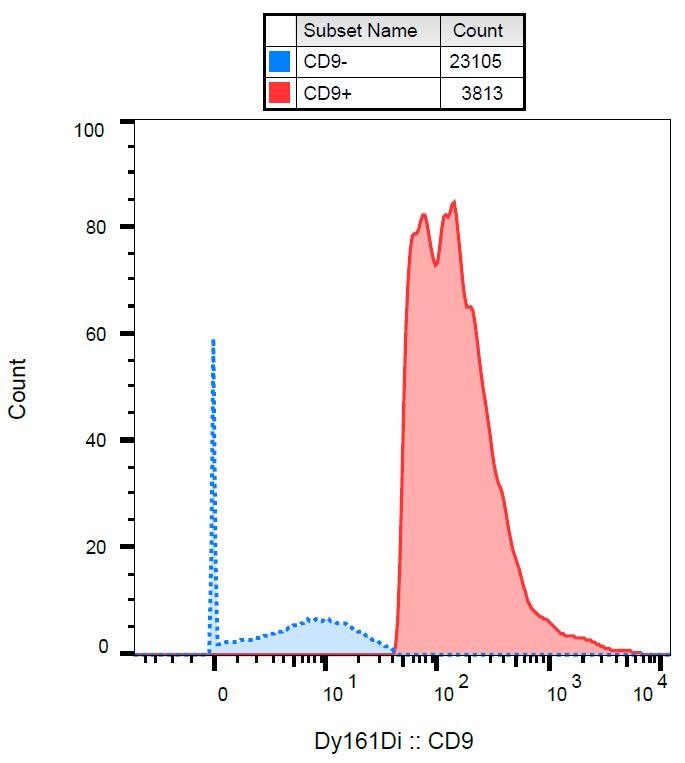
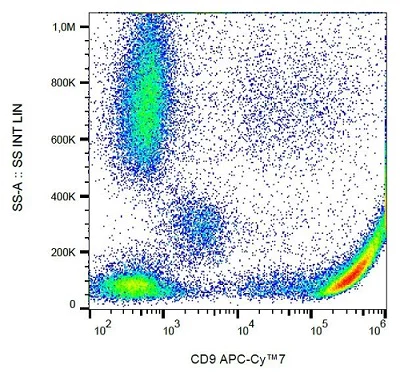
Flow Cytometry - APC/Cy7® Anti-CD9 antibody [MEM-61] (AB239306)
  • Flow Cyt

Supplier Data

Flow Cytometry - APC/Cy7® Anti-CD9 antibody [MEM-61] (AB239306)

Flow Cytometry analysis of human peripheral blood labeling CD9 with ab239306. Surface staining.

  • 660 APC

    APC Anti-CD9 antibody [MEM-61]

  • 665 Alexa Fluor® 647

    Alexa Fluor® 647 Anti-CD9 antibody [MEM-61]

  • Biotin

    Biotin Anti-CD9 antibody [MEM-61]

  • 519 FITC

    FITC Anti-CD9 antibody [MEM-61]

Key facts

Host species

Mouse

Clonality

Monoclonal

Clone number

MEM-61

Isotype

IgG1

Light chain type

kappa

Conjugation

APC/Cy7®

Excitation/Emission

Ex: 650nm, Em: 785nm

Carrier free

No

Reacts with

Human

Applications

Flow Cyt

applications

Immunogen

Cell preparation containing CD9 protein. The exact immunogen used to generate this antibody is proprietary information.

P21926

Reactivity data

{ "title": "Reactivity Data", "filters": { "stats": ["", "Species", "Dilution Info", "Notes"], "tabs": { "all-applications": {"fullname" : "All Applications", "shortname": "All Applications"}, "FlowCyt" : {"fullname" : "Flow Cytometry", "shortname":"Flow Cyt"} }, "product-promise": { "all": "all", "testedAndGuaranteed": "tested", "guaranteed": "expected", "predicted": "predicted", "notRecommended": "not-recommended" } }, "values": { "Human": { "FlowCyt-species-checked": "testedAndGuaranteed", "FlowCyt-species-dilution-info": "4 µL for 10^5 Cells", "FlowCyt-species-notes": "<p>OR 100 μl of whole blood.</p>" } } }

Product details

This product or portions thereof is manufactured under license from Carnegie Mellon University under U.S. Patent Number 5, 268, 486 and related patents. Cy® and CyDye® are trademarks of Cytiva.

Properties and storage information

Form
Liquid
Purification technique
Size-exclusion chromatography
Purification notes
The purified antibody is conjugated with tandem dye APC-Cy™7 under optimum conditions. The conjugate is purified by size-exclusion chromatography and adjusted for direct use. No reconstitution is necessary.
Storage buffer
pH: 7.4 Preservative: 0.0975% Sodium azide Constituents: PBS
Shipped at conditions
Blue Ice
Appropriate short-term storage conditions
+4°C
Appropriate long-term storage conditions
+4°C
Storage information
Store in the dark

Supplementary information

This supplementary information is collated from multiple sources and compiled automatically.

CD9 also known as motility-related protein-1 (MRP-1) is a transmembrane glycoprotein with a molecular weight of approximately 24 kDa. This protein is part of the tetraspanin family and shows widespread expression throughout different tissues including hematopoietic and non-hematopoietic cells. CD9 participates in numerous cellular processes by interacting with integrins and other cell surface receptors facilitating the organization of molecular complexes within the cell membrane.
Biological function summary

The CD9 protein is integral to cell adhesion migration and fusion. It forms complexes with other tetraspanins and proteins like EWI-2 and EWI-F contributing to cellular signaling and membrane compartmentalization. Additionally CD9 plays an important role in the formation and secretion of exosomes tiny vesicles emitted by cells that mediate cell-to-cell communication. These exosomes can be analyzed using tools like exosome assays and detection kits that target CD9 proteins.

Pathways

CD9 is involved in the regulation of immune response and cell morphology. It participates in pathways such as the integrin signaling pathway and the phosphatidylinositol 3-kinase (PI3K) signaling pathway. CD9 modulates these interactions by associating with proteins such as integrins and other members of the tetraspanin family influencing cellular movement and proliferation.

CD9 has connections to various conditions including cancer and infectious diseases. In cancer CD9 can influence tumor progression and metastasis while its altered expression levels have been associated with different cancer types. CD9 interacts with proteins such as integrins and CD81 in these contexts affecting cellular adhesion and migration mechanisms. In infectious diseases CD9 is involved in viral entry processes as some viruses utilize CD9 and its associated tetraspanins for entry into host cells.

Product protocols

For this product, it's our understanding that no specific protocols are required. You can visit:

Target data

Integral membrane protein associated with integrins, which regulates different processes, such as sperm-egg fusion, platelet activation and aggregation, and cell adhesion (PubMed : 14575715, PubMed : 18541721, PubMed : 8478605). Present at the cell surface of oocytes and plays a key role in sperm-egg fusion, possibly by organizing multiprotein complexes and the morphology of the membrane required for the fusion (By similarity). In myoblasts, associates with CD81 and PTGFRN and inhibits myotube fusion during muscle regeneration (By similarity). In macrophages, associates with CD81 and beta-1 and beta-2 integrins, and prevents macrophage fusion into multinucleated giant cells specialized in ingesting complement-opsonized large particles (PubMed : 12796480). Also prevents the fusion between mononuclear cell progenitors into osteoclasts in charge of bone resorption (By similarity). Acts as a receptor for PSG17 (By similarity). Involved in platelet activation and aggregation (PubMed : 18541721). Regulates paranodal junction formation (By similarity). Involved in cell adhesion, cell motility and tumor metastasis (PubMed : 7511626, PubMed : 8478605).
See full target information CD9

Alternative Names

CD9, MIC3, TSPAN29, GIG2, CD9 antigen, 5H9 antigen, Cell growth-inhibiting gene 2 protein, Leukocyte antigen MIC3, Motility-related protein, Tetraspanin-29, p24, MRP-1, Tspan-29

Product promise

We are committed to supporting your work with high-quality reagents, and we're here for you every step of the way. In the unlikely event that one of our products does not perform as expected, you're protected by our Product Promise.
For full details, please see our Terms & Conditions

Please note: All products are 'FOR RESEARCH USE ONLY. NOT FOR USE IN DIAGNOSTIC OR THERAPEUTIC PROCEDURES'.

For licensing inquiries, please contact partnerships@abcam.com