JavaScript is disabled in your browser. Please enable JavaScript to view this website.
AB154258

Anti-APIP antibody

Be the first to review this product! Submit a review

|

(1 Publication)

Rabbit Polyclonal APIP antibody. Suitable for WB and reacts with Human samples. Cited in 1 publication. Immunogen corresponding to Recombinant Fragment Protein within Human APIP aa 1-250.
1 Images
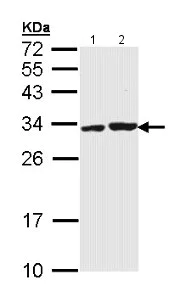
Western blot - Anti-APIP antibody (AB154258)
  • WB

Unknown

Western blot - Anti-APIP antibody (AB154258)

12% SDS PAGE

All lanes:

Western blot - Anti-APIP antibody (ab154258) at 1/1000 dilution

Lane 1:

MOLT4 whole cell lysate at 30 µg

Lane 2:

Raji whole cell lysate at 30 µg

Predicted band size: 27 kDa

false

Key facts

Host species

Rabbit

Clonality

Polyclonal

Isotype

IgG

Carrier free

No

Reacts with

Human

Applications

WB

applications

Immunogen

Recombinant Fragment Protein within Human APIP aa 1-250. The exact immunogen used to generate this antibody is proprietary information.

Q96GX9

Reactivity data

{ "title": "Reactivity Data", "filters": { "stats": ["", "Species", "Dilution Info", "Notes"], "tabs": { "all-applications": {"fullname" : "All Applications", "shortname": "All Applications"}, "WB" : {"fullname" : "Western blot", "shortname":"WB"} }, "product-promise": { "all": "all", "testedAndGuaranteed": "tested", "guaranteed": "expected", "predicted": "predicted", "notRecommended": "not-recommended" } }, "values": { "Human": { "WB-species-checked": "testedAndGuaranteed", "WB-species-dilution-info": "1/500 - 1/3000", "WB-species-notes": "<p></p>" }, "Mouse": { "WB-species-checked": "predicted", "WB-species-dilution-info": "", "WB-species-notes": "" }, "Cow": { "WB-species-checked": "predicted", "WB-species-dilution-info": "", "WB-species-notes": "" } } }

Properties and storage information

Form
Liquid
Purification technique
Affinity purification Immunogen
Storage buffer
pH: 7 Preservative: 0.01% Thimerosal (merthiolate) Constituents: 20% Glycerol (glycerin, glycerine), 1.21% Tris, 0.75% Glycine
Shipped at conditions
Blue Ice
Appropriate short-term storage conditions
+4°C
Appropriate long-term storage conditions
-20°C
Aliquoting information
Upon delivery aliquot
Storage information
Avoid freeze / thaw cycle

Supplementary information

This supplementary information is collated from multiple sources and compiled automatically.

APIP also known as APAF1-interacting protein weighs around 26 kDa and serves as an anti-apoptotic factor. This protein is widely expressed in various tissues including the liver brain and heart. Mechanically APIP regulates apoptosis by interacting with APAF1 which prevents the activation of the apoptosome. The inhibition of apoptosis helps cells survive under stress conditions.
Biological function summary

APIP plays a significant role in modulating the cellular mechanism of apoptosis. As part of the apoptosis inhibition complex it interacts with APAF1 to control programmed cell death. Additionally APIP contributes to cell survival during oxidative stress by modulating the methionine salvage pathway and maintaining cellular redox balance.

Pathways

APIP integrates into essential cellular systems such as the apoptosis and methionine salvage pathways. By interacting with APAF1 in the apoptotic pathway APIP directly influences the intrinsic pathway of apoptosis. At the same time it connects with enzymes involved in methionine metabolism supporting cellular survival mechanisms through antioxidant defense.

APIP shows a connection to cancer and ischemic injury. In cancer APIP confers resistance to apoptosis promoting tumor survival even under cellular stress. Its interaction with APAF1 plays an important role in this mechanism. In ischemic conditions APIP involvement in the methionine salvage pathway helps prevent oxidative damage by supporting cellular redox balance potentially linking it to proteins involved in ischemic protection.

Product protocols

For this product, it's our understanding that no specific protocols are required. You can visit:

Target data

Catalyzes the dehydration of methylthioribulose-1-phosphate (MTRu-1-P) into 2,3-diketo-5-methylthiopentyl-1-phosphate (DK-MTP-1-P). Functions in the methionine salvage pathway, which plays a key role in cancer, apoptosis, microbial proliferation and inflammation. May inhibit the CASP1-related inflammatory response (pyroptosis), the CASP9-dependent apoptotic pathway and the cytochrome c-dependent and APAF1-mediated cell death.
See full target information APIP

Alternative Names

CGI-29, APIP, Methylthioribulose-1-phosphate dehydratase, MTRu-1-P dehydratase, APAF1-interacting protein, hAPIP

Publications (1)

Recent publications for all applications. Explore the full listand refine your search

Environmental toxicology 36:2484-2492 PubMed34529319

2021

LncRNA SNHG14 contributes to proinflammatory cytokine production in rheumatoid arthritis via the regulation of the miR-17-5p/MINK1-JNK pathway.

Applications

Unspecified application

Species

Unspecified reactive species

Jihui Zhang,Hongwei Lei,Xiu Li
View all publications

Product promise

We are committed to supporting your work with high-quality reagents, and we're here for you every step of the way. In the unlikely event that one of our products does not perform as expected, you're protected by our Product Promise.
For full details, please see our Terms & Conditions

Please note: All products are 'FOR RESEARCH USE ONLY. NOT FOR USE IN DIAGNOSTIC OR THERAPEUTIC PROCEDURES'.

For licensing inquiries, please contact partnerships@abcam.com