Anti-Apolipoprotein E antibody
Be the first to review this product! Submit a review
|
(7 Publications )
- IHC-P
Unknown
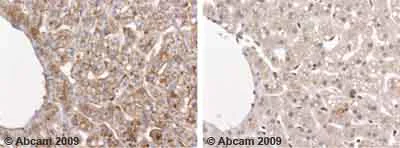
Immunohistochemistry (Formalin/PFA-fixed paraffin-embedded sections) - Anti-Apolipoprotein E antibody (AB24139)
ab24139 staining Human normal liver parenchyma. Staining is localized to the cytoplasm.
Left panel : with primary antibody at 1 : 400 dilution. Right panel : isotype control.
Sections were stained using an automated system DAKO Autostainer Plus , at room temperature. Sections were rehydrated and antigen retrieved with the Dako 3-in-1 AR buffer citrate pH 6.0 in a DAKO PT Link. Slides were peroxidase blocked in 3% H2O2 in methanol for 10 minutes. They were then blocked with Dako Protein block for 10 minutes (containing casein 0.25% in PBS), then incubated with primary antibody for 20 minutes, and detected with Dako Envision Flex amplification kit for 30 minutes. Colorimetric detection was completed with diaminobenzidine for 5 minutes. Slides were counterstained with Haematoxylin and coverslipped under DePeX. Please note that for manual staining we recommend to optimize the primary antibody concentration and incubation time (overnight incubation), and amplification may be required.
- ICC/IF
Unknown
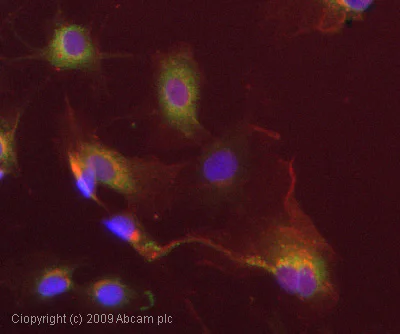
Immunocytochemistry/ Immunofluorescence - Anti-Apolipoprotein E antibody (AB24139)
ICC/IF image of ab24139 stained HepG2 cells. The cells were 4% PFA fixed (10 min) and then incubated in 1%BSA / 10% normal goat serum / 0.3M glycine in 0.1% PBS-Tween for 1h to permeabilise the cells and block non-specific protein-protein interactions. The cells were then incubated with the antibody (ab24139, 1/1000 dilution) overnight at +4°C. The secondary antibody (green) was Alexa Fluor® 488 goat anti-rabbit IgG (H+L) used at a 1/1000 dilution for 1h. Alexa Fluor® 594 WGA was used to label plasma membranes (red) at a 1/200 dilution for 1h. DAPI was used to stain the cell nuclei (blue) at a concentration of 1.43µM.
Alternative Products
Primary Antibodies
AB183596
Anti-Apolipoprotein E antibody [EPR19378]
BOND RX™ Validated|20ul selling size|KO Validated|RabMAb|Recombinant
- 2
- 1
Primary Antibodies
AB51015
Anti-Apolipoprotein E antibody [EP1373Y]
20ul selling size|RabMAb|Recombinant|KO Validated
- 0
- 0
Primary Antibodies
AB52607
Anti-Apolipoprotein E antibody [EP1374Y]
BOND RX™ Validated|20ul selling size|RabMAb|Recombinant|KO Validated
- 4
- 3
Primary Antibodies
AB227993
Anti-Apolipoprotein E antibody [EPR19392] - Low endotoxin, Azide free
RabMAb|Recombinant|KO Validated
- 0
- 0
Primary Antibodies
AB195855
HRP Anti-Apolipoprotein E antibody [EP1374Y]
BOND RX™ Validated|RabMAb|Recombinant

- 0
- 0
Primary Antibodies
AB196463
Alexa Fluor® 488 Anti-Apolipoprotein E antibody [EP1374Y]
RabMAb|Recombinant

- 1
- 1
Primary Antibodies
AB183597
Anti-Apolipoprotein E antibody [EPR19392]
20ul selling size|RabMAb|Recombinant|KO Validated

- 0
- 0
Complementary Products

Primary Antibodies
AB9485
Anti-GAPDH antibody - Loading Control
BOND RX™ Validated|Lab Essentials

- 5
- 88
Primary Antibodies
AB32454
Anti-MAP2 antibody - Neuronal Marker
BOND RX™ Validated|Lab Essentials

- 5
- 35
Primary Antibodies
AB32127
Anti-Synaptophysin antibody [YE269] - Synaptic Marker
20ul selling size|BOND RX™ Validated|RabMAb|Recombinant|KO Validated

- 5
- 39
Reactivity data
Properties and storage information
Form
Purification technique
Purification notes
Storage buffer
Shipped at conditions
Appropriate short-term storage duration
Appropriate short-term storage conditions
Appropriate long-term storage conditions
Aliquoting information
Storage information
Supplementary information
This supplementary information is collated from multiple sources and compiled automatically.
Biological function summary
ApoE mediates the binding internalization and catabolism of these lipoprotein particles facilitating their interaction with specific cell-surface receptors such as the LDL receptor. This protein operates as part of a complex that includes various other apolipoproteins and lipid molecules. The study of mouse apoe using tools like a mouse apoe ELISA provides valuable data due to its similar physiological functions in lipid transport and metabolism.
Pathways
In the lipid metabolism pathway ApoE interacts with proteins such as the LDL receptor influencing the clearance of chylomicron remnants and VLDL from the bloodstream. In the cardiovascular disease pathway this protein impacts cholesterol levels and promotes plaques stabilization. ApoE's role in these pathways offers insights into its interaction with related proteins like apolipoprotein B and LDL receptor which are critical for maintaining lipid equilibrium.
Product protocols
- Visit the General protocols
- Visit the Troubleshooting
Target data
Alternative Names
Publications (7)
Recent publications for all applications. Explore the full list and refine your search
ACS synthetic biology 11:1292-1302 PubMed35176859
2022
Applications
Unspecified application
Species
Unspecified reactive species
Journal of translational medicine 19:97 PubMed33663537
2021
Applications
Unspecified application
Species
Unspecified reactive species
Molecular neurobiology 57:1986-2001 PubMed31903524
2020
Applications
Unspecified application
Species
Unspecified reactive species
The Journal of experimental medicine 216:2546-2561 PubMed31601677
2019
Applications
Unspecified application
Species
Unspecified reactive species
Experimental cell research 376:18-26 PubMed30710501
2019
Applications
Unspecified application
Species
Unspecified reactive species
Nature 549:523-527 PubMed28959956
2017
Applications
Unspecified application
Species
Unspecified reactive species
Virology 458-459:190-208 PubMed24928051
2014
Applications
Unspecified application
Species
Unspecified reactive species
Product promise
Please note: All products are 'FOR RESEARCH USE ONLY. NOT FOR USE IN DIAGNOSTIC OR THERAPEUTIC PROCEDURES'.
For licensing inquiries, please contact partnerships@abcam.com