JavaScript is disabled in your browser. Please enable JavaScript to view this website.
AB182794

Anti-AQP-10 antibody - C-terminal

Be the first to review this product! Submit a review

|

(1 Publication)
Rabbit Polyclonal AQP-10 antibody. C-terminal. Suitable for WB and reacts with Human samples. Cited in 1 publication. Immunogen corresponding to Synthetic Peptide within Human AQP10 aa 250-300.
1 Images
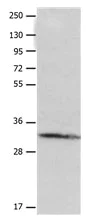
Western blot - Anti-AQP-10 antibody - C-terminal (AB182794)
  • WB

Supplier Data

Western blot - Anti-AQP-10 antibody - C-terminal (AB182794)

All lanes:

Western blot - Anti-AQP-10 antibody - C-terminal (ab182794) at 1/455 dilution

All lanes:

Jurkat cell at 50 µg

Secondary

All lanes:

Goat anti Rabbit IgG at 1/5000 dilution

Predicted band size: 32 kDa

false

Exposure time: 1min

Key facts

Host species

Rabbit

Clonality

Polyclonal

Isotype

IgG

Carrier free

No

Reacts with

Human

Applications

WB

applications

Immunogen

Synthetic Peptide within Human AQP10 aa 250-300. The exact immunogen used to generate this antibody is proprietary information.

Q96PS8

Reactivity data

{ "title": "Reactivity Data", "filters": { "stats": ["", "Species", "Dilution Info", "Notes"], "tabs": { "all-applications": {"fullname" : "All Applications", "shortname": "All Applications"}, "WB" : {"fullname" : "Western blot", "shortname":"WB"} }, "product-promise": { "all": "all", "testedAndGuaranteed": "tested", "guaranteed": "expected", "predicted": "predicted", "notRecommended": "not-recommended" } }, "values": { "Human": { "WB-species-checked": "testedAndGuaranteed", "WB-species-dilution-info": "1/500 - 1/2000", "WB-species-notes": "<p></p>" } } }

Properties and storage information

Form
Liquid
Purification technique
Affinity purification Immunogen
Storage buffer
pH: 7.4 Preservative: 0.05% Sodium azide Constituents: PBS, 50% Glycerol (glycerin, glycerine)
Shipped at conditions
Blue Ice
Appropriate short-term storage duration
1-2 weeks
Appropriate short-term storage conditions
+4°C
Appropriate long-term storage conditions
-20°C
Aliquoting information
Upon delivery aliquot
Storage information
Avoid freeze / thaw cycle

Supplementary information

This supplementary information is collated from multiple sources and compiled automatically.

AQP-10 also known as Aquaporin-10 functions as a water channel protein that facilitates water transport across cell membranes. It is identified by a molecular mass of approximately 32 kDa. AQP-10 is primarily expressed in the small intestine but also found in the adipose tissue. This suggests its significant role in the physiology of these tissues. The protein shares structural similarities with other members of the aquaporin family which also mediate water movement in various tissues.
Biological function summary

The function of AQP-10 centers around the regulation of water homeostasis and glycerol transport in intestinal and adipose tissues. As a part of the aquaporin channel family AQP-10 ensures the cells maintain proper water balance and nutrient handling. The protein does not form part of known protein complexes but works in coordination with other aquaporins contributing to cellular hydration and nutrient absorption. This fundamental task is essential for maintaining osmotic balance and metabolic support within these tissues.

Pathways

AQP-10 participates in metabolic pathways focusing on nutrient absorption and water regulation. It plays a role in the glycerol uptake pathway which connects to lipid metabolism in adipose tissue. The presence of AQP-10 in pathways such as the glycerol uptake pathway indicates its association with other aquaporin family members such as AQP-7 which similarly transport glycerol. The involvement of AQP-10 in these pathways highlights its contribution to energy balance and metabolic processes.

The dysregulation or altered expression of AQP-10 has been associated with obesity and chronic diarrhea. In obesity the link comes through the protein's role in adipose tissue metabolism which involves other aquaporins like AQP-7 implicated in fat accumulation and storage. In chronic diarrhea AQP-10's water transport function in the intestine relates to improper water balance and absorption. Understanding these connections helps explore therapeutic targeting of AQP-10 for managing metabolic disorders and gastrointestinal diseases.

Product protocols

For this product, it's our understanding that no specific protocols are required. You can visit:

Target data

Aquaglyceroporins form homotetrameric transmembrane channels, with each monomer independently mediating glycerol and water transport across the plasma membrane along their osmotic gradient (PubMed : 11573934, PubMed : 12084581, PubMed : 21733844, PubMed : 23382902, PubMed : 30420639). Could also be permeable to urea (PubMed : 12084581). Among aquaglyceroporins, it exhibits a unique pH-gated glycerol transport activity, being more active at acidic pH. It most likely plays a central role in the efflux of glycerol formed during triglyceride hydrolysis in adipocytes and in glycerol uptake by enterocytes, as both processes occur and are stimulated at acidic pH (PubMed : 11573934, PubMed : 23382902, PubMed : 30420639).
See full target information AQP10

Alternative Names

Aquaporin-10, AQP-10, Aquaglyceroporin-10, Small intestine aquaporin, AQP10

Publications (1)

Recent publications for all applications. Explore the full list and refine your search

Frontiers in immunology 15:1513196 PubMed39902039

2025

Inflammatory biomarkers and therapeutic potential of milk exosome-mediated CCL7 siRNA in murine intestinal ischemia-reperfusion injury.

Applications

Unspecified application

Species

Unspecified reactive species

WenDong Chen,WenPing Xu,Li Ma,Chun Bi,MeiXu Yang,Wei Yang
View all publications

Product promise

We are committed to supporting your work with high-quality reagents, and we're here for you every step of the way. In the unlikely event that one of our products does not perform as expected, you're protected by our Product Promise.
For full details, please see our Terms & Conditions

Please note: All products are 'FOR RESEARCH USE ONLY. NOT FOR USE IN DIAGNOSTIC OR THERAPEUTIC PROCEDURES'.

For licensing inquiries, please contact partnerships@abcam.com