Anti-ARPC5/p16 ARC antibody [EP1551Y] - BSA and Azide free
- RabMAb
- Recombinant
- KO Validated
- What is this?
Be the first to review this product! Submit a review
|
(5 Publications )
ab220800 detects p16 ARC, part of the Arp2/3 complex, which is involved in actin polymerization. ab220800 does not detect the tumor suppressor CDKN2A/p16INK4a involved in cell cycle regulation, which is commonly referred to as p16.
- IHC-P
Lab
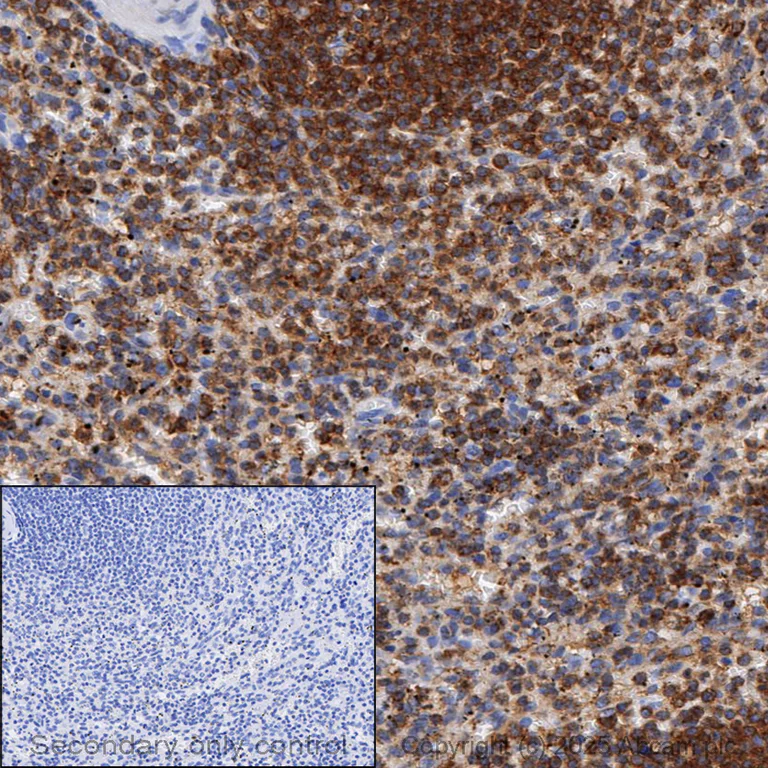
Immunohistochemistry (Formalin/PFA-fixed paraffin-embedded sections) - Anti-ARPC5/p16 ARC antibody [EP1551Y] - BSA and Azide free (AB220800)
This data was developed using ab51243, the same antibody clone in a different buffer formulation.
Immunohistochemical analysis of formalin fixed paraffin embedded human spleen labelling ARPC5/p16 ARC with ab51243 at a concentration of 0.1µg/ml. The immunostaining was performed on a Ventana DISCOVERY ULTRA (Roche Tissue Diagnostics) instrument with a OptiView DAB IHC Detection Kit. Heat mediated antigen retrieval was performed with DISCOVERY cell conditioning solution (CC1) 100°C, pH8.5 for 32mins ab51243 Anti-ARPC5/p16 ARC antibody [EP1551Y] was incubated for 16mins at 37°C. Sections were counterstained with Hematoxylin II. Image inset shows absence of staining in secondary antibody only control.
Customers are encouraged to optimise antigen retrieval conditions, antibody concentration, incubation times and temperature for best results in their own IHC assay workflow (automated and manual).
- IHC-P
Supplier Data
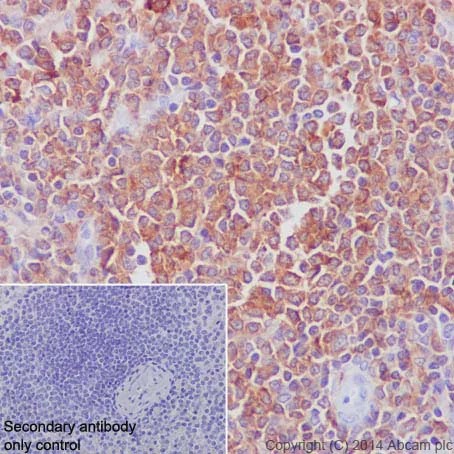
Immunohistochemistry (Formalin/PFA-fixed paraffin-embedded sections) - Anti-ARPC5/p16 ARC antibody [EP1551Y] - BSA and Azide free (AB220800)
Immunohistochemistry (Formalin/PFA-fixed paraffin-embedded sections) analysis of human spleen tissue labelling p16 ARC with purified ab51243 at a dilution of 1/50. Heat mediated antigen retrieval was performed using Tris/EDTA buffer pH 9. ab97051, a HRP-conjugated goat anti-rabbit IgG (H+L) was used as the secondary antibody (1/500). Negative control using PBS instead of primary antibody. Counterstained with hematoxylin.
This data was developed using the same antibody clone in a different buffer formulation containing PBS, BSA, glycerol, and sodium azide (ab51243).
- IP
Unknown
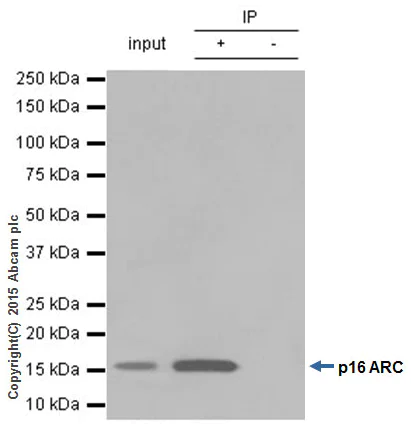
Immunoprecipitation - Anti-ARPC5/p16 ARC antibody [EP1551Y] - BSA and Azide free (AB220800)
ab51243 (purified) at a dilution of 1/20 immunoprecipitating p16 ARC in human fetal brain tissue lysate.
Lane 1 (input) : Human fetal brain tissue lysate (10µg)
Lane 2 (+) : ab51243 + human fetal brain tissue lysate.
Lane 3 (-) : Rabbit monoclonal IgG (ab172730) instead of ab51243 in human fetal brain tissue lysate.
For western blotting, a HRP-conjugated anti-rabbit specific to the non-reduced form of IgG was used as the secondary antibody (1/1500).
Blocking buffer and concentration : 5% NFDM/TBST.
Diluting buffer and concentration : 5% NFDM /TBST.
This data was developed using the same antibody clone in a different buffer formulation containing PBS, BSA, glycerol, and sodium azide (ab51243).
All lanes:
Immunoprecipitation - Anti-ARPC5/p16 ARC antibody [EP1551Y] (<a href='/en-us/products/primary-antibodies/arpc5-p16-arc-antibody-ep1551y-ab51243'>ab51243</a>)
Predicted band size: 16 kDa
Observed band size: 16 kDa
false
- ICC/IF
Unknown
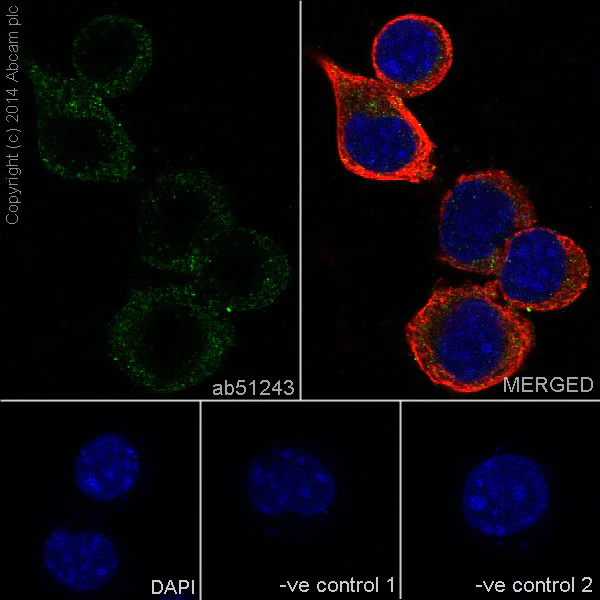
Immunocytochemistry/ Immunofluorescence - Anti-ARPC5/p16 ARC antibody [EP1551Y] - BSA and Azide free (AB220800)
Immunocytochemistry/Immunofluorescence analysis of Neuro-2a cells labelling p16 ARC with purified ab51243 at a dilution of 1/100. Cells were fixed with 4% paraformaldehyde and permeabilized with 0.1% Triton X-100. ab150077, an Alexa Fluor® 488-conjugated goat anti-rabbit IgG (1/1000) was used as the secondary antibody. DAPI (blue) was used as the nuclear counterstain. ab7291, a mouse anti-tubulin (1/1000) and ab150120, an Alexa Fluor® 594-conjugated goat anti-mouse IgG (1/1000) were also used.
Control 1 : primary antibody (1/100) and secondary antibody, ab150120, an Alexa Fluor® 594-conjugated goat anti-mouse IgG (1/1000).
Control 2 : ab7291 (1/1000) and secondary antibody, ab150077, an Alexa Fluor® 488-conjugated goat anti-rabbit IgG (1/1000).
This data was developed using the same antibody clone in a different buffer formulation containing PBS, BSA, glycerol, and sodium azide (ab51243).
- WB
Lab
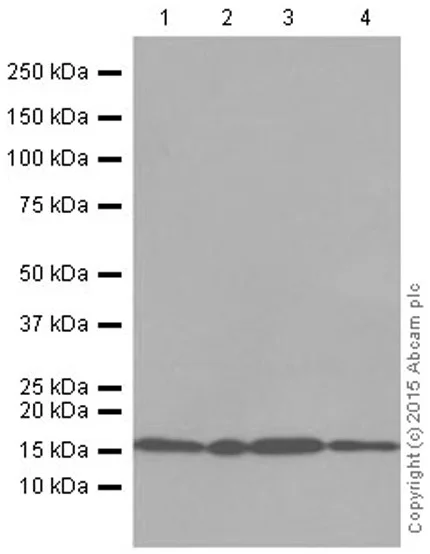
Western blot - Anti-ARPC5/p16 ARC antibody [EP1551Y] - BSA and Azide free (AB220800)
This data was developed using ab51243, the same antibody clone in a different buffer formulation.
Blocking and dilution buffer : 5% NFDM/TBST.
All lanes:
Western blot - Anti-ARPC5/p16 ARC antibody [EP1551Y] (<a href='/en-us/products/primary-antibodies/arpc5-p16-arc-antibody-ep1551y-ab51243'>ab51243</a>) at 1/5000 dilution
Lane 1:
HeLa whole cell lysate at 20 µg
Lane 2:
SKBR-3 whole cell lysate at 20 µg
Lane 3:
MCF-7 whole cell lysate at 20 µg
Lane 4:
HepG2 whole cell lysate at 20 µg
Secondary
All lanes:
Peroxidase-conjugated goat anti-rabbit IgG (H+L) at 1/1000 dilution
Predicted band size: 16 kDa
Observed band size: 16 kDa
false
- WB
Lab
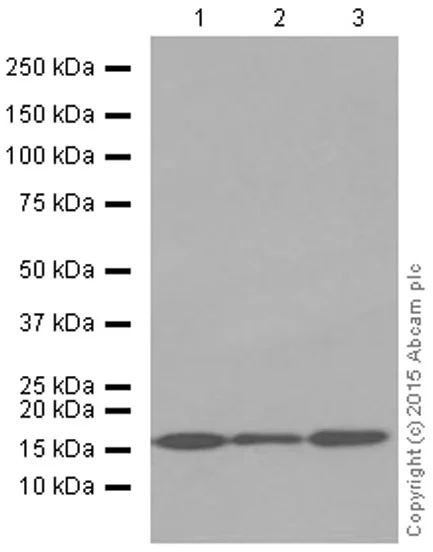
Western blot - Anti-ARPC5/p16 ARC antibody [EP1551Y] - BSA and Azide free (AB220800)
This data was developed using ab51243, the same antibody clone in a different buffer formulation.
Blocking and dilution buffer : 5% NFDM/TBST.
All lanes:
Western blot - Anti-ARPC5/p16 ARC antibody [EP1551Y] (<a href='/en-us/products/primary-antibodies/arpc5-p16-arc-antibody-ep1551y-ab51243'>ab51243</a>) at 1/5000 dilution
Lane 1:
Human brain tissue lysate at 20 µg
Lane 2:
Mouse brain tissue lysate at 20 µg
Lane 3:
Rat brain tissue lysate at 20 µg
Secondary
All lanes:
Peroxidase-conjugated goat anti-rabbit IgG (H+L) at 1/1000 dilution
Predicted band size: 16 kDa
Observed band size: 16 kDa
false
- WB
Lab
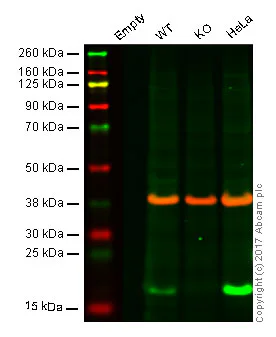
Western blot - Anti-ARPC5/p16 ARC antibody [EP1551Y] - BSA and Azide free (AB220800)
This data was developed using ab51243, the same antibody clone in a different buffer formulation.
Lane 1 : Wild type HAP1 whole cell lysate (20 μg)
Lane 2 : p16 ARC knockout HAP1 whole cell lysate (20 μg)
Lane 3 : HeLa whole cell lysate (20 μg)
Lanes 1 - 4 : Merged signal (red and green). Green - ab51243 observed at 16 kDa. Red - loading control, ab8245, observed at 37 kDa.
ab51243 was shown to specifically react with p16 ARC when p16 ARC knockout samples were used. Wild-type and p16 ARC knockout samples were subjected to SDS-PAGE. ab51243 and ab8245 (Mouse anti GAPDH loading control) were incubated overnight at 4°C at 1/1000 dilution and 1/10000 dilution respectively. Blots were developed with Goat anti-Rabbit IgG H&L (IRDye® 800CW) preabsorbed ab216773 and Goat anti-Mouse IgG H&L (IRDye® 680RD) preabsorbed ab216776 secondary antibodies at 1/10000 dilution for 1 hour at room temperature before imaging.
All lanes:
Western blot - Anti-ARPC5/p16 ARC antibody [EP1551Y] (<a href='/en-us/products/primary-antibodies/arpc5-p16-arc-antibody-ep1551y-ab51243'>ab51243</a>)
Predicted band size: 16 kDa
false
Related conjugates and formulations (8)
-
Anti-ARPC5/p16 ARC antibody [EP1551Y]
-
660 APC
APC Anti-ARPC5/p16 ARC antibody [EP1551Y]
-
519 Alexa Fluor® 488
Alexa Fluor® 488 Anti-ARPC5/p16 ARC antibody [EP1551Y]
-
565 Alexa Fluor® 555
Alexa Fluor® 555 Anti-ARPC5/p16 ARC antibody [EP1551Y]
-
617 Alexa Fluor® 594
Alexa Fluor® 594 Anti-ARPC5/p16 ARC antibody [EP1551Y]
-
665 Alexa Fluor® 647
Alexa Fluor® 647 Anti-ARPC5/p16 ARC antibody [EP1551Y]
-
775 Alexa Fluor® 750
Alexa Fluor® 750 Anti-ARPC5/p16 ARC antibody [EP1551Y]
-
578 PE
PE Anti-ARPC5/p16 ARC antibody [EP1551Y]
Alternative Products
Complementary Products

Primary Antibodies
AB109520
RabMAb|Recombinant|KO Validated|Lab Essentials|20ul selling size

- 5
- 17
Primary Antibodies
AB181602
Anti-GAPDH antibody [EPR16891] - Loading Control
KD Validated|RabMAb|Recombinant|Lab Essentials|20ul selling size

- 5
- 23
Primary Antibodies
AB115777
Anti-beta Actin antibody [SP124] - Cytoskeleton Marker
20ul selling size|RabMAb|Lab Essentials|Recombinant
- 4
- 1
Primary Antibodies
AB192890
Anti-LC3B antibody [EPR18709] - Autophagosome Marker
BOND RX™ Validated|RabMAb|Recombinant|KO Validated|Lab Essentials|20ul selling size
- 5
- 19
Reactivity data
Product details
ab220800 is the carrier-free version of ab51243.
Patented technology
Our RabMAb® technology is a patented hybridoma-based technology for making rabbit monoclonal antibodies. For details on our patents, please refer to RabMAb® patents.
Conjugation ready
Our carrier-free antibodies are typically supplied in a PBS-only formulation, purified and free of BSA, sodium azide and glycerol. This conjugation-ready format is designed for use with fluorochromes, metal isotopes, oligonucleotides, and enzymes, which makes them ideal for antibody labelling, functional and cell-based assays, flow-based assays (e.g. mass cytometry) and Multiplex Imaging applications.
Use our conjugation kits for antibody conjugates that are ready-to-use in as little as 20 minutes with 1 minute hands-on-time and 100% antibody recovery: available for fluorescent dyes, HRP, biotin and gold.
Compatibility
This product is compatible with the Maxpar® Antibody Labeling Kit from Fluidigm, without the need for antibody preparation. Maxpar® is a trademark of Fluidigm Canada Inc.
Properties and storage information
Form
Purification technique
Storage buffer
Shipped at conditions
Appropriate short-term storage conditions
Appropriate long-term storage conditions
Storage information
Supplementary information
This supplementary information is collated from multiple sources and compiled automatically.
Biological function summary
The ARPC5 protein is essential for effective actin polymerization making it an important contributor to cell motility and structure. As part of the Arp2/3 complex it interacts with other proteins to stimulate the growth of new actin filaments. This activity is important in processes like endocytosis phagocytosis and cell migration. Furthermore ARPC5 plays a role in maintaining cellular homeostasis and is involved in cellular signaling pathways.
Pathways
Arpc5 influences the regulation of the actin cytoskeleton which intersects with pathways associated with cell movement and morphogenesis. It prominently relates to the WAVE complex working synergistically to regulate actin dynamics. ARPC5's involvement in the Rac1-WAVE-Arp2/3 pathway highlights its relationship with Rac1 a small GTPase known for regulating the cytoskeleton and cellular functions like adhesion and migration.
Product protocols
- Visit the General protocols
- Visit the Troubleshooting
Target data
Alternative Names
Publications (5)
Recent publications for all applications. Explore the full listand refine your search
Cellular & molecular biology letters 27:86 PubMed36209059
2022
Applications
Unspecified application
Species
Unspecified reactive species
Oncology letters 22:603 PubMed34188705
2021
Applications
Unspecified application
Species
Unspecified reactive species
Proceedings of the National Academy of Sciences of 109:5750-5 PubMed22447776
2012
Applications
ICC/IF
Species
Mouse
The Journal of cell biology 192:883-97 PubMed21357746
2011
Applications
ICC/IF
Species
Mouse
Biochemical and biophysical research communications 404:153-8 PubMed21108927
2010
Applications
ICC/IF
Species
Human
Product promise
Please note: All products are 'FOR RESEARCH USE ONLY. NOT FOR USE IN DIAGNOSTIC OR THERAPEUTIC PROCEDURES'.
For licensing inquiries, please contact partnerships@abcam.com