Anti-ATG4C antibody [EPR15001] - BSA and Azide free
- RabMAb
- Recombinant
- KO Validated
- What is this?
Be the first to review this product! Submit a review
|
(1 Publication)
- Flow Cyt (Intra)
Supplier Data
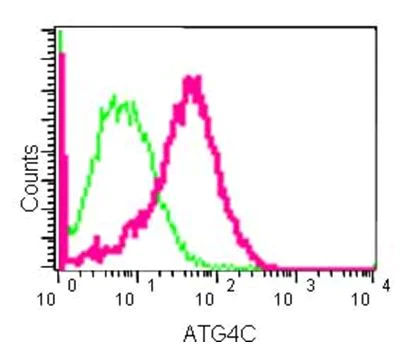
Flow Cytometry (Intracellular) - Anti-ATG4C antibody [EPR15001] - BSA and Azide free (AB250668)
This data was developed using ab183516, the same antibody clone in a different buffer formulation.
Intracellular flow cytometric analysis of 2% paraformaldehyde-fixed 293 cells labeling ATG4C with ab183516 at 1/100 dilution (green). Goat anti-rabbit IgG (FITC) at 1/150 dilution was used as the secondary antibody. Rabbit monoclonal IgG was used as the isotype control (red).
- IHC-P
Supplier Data
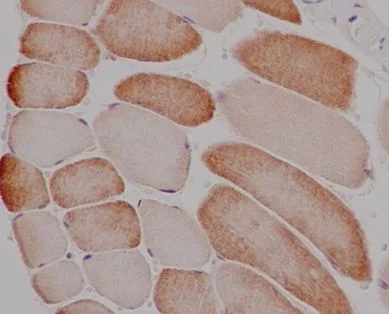
Immunohistochemistry (Formalin/PFA-fixed paraffin-embedded sections) - Anti-ATG4C antibody [EPR15001] - BSA and Azide free (AB250668)
This data was developed using ab183516, the same antibody clone in a different buffer formulation.
Immunohistochemical analysis of paraffin-embedded Human skeletal muscle tissue labeling ATG4C with ab183516 at 1/250 dilution. The slide is counterstained with Hematoxylin.
Perform heat mediated antigen retrieval with EDTA buffer pH 9 before commencing with IHC staining protocol.

- WB
Lab
Western blot - Anti-ATG4C antibody [EPR15001] - BSA and Azide free (AB250668)
This data was developed using ab183516, the same antibody clone in a different buffer formulation.
Lanes 1-4 : Merged signal (red and green). Green - ab183516 observed at 52 kDa. Red - loading control ab8245 observed at 36 kDa.
ab183516 Anti-ATG4C antibody [EPR15001] was shown to specifically react with ATG4C in wild-type HEK293T cells. Loss of signal was observed when knockout cell line ab267324 (knockout cell lysate ab257847) was used. Wild-type and ATG4C knockout samples were subjected to SDS-PAGE. ab183516 and Anti-GAPDH antibody [6C5] - Loading Control (ab8245) were incubated overnight at 4°C at 1 in 1000 dilution and 1 in 20000 dilution respectively. Blots were developed with Goat anti-Rabbit IgG H&L (IRDye® 800CW) preadsorbed (ab216773) and Goat anti-Mouse IgG H&L (IRDye® 680RD) preadsorbed (ab216776) secondary antibodies at 1 in 20000 dilution for 1 hour at room temperature before imaging.
All lanes:
Western blot - Anti-ATG4C antibody [EPR15001] (<a href='/en-us/products/primary-antibodies/atg4c-antibody-epr15001-ab183516'>ab183516</a>) at 1/1000 dilution
Lane 1:
Wild-type HEK293T cell lysate at 20 µg
Lane 2:
ATG4C knockout HEK293T cell lysate at 20 µg
Lane 2:
Western blot - Human ATG4C knockout HEK-293T cell line (<a href='/en-us/products/cell-lines/human-atg4c-knockout-hek-293t-cell-line-ab267324'>ab267324</a>)
Lane 3:
Jurkat cell lysate at 20 µg
Lane 4:
Raji cell lysate at 20 µg
Secondary
All lanes:
Western blot - Goat anti-Rabbit IgG H&L (IRDye® 800CW) preadsorbed (<a href='/en-us/products/secondary-antibodies/goat-rabbit-igg-h-l-irdye-800cw-preadsorbed-ab216773'>ab216773</a>) at 1/10000 dilution
Predicted band size: 52 kDa
Observed band size: 52 kDa
false
- WB
Supplier Data
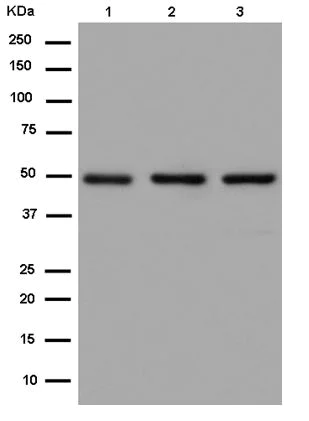
Western blot - Anti-ATG4C antibody [EPR15001] - BSA and Azide free (AB250668)
This data was developed using ab183516, the same antibody clone in a different buffer formulation.
All lanes:
Western blot - Anti-ATG4C antibody [EPR15001] (<a href='/en-us/products/primary-antibodies/atg4c-antibody-epr15001-ab183516'>ab183516</a>) at 1/20000 dilution
Lane 1:
Jurkat cell lysate at 20 µg
Lane 2:
Raji cell lysate at 20 µg
Lane 3:
293 cell lysate at 20 µg
Secondary
All lanes:
Goat Anti-Rabbit IgG, (H+L), Peroxidase conjugated at 1/1000 dilution
Predicted band size: 52 kDa
false
Related conjugates and formulations (1)
-
Anti-ATG4C antibody [EPR15001]
Complementary Products
Primary Antibodies
AB192890
Anti-LC3B antibody [EPR18709] - Autophagosome Marker
BOND RX™ Validated|RabMAb|Recombinant|KO Validated|Lab Essentials|20ul selling size

- 5
- 19
Primary Antibodies
AB126607
Anti-GABARAPL2/GATE-16 antibody [EP4808]
RabMAb|Recombinant|KO Validated

- 5
- 4
Primary Antibodies
AB6276
Anti-beta Actin antibody [AC-15] - Loading Control
KO Validated|Lab Essentials

- 5
- 94
Reactivity data
Product details
ab250668 is the carrier-free version of ab183516.
Patented technology
Our RabMAb® technology is a patented hybridoma-based technology for making rabbit monoclonal antibodies. For details on our patents, please refer to RabMAb® patents.
What are the advantages of a recombinant monoclonal antibody?
This product is a recombinant monoclonal antibody, which offers several advantages including:
- - High batch-to-batch consistency and reproducibility
- - Improved sensitivity and specificity
- - Long-term security of supply
- - Animal-free batch production
For more information, read more on recombinant antibodies.
Conjugation ready
Our carrier-free antibodies are typically supplied in a PBS-only formulation, purified and free of BSA, sodium azide and glycerol. This conjugation-ready format is designed for use with fluorochromes, metal isotopes, oligonucleotides, and enzymes, which makes them ideal for antibody labelling, functional and cell-based assays, flow-based assays (e.g. mass cytometry) and Multiplex Imaging applications.
Use our conjugation kits for antibody conjugates that are ready-to-use in as little as 20 minutes with 1 minute hands-on-time and 100% antibody recovery: available for fluorescent dyes, HRP, biotin and gold.
Compatibility
This product is compatible with the Maxpar® Antibody Labeling Kit from Fluidigm, without the need for antibody preparation. Maxpar® is a trademark of Fluidigm Canada Inc.
Properties and storage information
Form
Purification technique
Storage buffer
Shipped at conditions
Appropriate short-term storage conditions
Appropriate long-term storage conditions
Storage information
Supplementary information
This supplementary information is collated from multiple sources and compiled automatically.
Biological function summary
ATG4C cleaves the ATG8 family proteins such as LC3 at a conserved glycine residue facilitating their conjugation to phosphatidylethanolamine. This step is critical in the elongation of the isolation membrane during autophagosome formation. ATG4C is not typically found as part of a large protein complex but its interaction with ATG8 family members is an important regulatory point. Its function in recycling ATG8-family proteins helps maintain cellular homeostasis and responds to stress conditions like nutrient deprivation.
Pathways
ATG4C plays a central role in the autophagy pathway essential for cell survival differentiation and tissue remodeling. The protein closely interacts with components of the autophagy machinery such as ATG5 and the ULK1 complex coordinating the effective sequestration of cytoplasmic constituents. Its activity impacts the broader cellular pathways involving mTOR and AMPK both of which regulate cellular energy status and respond to metabolic signals positioning ATG4C as a vital component in these pathways.
Product protocols
- Visit the General protocols
- Visit the Troubleshooting
Target data
Alternative Names
Publications (1)
Recent publications for all applications. Explore the full listand refine your search
Open medicine (Warsaw, Poland) 18:20230639 PubMed36820063
2023
Applications
Unspecified application
Species
Unspecified reactive species
Product promise
Please note: All products are 'FOR RESEARCH USE ONLY. NOT FOR USE IN DIAGNOSTIC OR THERAPEUTIC PROCEDURES'.
For licensing inquiries, please contact partnerships@abcam.com