Anti-Axl antibody [7E10] - BSA and Azide free
- Recombinant
- What is this?
Be the first to review this product! Submit a review
|
(0 Publication)
- Flow Cyt
Lab
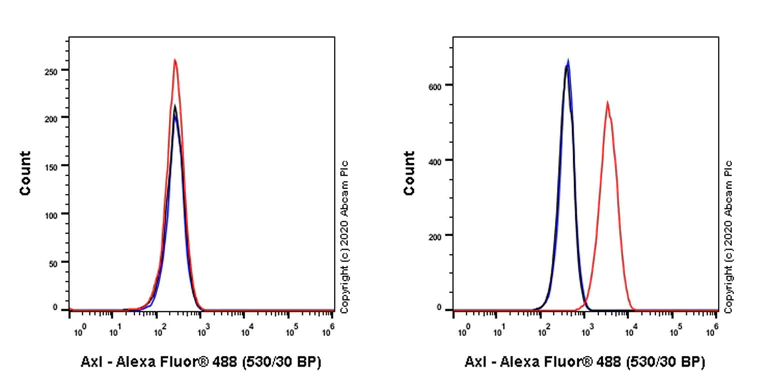
Flow Cytometry - Anti-Axl antibody [7E10] - BSA and Azide free (AB264492)
Flow Cytometry analysis of Jurkat (Human T cell leukemia T lymphocyte, Left panel) / HeLa (Human cervix adenocarcinoma epithelial cell, Right panel) labeling Axl using Anti-Axl antibody [7E10] (ab130218) at a 0.974 μg/mL (Red) followed by Goat anti mouse IgG (Alexa Fluor® 488, ab150113) at a 1/2000. Mouse monoclonal IgG isotype control (Black). The unlabeled control is cells without incubation with primary antibody or secondary antibody (Blue).
Negative control : Jurkat.
Gated on viable cells.
This image was produced using the same antibody clone in a different buffer formulation containing PBS, glycerol, BSA and sodium azide (ab130218).
- ICC/IF
Lab
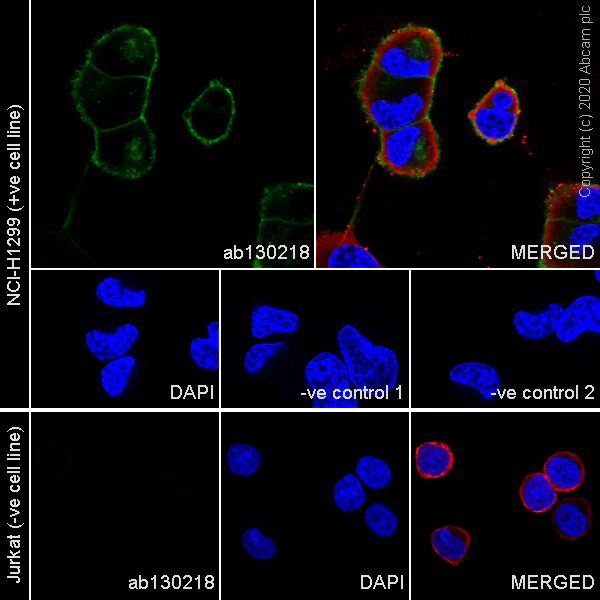
Immunocytochemistry/ Immunofluorescence - Anti-Axl antibody [7E10] - BSA and Azide free (AB264492)
Immunofluorescent analysis of 4% methanol-fixed, 0.1% Triton X-100 permeabilized NCI-H1299 cells labeling Axl with ab130218 at 7.788 μg/mL, followed by Goat Anti-Mouse IgG (Alexa Fluor® 488) (ab150113) secondary antibody at 1/1000 dilution (green). Confocal image showing membranous staining on NCI-H1299 cell line.
Negative control : Jurkat (PMID : 28423548).
The nuclear counterstain is DAPI (blue). Tubulin is detected with ab179513 Anti-beta Tubulin rabbit monoclonal antibody at 1/200 dilution, followed by Goat Anti-Rabbit IgG (Alexa Fluor® 594) (ab150080) secondary antibody at 1/1000 dilution (red).
The negative controls are as follows :
-ve control 1 : ab130218 at 1/250 dilution, followed by Goat Anti-Rabbit IgG (Alexa Fluor® 594) (ab150080) secondary antibody at 1/1000 dilution.
-ve control 2 : ab179513 at 1/200 dilution, followed by ab150113 AlexaFluor®488 Goat anti-Mouse secondary at 1/1000 dilution.
This image was produced using the same antibody clone in a different buffer formulation containing PBS, glycerol, BSA and sodium azide (ab130218).
- WB
Lab
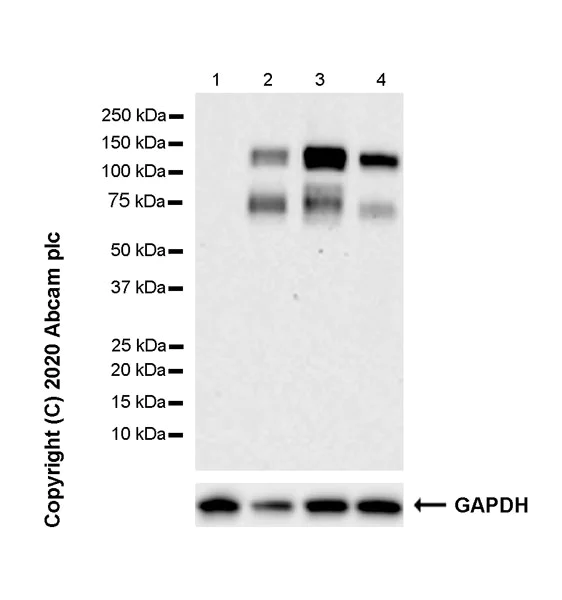
Western blot - Anti-Axl antibody [7E10] - BSA and Azide free (AB264492)
The molecular weight observed was in consistant with the literature (PMID : 19541935).
Negative control : Jurkat (PMID : 28423548).
Blocking/Dilution buffer : 5% NFDM/TBST.
This image was produced using the same antibody clone in a different buffer formulation containing PBS, glycerol, BSA and sodium azide (ab130218).
All lanes:
Western blot - Anti-Axl antibody [7E10] (<a href='/en-us/products/primary-antibodies/axl-antibody-7e10-ab130218'>ab130218</a>) at 1.947 µg/mL
Lane 1:
Jurkat (human T cell leukemia T lymphocyte), whole cell lysate at 20 µg
Lane 2:
DU145 (human prostate carcinoma epithelial cell), whole cell lysate at 20 µg
Lane 3:
NCI-H1299 (human lung carcinoma epithelial cell), whole cell lysate at 20 µg
Lane 4:
HeLa (human cervix adenocarcinoma epithelial cell ), whole cell lysate at 20 µg
Secondary
All lanes:
Peroxidase-Conjugated Goat anti-Mouse IgG (H+L) at 1/10000 dilution
Predicted band size: 98 kDa
Observed band size: 140 kDa,80 kDa
false
Exposure time: 180s
Related conjugates and formulations (4)
-
Anti-Axl antibody [7E10]
-
519 Alexa Fluor® 488
Alexa Fluor® 488 Anti-Axl antibody [7E 10]
-
665 Alexa Fluor® 647
Alexa Fluor® 647 Anti-Axl antibody [7E10]
-
578 PE
PE Anti-Axl antibody [7E10]
Complementary Products

Sample Prep & Detection Kits
AB201796
Biotinylation Kit / Biotin Conjugation Kit (Fast, Type B) - Lightning-Link®

- 3
- 1

Primary Antibodies
AB303530
Anti-MiTF antibody [EPR26363-10]
BOND RX™ Validated|20ul selling size|RabMAb|Recombinant

- 4
- 1

Primary Antibodies
AB183734
RabMAb|Recombinant|Lab Essentials|20ul selling size

- 5
- 24
Reactivity data
Product details
ab264492 is the carrier-free version of ab130218.
What are the advantages of a recombinant monoclonal antibody?
This product is a recombinant monoclonal antibody, which offers several advantages including:
- - High batch-to-batch consistency and reproducibility
- - Improved sensitivity and specificity
- - Long-term security of supply
- - Animal-free batch production
For more information, read more on recombinant antibodies.
Want a custom formulation?
This antibody clone is manufactured by Abcam. If you require a custom buffer formulation or conjugation for your experiments, please contact orders@abcam.com
Conjugation ready
Our carrier-free antibodies are typically supplied in a PBS-only formulation, purified and free of BSA, sodium azide and glycerol. This conjugation-ready format is designed for use with fluorochromes, metal isotopes, oligonucleotides, and enzymes, which makes them ideal for antibody labelling, functional and cell-based assays, flow-based assays (e.g. mass cytometry) and Multiplex Imaging applications.
Use our conjugation kits for antibody conjugates that are ready-to-use in as little as 20 minutes with 1 minute hands-on-time and 100% antibody recovery: available for fluorescent dyes, HRP, biotin and gold.
Compatibility
This product is compatible with the Maxpar® Antibody Labeling Kit from Fluidigm, without the need for antibody preparation. Maxpar® is a trademark of Fluidigm Canada Inc.
Properties and storage information
Form
Purification technique
Storage buffer
Shipped at conditions
Appropriate short-term storage conditions
Appropriate long-term storage conditions
Storage information
Supplementary information
This supplementary information is collated from multiple sources and compiled automatically.
Biological function summary
Axl is important in mediating cell survival proliferation and migration. It functions as part of the TAM family of receptors which also includes Tyro3 and Mer. Axl often forms complexes with these receptors to facilitate efficient signaling. This interaction triggers phosphorylation events that activate downstream signaling proteins reinforcing its influence in cellular functions.
Pathways
Axl is deeply involved in the PI3K-Akt and MAPK signaling pathways which are central to cellular growth and survival. In these pathways Axl interacts closely with proteins like PI3K and Akt to regulate processes such as apoptosis and metabolism. Its interaction with these pathways places Axl as an important modulator of intracellular signaling cascades.
Product protocols
- Visit the General protocols
- Visit the Troubleshooting
Target data
Alternative Names
Product promise
Please note: All products are 'FOR RESEARCH USE ONLY. NOT FOR USE IN DIAGNOSTIC OR THERAPEUTIC PROCEDURES'.
For licensing inquiries, please contact partnerships@abcam.com