JavaScript is disabled in your browser. Please enable JavaScript to view this website.
AB48283

Biotin Anti-Gastrin antibody

Be the first to review this product! Submit a review

|

(1 Publication)

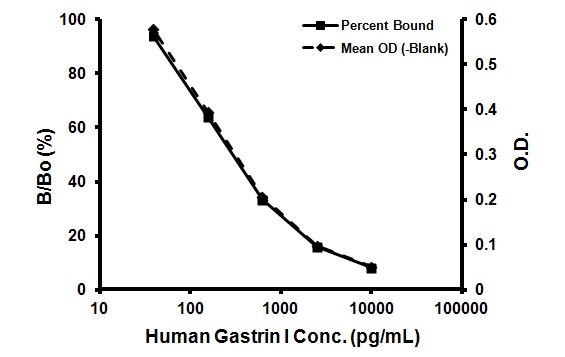
Anti-Gastrin antibody conjugated to Biotin is a rabbit polyclonal antibody suitable for ELISA, and reacts with human samples.

Key facts

Host species

Rabbit

Clonality

Polyclonal

Isotype

IgG

Conjugation

Biotin

Excitation/Emission
Carrier free

No

Reacts with

Human

Applications

ELISA

applications

Immunogen

Synthetic Peptide within Human GAST aa 50-100 conjugated to Keyhole Limpet Haemocyanin. The exact immunogen used to generate this antibody is proprietary information.

P01350

Reactivity data

{ "title": "Reactivity Data", "filters": { "stats": ["", "Species", "Dilution Info", "Notes"], "tabs": { "all-applications": {"fullname" : "All Applications", "shortname": "All Applications"}, "ELISA" : {"fullname" : "ELISA", "shortname":"ELISA"} }, "product-promise": { "all": "all", "testedAndGuaranteed": "tested", "guaranteed": "expected", "predicted": "predicted", "notRecommended": "not-recommended" } }, "values": { "Human": { "ELISA-species-checked": "guaranteed", "ELISA-species-dilution-info": "", "ELISA-species-notes": "<p></p>" }, "Cat": { "ELISA-species-checked": "predicted", "ELISA-species-dilution-info": "", "ELISA-species-notes": "" }, "Pig": { "ELISA-species-checked": "predicted", "ELISA-species-dilution-info": "", "ELISA-species-notes": "" } } }

Properties and storage information

Form
Liquid
Purification technique
Affinity purification Protein G
Storage buffer
pH: 7.5 Preservative: 0.01% Thimerosal (merthiolate) Constituents: PBS, 50% Glycerol (glycerin, glycerine)
Shipped at conditions
Blue Ice
Appropriate short-term storage duration
1-2 weeks
Appropriate short-term storage conditions
+4°C
Appropriate long-term storage conditions
-20°C
Storage information
Avoid freeze / thaw cycle

Supplementary information

This supplementary information is collated from multiple sources and compiled automatically.

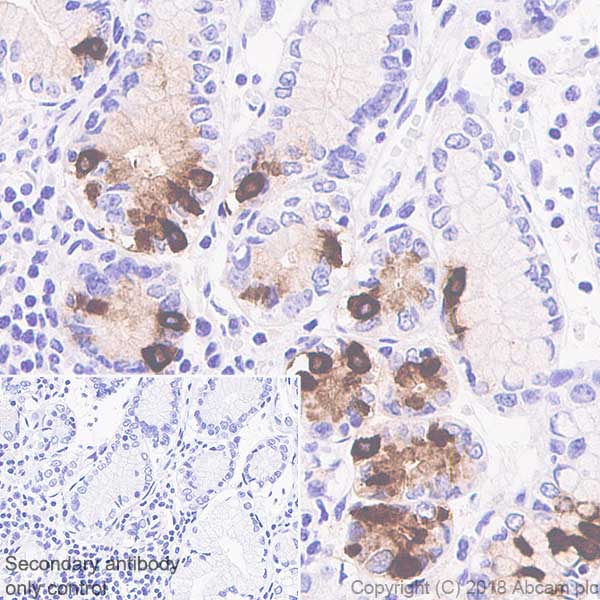
Gastrin sometimes referred to as gastrin peptide is a hormone consisting of 34 amino acids with a molecular mass of approximately 3.8 kDa. This protein is mainly expressed in the G cells of the stomach lining specifically the antrum but also found in the duodenum and pancreas. Gastrin operates by stimulating the secretion of gastric acid from parietal cells in the stomach playing an important role in the digestive process. The presence of gastrin can be detected through various methods like gastrin stain and antibodies such as anti-gastrin are often used for this purpose.
Biological function summary

Gastrin impacts digestion and is an important promoter of gastric acid secretion and mucosal growth. Gastrin does not assemble into larger protein complexes functioning instead as an independent peptide hormone. It exerts its effects by binding to the cholecystokinin B receptor (CCK-B) on target cells leading to increased intracellular calcium levels and activation of protein kinases. The interaction initiates a cascade of events facilitating digestion by optimizing the stomach's environment.

Pathways

Gastrin has a significant role in the gastrointestinal (GI) pathway where it activates the secretion of hydrochloric acid. It also influences the phosphoinositide pathway through its relationship with G-proteins. The hormonal action of gastrin involves several other proteins like somatostatin which serves as an inhibitory counterpart and histamine that works synergistically by promoting further acid secretion through different receptors.

Physicians often study gastrin in relation to conditions like Zollinger-Ellison syndrome and peptic ulcers. Zollinger-Ellison syndrome leads to excessive production of gastrin causing severe ulcerations and gastric acid secretions. Concurrently elevated gastrin levels sometimes associate with tumors like gastrinomas. The interplay between gastrin and H. pylori infection is pivotal for peptic ulcer development where bacteria-induced inflammation could alter gastrin's normal regulatory functions of acid secretion.

Product protocols

For this product, it's our understanding that no specific protocols are required. You can visit:

Target data

Gastrin stimulates the stomach mucosa to produce and secrete hydrochloric acid and the pancreas to secrete its digestive enzymes. It also stimulates smooth muscle contraction and increases blood circulation and water secretion in the stomach and intestine.
See full target information GAST

Alternative Names

GAS, GAST, Gastrin

Publications (1)

Recent publications for all applications. Explore the full listand refine your search

Neoplasia (New York, N.Y.) 15:1231-40 PubMed24339735

2013

Identification of molecular tumor markers in renal cell carcinomas with TFE3 protein expression by RNA sequencing.

Applications

Unspecified application

Species

Unspecified reactive species

Dorothee Pflueger,Andrea Sboner,Martina Storz,Jasmine Roth,Eva Compérat,Elisabeth Bruder,Mark A Rubin,Peter Schraml,Holger Moch
View all publications

Product promise

We are committed to supporting your work with high-quality reagents, and we're here for you every step of the way. In the unlikely event that one of our products does not perform as expected, you're protected by our Product Promise.
For full details, please see our Terms & Conditions

Please note: All products are 'FOR RESEARCH USE ONLY. NOT FOR USE IN DIAGNOSTIC OR THERAPEUTIC PROCEDURES'.

For licensing inquiries, please contact partnerships@abcam.com