JavaScript is disabled in your browser. Please enable JavaScript to view this website.
AB26034

Biotin Anti-HLA G antibody [MEM-G/1]

Be the first to review this product! Submit a review

|

(4 Publications )

Anti-HLA G antibody [MEM-G/1] conjugated to Biotin - suitable for Western blot. Clone [MEM-G/1] is a mouse monoclonal antibody cited in 2 publications.
1 Images
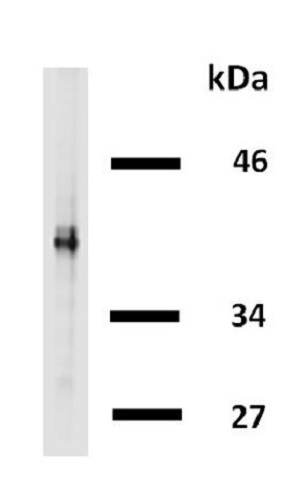
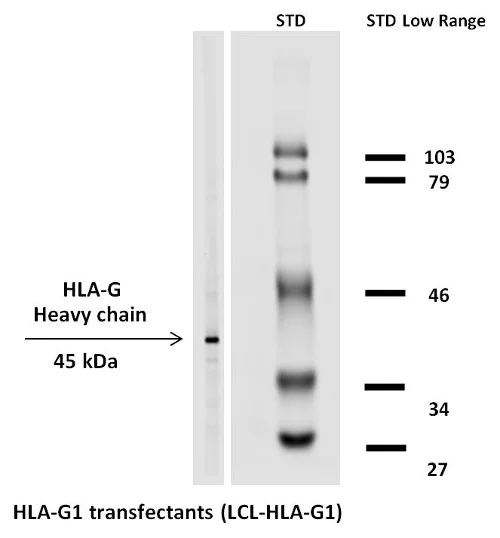
Western blot - Biotin Anti-HLA G antibody [MEM-G/1] (AB26034)
  • WB

Unknown

Western blot - Biotin Anti-HLA G antibody [MEM-G/1] (AB26034)

Western Blot of HLA-G1 transfectant cells labeling HLA G with Anti-HLA G antibody [MEM-G/1] (Biotin) (ab26034).

All lanes:

Western blot - Biotin Anti-HLA G antibody [MEM-G/1] (ab26034)

Predicted band size: 38 kDa

false

Key facts

Host species

Mouse

Clonality

Monoclonal

Clone number

MEM-G/1

Isotype

IgG1

Conjugation

Biotin

Excitation/Emission
Carrier free

No

Applications

WB

applications

Immunogen

Recombinant Full Length Protein corresponding to Human HLA-G.

P17693

Specificity

ab26034 reacts with denaturated HLA-G heavy chain.

Reactivity data

{ "title": "Reactivity Data", "filters": { "stats": ["", "Species", "Dilution Info", "Notes"], "tabs": { "all-applications": {"fullname" : "All Applications", "shortname": "All Applications"}, "WB" : {"fullname" : "Western blot", "shortname":"WB"} }, "product-promise": { "all": "all", "testedAndGuaranteed": "tested", "guaranteed": "expected", "predicted": "predicted", "notRecommended": "not-recommended" } }, "values": { "Recombinant fragment": { "WB-species-checked": "testedAndGuaranteed", "WB-species-dilution-info": "1/100", "WB-species-notes": "<p></p>" } } }

Product details

The purified antibody is conjugated with Biotin-LC-NHS under optimum conditions. The reagent is free of unconjugated biotin.

Properties and storage information

Form
Liquid
Purification technique
Affinity purification Protein A
Storage buffer
pH: 7.4 Preservative: 0.097% Sodium azide Constituents: PBS
Shipped at conditions
Blue Ice
Appropriate short-term storage duration
1-2 weeks
Appropriate short-term storage conditions
+4°C
Appropriate long-term storage conditions
-20°C
Storage information
Avoid freeze / thaw cycle

Product protocols

For this product, it's our understanding that no specific protocols are required. You can visit:

Target data

Isoform 1. Non-classical major histocompatibility class Ib molecule involved in immune regulatory processes at the maternal-fetal interface (PubMed : 19304799, PubMed : 23184984, PubMed : 29262349). In complex with B2M/beta-2 microglobulin binds a limited repertoire of nonamer self-peptides derived from intracellular proteins including histones and ribosomal proteins (PubMed : 7584149, PubMed : 8805247). Peptide-bound HLA-G-B2M complex acts as a ligand for inhibitory/activating KIR2DL4, LILRB1 and LILRB2 receptors on uterine immune cells to promote fetal development while maintaining maternal-fetal tolerance (PubMed : 16366734, PubMed : 19304799, PubMed : 20448110, PubMed : 23184984, PubMed : 27859042, PubMed : 29262349). Upon interaction with KIR2DL4 and LILRB1 receptors on decidual NK cells, it triggers NK cell senescence-associated secretory phenotype as a molecular switch to promote vascular remodeling and fetal growth in early pregnancy (PubMed : 16366734, PubMed : 19304799, PubMed : 23184984, PubMed : 29262349). Through interaction with KIR2DL4 receptor on decidual macrophages induces pro-inflammatory cytokine production mainly associated with tissue remodeling (PubMed : 19304799). Through interaction with LILRB2 receptor triggers differentiation of type 1 regulatory T cells and myeloid-derived suppressor cells, both of which actively maintain maternal-fetal tolerance (PubMed : 20448110, PubMed : 27859042). May play a role in balancing tolerance and antiviral-immunity at maternal-fetal interface by keeping in check the effector functions of NK, CD8+ T cells and B cells (PubMed : 10190900, PubMed : 11290782, PubMed : 24453251). Reprograms B cells toward an immune suppressive phenotype via LILRB1 (PubMed : 24453251). May induce immune activation/suppression via intercellular membrane transfer (trogocytosis), likely enabling interaction with KIR2DL4, which resides mostly in endosomes (PubMed : 20179272, PubMed : 26460007). Through interaction with the inhibitory receptor CD160 on endothelial cells may control angiogenesis in immune privileged sites (PubMed : 16809620).. Isoform 2. Likely does not bind B2M and presents peptides. Negatively regulates NK cell- and CD8+ T cell-mediated cytotoxicity (PubMed : 11290782).. Isoform 3. Likely does not bind B2M and presents peptides. Negatively regulates NK cell- and CD8+ T cell-mediated cytotoxicity (PubMed : 11290782).. Isoform 4. Likely does not bind B2M and presents peptides. Negatively regulates NK cell- and CD8+ T cell-mediated cytotoxicity (PubMed : 11290782).. Isoform 5. Non-classical major histocompatibility class Ib molecule involved in immune regulatory processes at the maternal-fetal interface (PubMed : 19304799, PubMed : 23184984, PubMed : 29262349). In complex with B2M/beta-2 microglobulin binds a limited repertoire of nonamer self-peptides derived from intracellular proteins including histones and ribosomal proteins (PubMed : 7584149, PubMed : 8805247). Peptide-bound HLA-G-B2M complex acts as a ligand for inhibitory/activating KIR2DL4, LILRB1 and LILRB2 receptors on uterine immune cells to promote fetal development while maintaining maternal-fetal tolerance (PubMed : 16366734, PubMed : 19304799, PubMed : 20448110, PubMed : 23184984, PubMed : 29262349). Upon interaction with KIR2DL4 and LILRB1 receptors on decidual NK cells, it triggers NK cell senescence-associated secretory phenotype as a molecular switch to promote vascular remodeling and fetal growth in early pregnancy (PubMed : 16366734, PubMed : 19304799, PubMed : 23184984, PubMed : 29262349). Through interaction with KIR2DL4 receptor on decidual macrophages induces pro-inflammatory cytokine production mainly associated with tissue remodeling (PubMed : 19304799). Through interaction with LILRB2 receptor triggers differentiation of type 1 regulatory T cells and myeloid-derived suppressor cells, both of which actively maintain maternal-fetal tolerance (PubMed : 20448110). Reprograms B cells toward an immune suppressive phenotype via LILRB1 (PubMed : 24453251).. Isoform 6. Likely does not bind B2M and presents peptides.. Isoform 7. Likely does not bind B2M and presents peptides.
See full target information HLA-G

Alternative Names

HLA-6.0, HLAG, HLA-G, HLA G antigen, MHC class I antigen G
Publications (4)

Recent publications for all applications. Explore the full listand refine your search

Journal of immunology (Baltimore, Md. : 1950) 192:732-40 PubMed24337374

2013

Killer Ig-like receptor 2DL4 does not mediate NK cell IFN-γ responses to soluble HLA-G preparations.

Applications

Unspecified application

Species

Unspecified reactive species

Michael E L Le Page,Jodie P Goodridge,Elisabeth John,Frank T Christiansen,Campbell S Witt

Proceedings of the National Academy of Sciences of 99:16180-5 PubMed12454284

2002

Disulfide bond-mediated dimerization of HLA-G on the cell surface.

Applications

Unspecified application

Species

Unspecified reactive species

Jonathan E Boyson,Robert Erskine,Mary C Whitman,Michael Chiu,Julie M Lau,Louise A Koopman,Markus M Valter,Pavla Angelisova,Vaclav Horejsi,Jack L Strominger

Tissue antigens 56:30-7 PubMed10958353

2000

Melanomas and melanoma cell lines do not express HLA-G, and the expression cannot be induced by gammaIFN treatment.

Applications

Unspecified application

Species

Unspecified reactive species

G Frumento,S Franchello,G L Palmisano,M R Nicotra,P Giacomini,Y W Loke,D E Geraghty,M Maio,C Manzo,P G Natali,G B Ferrara

Tissue antigens 55:510-8 PubMed10902607

2000

Comparative reactivity of different HLA-G monoclonal antibodies to soluble HLA-G molecules.

Applications

Unspecified application

Species

Unspecified reactive species

S Fournel,X Huc,M Aguerre-Girr,C Solier,M Legros,C Praud-Brethenou,M Moussa,G Chaouat,A Berrebi,A Bensussan,F Lenfant,P Le Bouteiller
View all publications

Product promise

We are committed to supporting your work with high-quality reagents, and we're here for you every step of the way. In the unlikely event that one of our products does not perform as expected, you're protected by our Product Promise.
For full details, please see our Terms & Conditions

Please note: All products are 'FOR RESEARCH USE ONLY. NOT FOR USE IN DIAGNOSTIC OR THERAPEUTIC PROCEDURES'.

For licensing inquiries, please contact partnerships@abcam.com